
If it feels like your audience is moving faster than your marketing, you’re not imagining it.
Consumers are jumping between search, social, AI assistants, text, email, and in-person touchpoints in minutes. In that chaos, AI has moved from an “interesting experiment” to the connective tissue between data, channels, and creative. It is no longer just a copywriting shortcut or a way to spin out more assets.
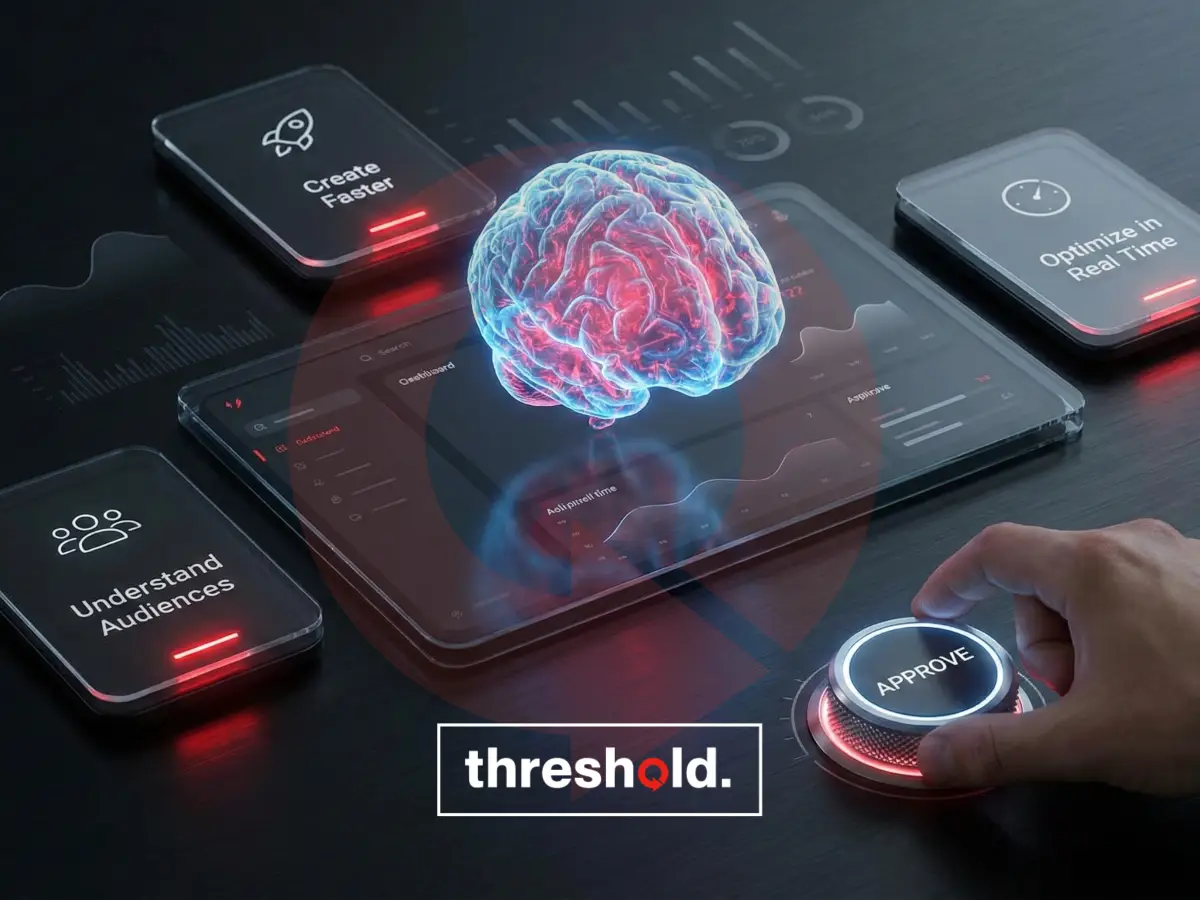
Used well, AI can be the brain of your marketing engine. Used poorly, it’s one more shiny toy that adds work to your plate without moving the needle.
from gimmick to growth driver.
The teams getting real value from AI are using it to do three big jobs:
- understand audiences at a deeper level.
- Cluster users by behavior and intent, not just demographic labels.
- Surface patterns in campaign performance that are invisible in a standard dashboard.
- create and adapt content faster.
- Draft headlines, ad variations, email copy, and landing page tests in minutes.
- Generate first-pass concepts so writers and designers are editing and elevating, not starting from zero.
- optimize in real time.
- Adjust bids, creative, and offers based on live performance signals.
- Recommend and trigger “next best action” for each segment automatically.
This is why enterprise AI investment has surged: brands are shifting from experimentation to production deployment where AI is embedded into everyday workflows, not sitting in a separate lab.
why ai should be your co-pilot, not your driver.
At Threshold, our stance is simple:
- AI should be your co-pilot, not your driver.
That is the core of AIO: AI-assisted, human-optimized marketing. AI handles the heavy lifting so humans can focus on what actually differentiates your brand:
- Strategy, positioning, and offer design
- Voice, storytelling, and creative judgment
- Cross-channel orchestration and stakeholder alignment
In practice, that means:
- Letting AI pull and summarize performance data so strategists can make faster decisions.
- Using AI to draft concepts that your team refines to match brand standards, compliance, and tone.
- Using AI to scale what you already know works, instead of endlessly guessing at new angles.
where should you start?
If AI still feels abstract, choose one use case where it can clearly save time or improve relevance:
- Analyze the last 90 days of campaign performance and summarize key patterns.
- Generate 10 headline and body variants for a top-performing ad set.
- Build a first-pass content outline for a new landing page, then have your team refine it.
Let that first win prove the value. Then expand deliberately.
- The goal is not to become an “AI-first brand.”
- The goal is to become a brand that uses AI to be more human, more responsive, and more effective at scale.
Make AI work for you: Identify one workflow this quarter where AI can play the role of marketing brain, then set up a simple test to compare outcomes with and without AI in the loop.
Let’s do this.