
 Laura Robbins, Corporate Marketing Manager
For two decades, the playbook for digital visibility was simple, predictable, and linear. You identified a high-volume keyword, engineered a piece of content around it, built a network of backlinks, and climbed the search engine results page (SERP). Success was binary: you were either on page one, or you were invisible. The ultimate trophy was the “number one ranking.”
But the ground has shifted. The rise of Artificial Intelligence Overviews (AIO), generative search, and answer engines has turned the traditional SERP into a relic of the past.
When a user asks a complex question today, they are no longer greeted merely by a list of ten blue links. They receive a synthesized, comprehensive answer generated in real-time. If your digital strategy is still hyper-focused on traditional “ranking,” you are optimizing for a landscape that is rapidly disappearing.
To lead in this new era, executives must shift their perspective from winning a rank to winning the answer.
the great shift: from keywords to trust and context.
Traditional search rewarded optimization. Generative AI rewards clarity, structure, and trust.
In the keyword era, search engines acted as indexers, matching a user’s typed phrase to the most relevant documents. In the AI era, search models act as researchers and synthesizers. They don’t just look for pages that mention a topic; they evaluate pages that understand it.
This evolution fundamentally changes what it takes to be visible:
-
from keywords to conceptual clarity: Shoving exact-match phrases into headers is no longer effective. AI engines understand semantic intent. They parse content to see if it actually resolves a user’s friction. If your content lacks depth or fails to articulate a clear point of view, it will be bypassed, regardless of how many keywords are present.
-
from formatting to technical structure: AI models consume information at scale, but they rely heavily on clean, logical infrastructure. Schema markup, conversational formatting, intuitive site hierarchy, and clear Q&A data are no longer “technical SEO” afterthoughts—they are the prerequisite format for how AI reads your brand.
-
from traffic generation to radical trust: Because AI engines synthesize information from multiple sources, they prioritize authority and accuracy over mere volume. For highly regulated or high-stakes industries, building digital trust through verifiable data, transparent authorship, and unwavering topical authority is the only currency that matters.
what’s changing (and what isn’t).
Navigating this transition requires separating the foundational truths of digital marketing from the tactical shifts demanded by AI.
what isn’t changing.
The core driver of business growth remains identical: the need to solve real audience problems. Buyers still search because they have a point of friction, an unanswered question, or a decision to make. High-quality, experience-driven insights will always be the foundation of strong brand authority. The necessity of presenting an authentic, human-backed perspective has actually intensified as the internet becomes flooded with commoditized, AI-generated text.
what is changing.
The destination of the user journey has transformed. Instead of routing traffic solely through a traditional home page or an isolated blog post, your digital footprint must act as a distributed network of answers. Optimization is no longer about convincing a search algorithm to rank your URL first; it is about ensuring your proprietary insights, data, and value propositions are natively integrated into the answers synthesized by AI.
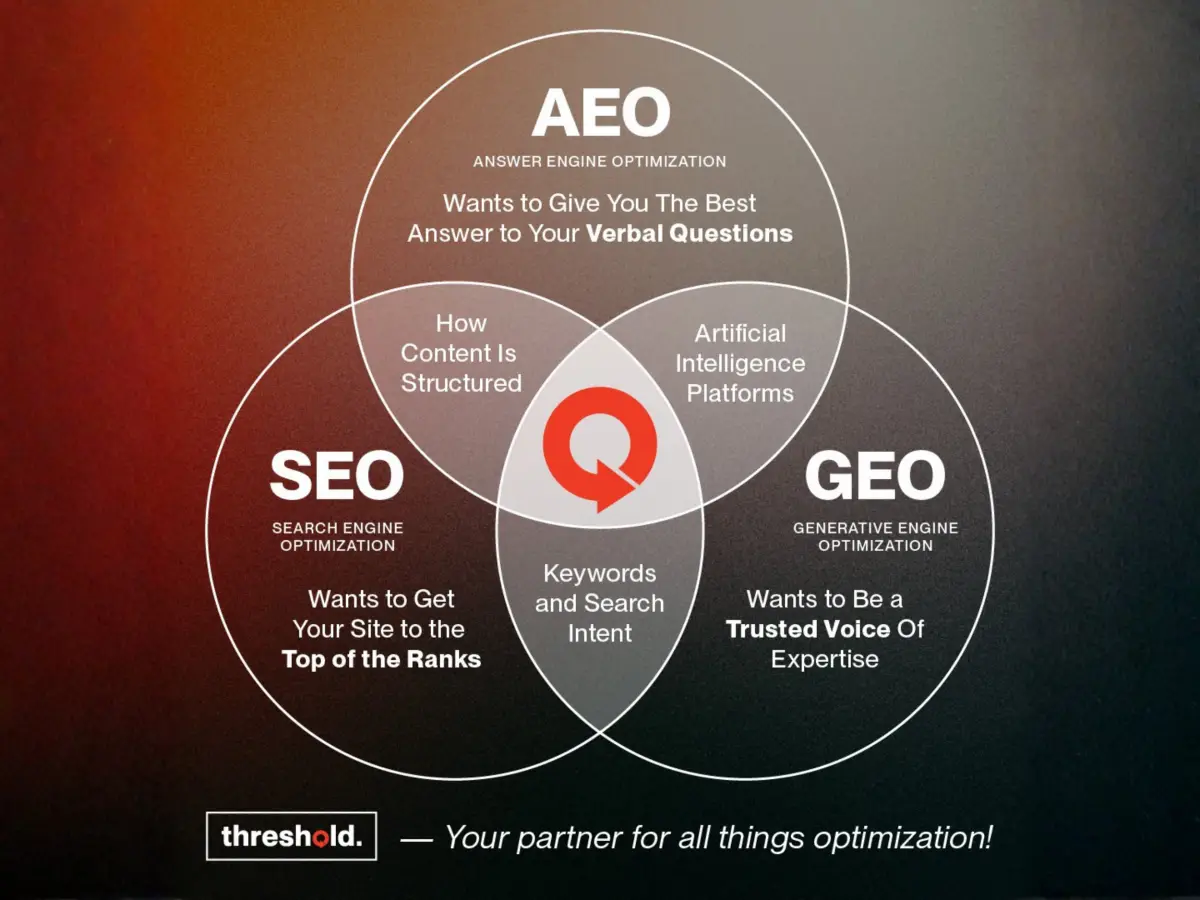
moving toward answer engine optimization (AEO).
Continuing to measure digital health through legacy keywords and top-of-funnel traffic metrics creates a dangerous blind spot. While those metrics may look productive on a monthly dashboard, they fail to capture whether your brand is being recommended in the AI-generated summaries where modern buyers are making decisions.
The transition from SEO to AEO is an architectural and philosophical shift. It requires auditing how your expertise is structured, evaluating whether your data is machine-readable, and fundamentally changing how you define online visibility.
The question is no longer where your website ranks on a page. The question is whether the AI engines trust your brand enough to use your answers.
are you AIO ready? a quick diagnostic quiz.
1. how does your content handle direct questions?
-
A. We hide answers deep within long-form, narrative blog posts to maximize time-on-site metrics.
-
B. We have a few FAQ sections, but our content is mostly structured around broad industry keywords.
-
C. We actively use clear Q&A formatting, bulleted summaries, and bold text at the top of pages to give immediate, direct answers to user queries.
2. what does your site’s schema markup look like?
-
A. What is schema markup?
-
B. We use basic article or organization schema, but we haven’t updated our structured data strategy in years.
-
C. We use robust, advanced schema markup (like FAQ, Product, and SameAs profiles) to explicitly tell AI engines exactly what our data means.
3. how do you define and measure digital search success?
-
A. We strictly track traditional keyword rankings and organic traffic volume to individual URLs.
-
B. We track rankings but are starting to notice a drop in traffic despite maintaining our top spots.
-
C. We track brand share-of-voice inside AI-generated summaries (like Google AIO, Perplexity, and ChatGPT) alongside traditional traffic.
4. what is the primary source of authority behind your content?
-
A. We use ghostwriters or generic copy heavily focused on keyword density, with no clear author bios.
-
B. Our company blog publishes articles under a generic “Admin” or corporate brand account.
-
C. Our content is authored or explicitly reviewed by verified, real-world subject matter experts with robust digital footprints and clear author biographies.
5. how conversational is your keyword targeting strategy?
-
A. We target short, fragmented head terms like “enterprise CRM software.”
-
B. We target mid-tail keywords, but our phrasing still feels designed for an old-school search bar.
-
C. We optimize for long-tail, natural language questions and multi-turn prompts like, “what is the best enterprise CRM software for a distributed remote healthcare team?”
grading the results.
-
mostly A’s: legacy optimizer. Your strategy is firmly rooted in the 2010s keyword playbook. Because AI engines prioritize structured data, explicit answers, and deep trust, your content is at a high risk of being bypassed by AI Overviews.
-
mostly B’s: transitional spectator. You are aware that the landscape is changing and have some foundational elements in place, but you are still treating AI visibility as an afterthought to traditional SEO ranking.
-
mostly C’s: AIO pioneer. Congratulations. You recognize that search is shifting from links to answers. Your content is structured, authoritative, and machine-readable—primed to be synthesized by modern answer engines.
If you landed mostly in the A or B category, it’s time to rethink your digital architecture before your organic visibility disappears behind an AI summary. You can see how we audit and transition brands for this exact shift by exploring our AI Optimization Service Page.