
Every few years, someone declares organic search finished. Social was going to kill it. Then voice assistants. Now it’s AI: ChatGPT, Perplexity, Gemini, and Google’s own AI Overviews answering questions before anyone clicks a link.
Here’s what’s actually happening for real estate: renters, students, and families researching senior living are still searching. They’re just searching in more places, asking longer questions, and arriving at your website further along in their decision. The communities winning right now aren’t the ones that abandoned SEO for AI. They’re the ones treating organic search and AI search as one connected system, and actually following up on the leads it produces.
This is a follow-up to some of our most-read posts. In 2020, we shared quick SEO wins for apartment marketing. In late 2024, our local SEO guide for real estate made the case for a complete Google Business Profile, active reviews, and location pages to win Google’s Local Pack. And in early 2025, we wrote that SEO and content are two sides of the same coin, and flagged that AI-powered and voice search were changing how people find content. That shift arrived faster than almost anyone expected. Here’s what’s changed and what hasn’t.
organic search is still where real estate decisions happen.
Let’s be honest about the bad news first. A randomized field study published in April 2026 found that Google’s AI Overviews cut organic clicks by about 38% on the searches where they appear, and pushed zero-click searches from 54% to 72% (Search Engine Journal). If your property blog is built on generic “what is a security deposit” posts, you’ve probably felt it.
But the damage isn’t evenly spread, and that’s the part most “SEO is dead” takes skip. One 2026 analysis of 21.7 million search impressions found informational queries lost 61% of clicks year over year, while local searches lost 18%, branded searches lost 3%, and pricing and contact pages barely moved (Visionary Marketing). Real estate lives in exactly the searches AI hurts least: local, branded, and ready-to-act.
what renters are actually doing.
The research behavior hasn’t disappeared. It’s spread out.
- search engines are still a core tool. In Apartments.com’s 2026 survey of 15,000+ U.S. renters, 35% rely on search engines, behind only listing sites (85%) and word of mouth (37%). AI chatbots came in at 5% (NAA).
- most renters are wide open. 87% don’t have a specific property in mind when they start, and the average renter researches 10 communities before seriously considering three (NAA). That’s a discovery problem, and discovery is what organic search solves.
- AI is a research layer, not the front door. J Turner Research found 45.9% of renters now use AI to research apartments, but only 5.7% started their most recent search with an AI tool (J Turner Research).
The same pattern holds across student housing and senior living. Parents comparing purpose-built student housing near campus and adult children researching memory care for a parent are asking more questions, in more places, before they ever fill out a form. Organic search is still the thread that ties those moments together.
AI search runs on organic search.
Here’s the part that should change how you think about budget: AI answers are pulled from websites that search engines already trust.
In the same 2026 analysis, 78% of AI Overview citations went to sites already ranking in Google’s organic top 10 (Visionary Marketing). In other words, AI visibility is mostly earned through organic visibility. Cut your SEO, and you don’t “move to AI.” You disappear from both.
from featured snippets to AI answers.
If this sounds familiar, it should. In 2025, we recommended clear headings, numbered lists, and concise answers to win featured snippets, plus structured data to show up in rich results. AI Overviews and chatbot answers reward the same habits. What’s changed is the stakes: a featured snippet was one box on the results page, while an AI answer may be the only thing a prospect reads before deciding which communities to call.
same foundation, two kinds of results.
Think of traditional SEO and AI optimization (AIO, sometimes called answer engine optimization or AEO) as two outputs of one system:
traditional organic search
- What the prospect sees: a ranked list of links
- What you’re competing for: a click
- What wins: relevance, authority, local signals, and technical health
- Where the lead shows up: organic search in your analytics
AI search (AIO / AEO)
- What the prospect sees: a written answer that names a few sources
- What you’re competing for: a mention or citation
- What wins: the same, plus clear, quotable answers and consistent facts across the web
- Where the lead shows up: often as branded search, direct traffic, or a phone call
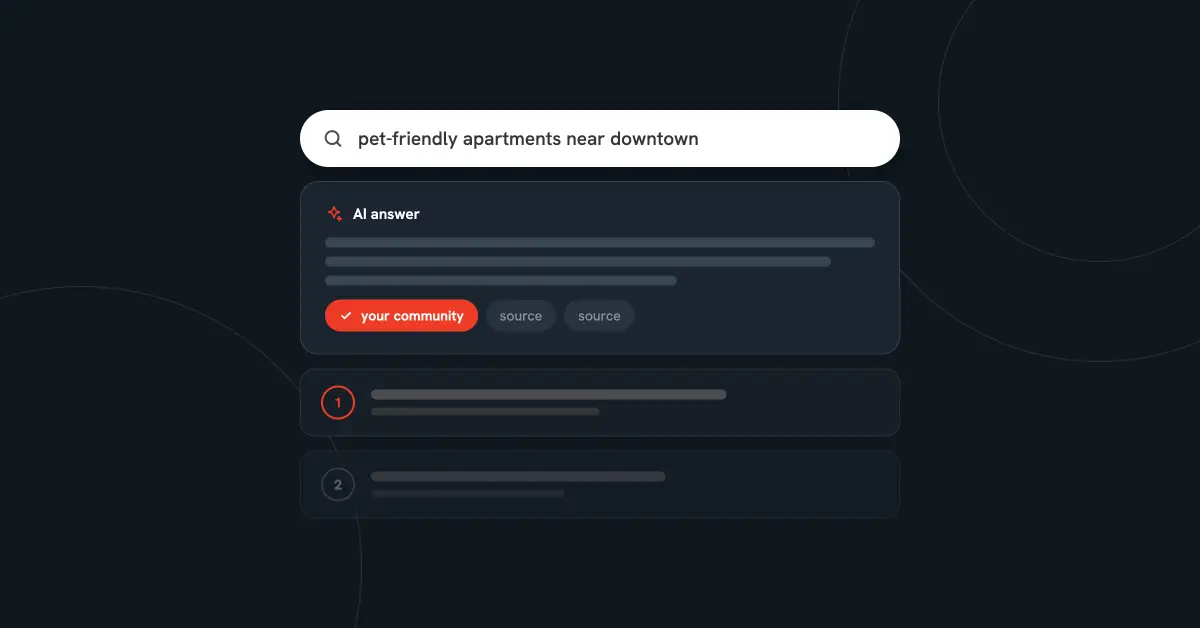
That last point matters. When a prospect asks ChatGPT for “pet-friendly apartments near downtown with a gym” and sees your community named, they may not click the citation. They search your name later, or type in your URL. The same analysis found that brands newly cited in AI Overviews saw branded search climb 23% within 30 days (Visionary Marketing). That demand is real, but it shows up looking like something else.
how the loop works.
- Your website and listings answer real prospect questions clearly and consistently.
- Strong organic rankings make you eligible for AI citations.
- AI tools mention your community while prospects compare options.
- Prospects come back through branded search, direct visits, or a call.
- They land on your site ready to act, and convert.
- You capture, follow up, and learn which content drove it, then feed that back into step 1.
Most real estate marketers have pieces of this loop. Very few have all six connected.
making SEO and AIO work together for your communities.
The fundamentals from our earlier posts still apply: local keywords and a fast, mobile-first site, a complete Google Business Profile with fresh photos and active review responses, and keyword research that matches what people actually search. That foundation is what earns organic rankings, and organic rankings are what earn AI citations. What’s changed is how you write and structure the content on top of it.
1. answer the question first.
AI tools pull short, self-contained answers. Search engines reward pages that satisfy the search quickly. Both point to the same habit: open every page section with a direct, one- or two-sentence answer, then add detail. “Yes, we’re pet friendly: up to two pets per home, no weight limit, $35 monthly pet rent” beats a paragraph about loving your furry friends.
This picks up where our voice search advice left off. We suggested writing for full, conversational questions like “What’s the best neighborhood for families in [city]?” or “affordable apartments near [landmark].” Those are exactly the kinds of prompts people now type into ChatGPT and Gemini, so build your FAQs and page sections around them.
2. get specific at the unit level.
In the Apartments.com survey, 99% of renters said unit-specific information matters, 77% want unit-specific photos, and for half of renters, missing unit photos is a deal-breaker (NAA). Specific, current details on pricing, floor plans, and availability are what both prospects and AI tools look for. Vague pages give neither anything to work with.
3. keep your facts identical everywhere.
AI tools cross-check your website, Google Business Profile, listing sites, and review platforms. If your pet policy, fees, or amenities differ across them, you look less trustworthy to algorithms and to people. Audit your community details across every profile at least quarterly. Reviews matter here too: AI tools lean on them to describe what it’s like to live somewhere, so keep encouraging residents to leave them and respond to every one, positive or negative. Our local SEO for real estate guide walks through the profile work.
4. add structured data.
Schema markup (for example, ApartmentComplex, LocalBusiness, and FAQPage) labels your content so search engines and AI tools can read it with confidence. On WordPress, most of this can be handled at the template level once and applied to every community page.
5. write for the questions your segment actually asks.
Generic “top 10 things to do in [city]” posts are the content AI absorbs fastest. Content that reflects your communities and your residents’ real decisions holds up far better. Here are the questions worth answering on your site for each segment:
- multifamily (renters comparing 10 or so communities): true monthly cost with all fees, pet policies, parking, commute times, move-in specials, and unit-level availability
- student housing (students and the parents who co-sign): walking or transit time to campus, by-the-bed vs. by-the-unit pricing, roommate matching, what’s furnished, lease start dates, and safety features
- senior living (older adults and their adult children): differences between independent living, assisted living, and memory care, what’s included in monthly fees, care level changes, staffing, touring, and move-in steps
6. track AI visibility alongside rankings.
You can’t improve what you don’t measure. Alongside keyword rankings and organic sessions, track how often AI tools mention your communities, branded search volume over time, and AI referral traffic (ChatGPT, Perplexity, Gemini, and Copilot visits are often lumped into “referral” or “direct” unless you set up a custom channel group in GA4).
if you’re not managing your organic leads, you’re missing out.
Here’s the uncomfortable truth: for many communities, the biggest organic search problem isn’t traffic. It’s what happens after someone raises their hand.
Organic leads are some of the most valuable you’ll get. You didn’t pay per click for them. They found you on their own, often after comparing you against competitors in Google, an ILS, and an AI tool. By the time they fill out your form or call, they’ve done their homework. Then too many of them wait. In 2025, we wrote that SEO isn’t just about bringing people to your site, it’s about guiding them to take action. The other half of that equation is your team acting back, fast.
the follow-up gap is real.
- a 2024 secret-shopper study by real estate analyst Mike DelPrete found 47% of online residential real estate inquiries got no response at all. The ones that did waited an average of 8 hours and 17 minutes.
- the MIT / InsideSales.com Lead Response Management Study found that responding within five minutes instead of 30 made reaching a prospect roughly 100 times more likely, and qualifying them 21 times more likely.
- Harvard Business Review found the average business took 42 hours to respond to an online lead, while those that responded within an hour were about seven times more likely to qualify it.
(All three studies as summarized in LetHub’s State of Residential Leasing 2026.)
A vacant unit costs roughly a month’s rent for every month it sits. A slow reply to an organic lead isn’t a minor service issue. It’s a leasing loss you paid to create.
where organic leads usually leak.
- the generic inbox. Website forms land in a shared email address that the leasing team checks between tours.
- no source tracking. Organic leads get lumped in with ILS and paid leads, so nobody knows which pages or searches actually produce leases.
- after-hours silence. Prospects research at night and on weekends. A next-morning reply is often too late.
- no nurture for long decisions. Senior living decisions can take months. Student housing often leases a year ahead. A single follow-up email doesn’t cover that window.
- AI influence goes uncounted. A prospect who found you through ChatGPT often shows up as “direct” or branded search, so the channel looks smaller than it is.
what managing organic leads actually looks like.
- capture every lead in a CRM, not an inbox, with the source and landing page attached automatically.
- respond in minutes, around the clock, with an instant, useful acknowledgment and clear routing to the right person or community.
- nurture by segment and stage. A parent of an incoming freshman needs different follow-up than a renter whose lease ends next month, or a family touring memory care.
- ask how they found you, and include “AI assistant (ChatGPT, Gemini, etc.)” as an option, so AI-influenced demand stops hiding.
- close the loop from organic visit to lead to tour to lease, then use what you learn to decide which content to create or update next.
This is where SEO and AIO stop being “marketing projects” and start being revenue. The visibility work earns the lead. Lead management turns it into a signed lease.
your organic search checklist.
Use this list to see where your communities stand:
- our community pages rank for local, high-intent searches (“[city] apartments,” “student housing near [university],” “assisted living in [city]”)
- every key page section opens with a clear, direct answer
- unit-level pricing, photos, floor plans, and availability are current
- our details match across our website, Google Business Profile, listing sites, and review platforms
- schema markup is in place on community and FAQ pages
- we know whether AI tools mention our communities, and for which questions
- organic leads go straight into a CRM with their source attached
- every new lead gets a response within minutes, including after hours
- we have segment-specific nurture for longer decisions
- we can trace organic visits all the way to signed leases
see how visible you are in AI search.
Talk with our team about building an SEO, AIO, and lead management program that turns search visibility into leases.

sources.
- Study Confirms Google AI Overviews Cut Organic Clicks 38%, Search Engine Journal, April 2026
- AI Overviews Traffic Impact 2026, Visionary Marketing, May 2026
- Survey: Renters Rely on Rental Listing Sites, National Apartment Association (Apartments.com 2026 renter survey)
- The Internet Adventure Study Part VI, J Turner Research
- State of Residential Leasing 2026, LetHub, June 2026