
 Laura Robbins, Corporate Marketing Manager
key takeaways.
- The gap between click and lease is the stretch of the leasing funnel no one owns: what happens after a prospect clicks an ad and before they sign a lease.
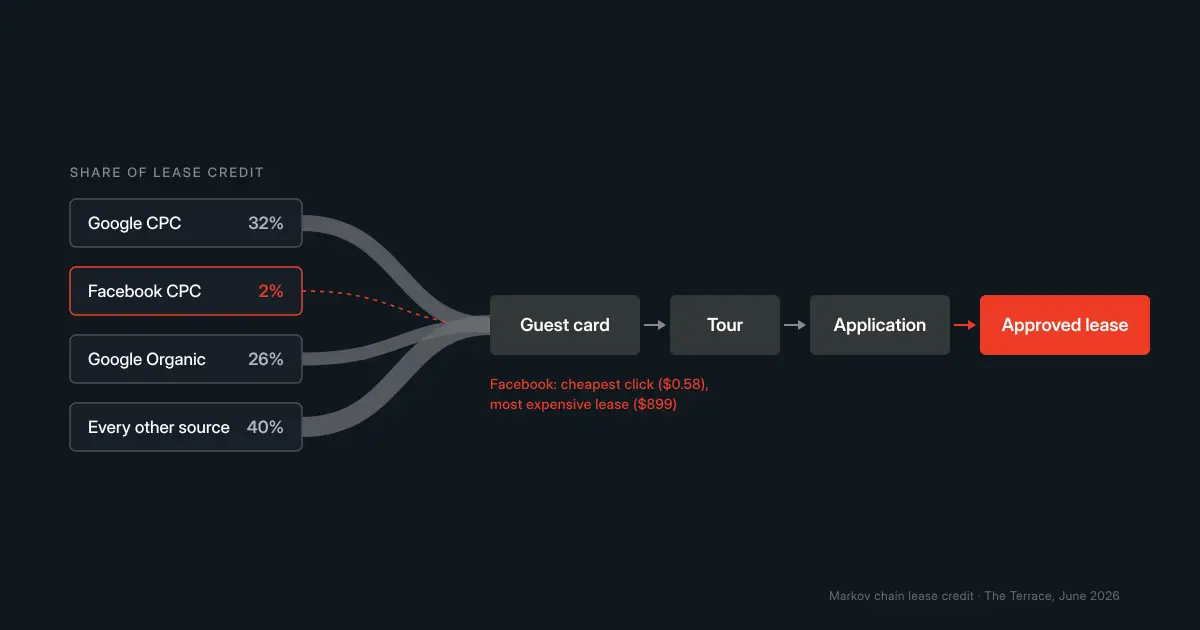
- At The Terrace, an apartment community Threshold tracked in June 2026, Facebook had the cheapest clicks ($0.58) but the most expensive leases ($899 per approved lease). Google search cost $3.75 per click and $500 per lease.
- Most marketing reports stop at the lead, so budget decisions get made on cost per click instead of cost per lease.
- Closing the gap usually means reallocating the budget you already have, not spending more.
Marketing rarely fails loudly. It leaks, and most reports can’t see where.
At The Terrace, Facebook delivered the cheapest clicks on the board: $0.58 each, about 6.5× cheaper than Google search. When Threshold followed those clicks all the way to signed leases, Facebook turned out to be the most expensive channel the property paid for: $899 per approved lease, compared with $500 for Google.
A report that stopped at clicks would have called Facebook the best deal going.
what is the gap between click and lease?
The gap between click and lease is everything that happens between a prospect clicking an ad and signing a lease: the landing page, the guest card, the tour, the application, and the approval. It’s where most leasing budgets leak, because no single team owns it and no standard report measures it.
Property marketing is usually split across three teams:
- Digital teams own reach, targeting, and cost per click
- Website teams own design, floor plans, photos, and content
- Leasing teams own the tour, the application, and the lease
Each one can be “working.” Together, they often aren’t. Ad platforms know who clicked. The property management system knows who signed. Nothing connects the two.
why do good property websites still underperform?
Property websites underperform when they aren’t built for the campaigns driving traffic. A site can have professional photography, virtual tours, and fast load times and still lose prospects because the page doesn’t match what earned the click.
Common examples in multifamily, student housing and senior living:
- An ad for a move-in special lands on a homepage where the special is nowhere in sight
- A search for a pet-friendly two-bedroom lands on a generic floor plans page
- A student housing pre-leasing campaign lands on a page that doesn’t show which floor plans are still available
- In senior living, the adult child doing the research lands on content written only for the resident
- Scheduling a tour takes several clicks, a form, and a callback
Nothing feels wrong, but nothing pulls the prospect forward either. A prospect with three other properties open in other tabs doesn’t wait to be pulled.
why is the click the most expensive moment in leasing?
The click is the moment when a prospect’s intent is clearest, their expectations are highest, and their attention is shortest. If the landing page doesn’t immediately confirm they’re in the right place and make the next step obvious, momentum is lost, and the prospect returns to a listing site.
The next step should be unmistakable: check availability, schedule a tour, or submit a guest card. No amount of bid optimization upstream can win back a prospect who left at this point.
why can’t most marketing reports see the gap?
Most marketing reports stop at the lead. They show clicks, cost per click, and sometimes guest cards, but not which guest cards became tours, applications, or signed leases, because that data lives in the property management system. As a result, budget goes to the channels with the cheapest clicks, not the cheapest leases.
When Threshold connected website analytics, ad platform data, and Entrata (The Terrace’s property management system) for June 2026, the full funnel looked like this:
- 7,001 website visits
- 161 guest cards (2.9% of website users)
- 35 approved leases (about 1 in 5 guest cards)
- $179 in blended ad spend per approved lease
Channel by channel, the picture changed:
- Organic search earned 25.8% of lease credit on $0 in ad spend.
- Listing sites earned 11.5% of lease credit (Apartment Guide 6.0%, CoStar 5.5%), a figure you can now weigh against their commissions.
- ChatGPT already appeared as a lead source, earning 1.5% of lead credit, tied with Bing.
None of that is visible in a report that ends at the click.
what is click-to-lease attribution?
Click-to-lease attribution tracks every prospect from their first website visit through guest card, tour, application, and approved lease, then credits each marketing channel for its role in producing signed leases. It connects ad platforms, website analytics, and the property management system into one report, so cost per lease can be calculated channel by channel.
Threshold’s model uses Markov chain attribution, which works in three steps:
- Map every path: chart each route prospects took from first click to signed lease.
- Remove a channel: take one channel out of the map and recalculate the odds of conversion.
- Measure the drop: the leases that disappear are that channel’s credit.
Unlike last-click attribution, this credits every touchpoint for what it contributed, not just the final one.
why doesn’t more optimization fix the problem?
Optimizing one channel can’t fix a broken handoff between channels. When digital, website, and leasing data aren’t connected, teams tune the part they own while the gap between them stays open.
That shows up as:
- Channels that look cheap getting more budget, even when they don’t sign leases
- Landing page fixes waiting in a queue behind other priorities
- Learning loops stretching from days to months
Performance plateaus. The team is capable, but no one can see the whole system.
how do you close the gap between click and lease?
You close the gap by running digital, website, and leasing as one system, measured against signed leases instead of clicks. In practice:
- Campaign intent shapes the landing experience, so the special in the ad is the first thing on the page
- The next step is obvious: check availability, schedule a tour, apply
- Every channel is measured to the signed lease, not the click
- Budget follows leases, not traffic
- Insights arrive in days, not quarters
Most importantly, someone owns the outcome (occupancy), not just a channel.
does closing the gap require more ad spend?
No. Closing the gap usually means reallocating existing budget, not increasing it. At The Terrace, the biggest opportunity was moving dollars from the channel with the cheapest clicks (Facebook) to the channel with the cheapest leases (Google search), and protecting the organic search that was signing leases for free.
Same budget, pointed at what actually fills units.
the takeaway.
If your campaigns are driving traffic but not move-ins, the problem may not be targeting, creative, or budget. It may be that no one owns the gap between click and lease, or can even see it.
Close that gap, and occupancy tends to follow.
frequently asked questions.
What’s the difference between cost per click and cost per lease?
Cost per click is ad spend divided by clicks. Cost per lease is ad spend divided by the approved leases a channel is credited with. The two can point in opposite directions: at The Terrace, Facebook was 6.5× cheaper per click than Google but 1.8× more expensive per lease.
Why would the cheapest click produce the most expensive lease?
Low-cost clicks often come from prospects with lower intent. They browse but rarely submit a guest card, tour or apply. A channel can drive lots of cheap traffic and still contribute very few signed leases.
What data does click-to-lease attribution use?
It uses data most properties already have: website analytics for sessions and sources, ad platforms for spend and clicks, and the property management system (such as Entrata) for guest cards, applications, and approved leases.
Are listing sites (ILSs) worth their commissions?
It depends on how many leases they produce. Click-to-lease attribution shows each listing site’s share of lease credit, which you can compare directly against the commission it charges. At The Terrace, listing sites earned 11.5% of lease credit in June 2026.
Is ChatGPT sending prospects to apartment websites?
Yes. At The Terrace, ChatGPT earned 1.5% of lead credit in June 2026, the same share as Bing. Attribution reporting makes it possible to spot new channels like this the month they appear.
Does this apply to student housing and senior living?
Yes. The funnel stages and names differ (pre-leasing in student housing, move-ins and family decision-makers in senior living), but the gap is the same: what happens between the click and the signed lease is rarely owned or measured.