
by threshold | Jul 15, 2026 | AI, AI Marketing, Digital Marketing
Let’s be honest for a second. When was the last time you actually scrolled past the top of a Google search page? Better yet, when was the last time you didn’t just read the paragraph-style answer summary at the very top and close the tab completely?
Welcome to the era of the Zero-Click Search.
With the rapid emergence of Answer Engines like ChatGPT, Perplexity, Gemini, and Google’s native AI Overviews, the way people discover brands has fundamentally transformed. Traditional SEO used to be about winning the battle of the “blue links.” Today, it’s about winning the battle of AI extraction. If an AI engine doesn’t instantly find, cross-reference, and trust your website’s data, your brand is eliminated from the consideration pool before a prospect ever even visits your site.
When our enterprise student housing client, Yugo, realized their audience of digital-native students was moving away from standard search bars and toward AI prompt boxes, they didn’t panic. They teamed up with Threshold to launch a massive, multi-platform Generative Engine Optimization (GEO/AIO) initiative across more than 50 concurrent campaigns.
The mission? Move Yugo beyond static rankings and drop them right into conversational AI recommendations.
Here’s exactly what went down, what we achieved, and why your brand needs to adapt to AEO before it gets left behind.
the strategy: coding for the AI brain.
AI models don’t fall for flashy, vague marketing copy. They operate entirely on Information Gain and Topical Authority. They scan the web for data-dense, cleanly structured, hyper-reliable facts that make it easy for them to form an answer for a user.
To get Yugo noticed, the Threshold activation team restructured its digital asset architecture. We targeted conversational, high-intent user queries (like “best budget-friendly student housing near UT Austin” or “local travel guides for students moving to Madrid”). By organizing content into “chunkable,” authoritative answers and backing them with deep technical schema coding, we gave the AI bots exactly what they were looking for.
the results: dominating the share of voice.
The first 90 days of onboarding and implementation proved that when you optimize for AI logic, the search engines reward you instantly. Here is a look at the hard numbers from the phase one rollout:
-
1,200+ Documented AI Mentions: Yugo achieved rapid, widespread visibility and brand authority across the major conversational search ecosystems.
-
8 High-Value Direct Citations: Instead of guessing, major AI search experiences cited Yugo directly inside responses, inserting clickable links straight back to Yugo’s site.
-
Algorithmic Diversification: We secured concurrent, rising visibility across AI Overview, AI Mode, ChatGPT, Gemini, and Perplexity—ensuring Yugo is protected against sudden platform algorithm updates.
-
Total Topic Ownership: Yugo successfully commanded the conversation where it mattered most, capturing an elite 0.35% presence in core Student Housing Search and a dominant 0.09% presence in City Travel Guides (beating out legacy global platforms).
-
10.9K Inbound Traffic Multiplier: This top-of-funnel AI authority successfully fueled 10.9K organic monthly sessions, driven by 27.2K ranking keywords and 1.6K referring domains.
the big takeaway: AI visibility = real business pipeline.
At Threshold, we don’t believe in vanity metrics. Brand mentions inside ChatGPT look great on a slide deck, but do they actually do anything for business growth?
Absolutely.
By mapping this initiative out, we proved a direct correlation across the modern conversion funnel:
AI Visibility (1,200+ Mentions)⟶High-Intent Organic Traffic⟶Qualified Leads⟶Closed Revenue
When an AI engine recommends a brand, it bypasses the middleman of traditional multi-page aggregators or forums. The AI essentially acts as a trusted peer review. By the time a student or a parent clicks through a direct citation link to Yugo’s property pages, they are already highly educated, pre-vetted, and primed to convert into a lease.
is your site ready for the future of search?
The digital landscape is shifting right under our feet. If your current marketing strategy is strictly relying on 2018-era keyword stuffing, you’re missing the audience that has already transitioned to conversational search.
Want to check if your brand is accidentally blocking AI crawlers, or ready to turn your website into an AI-extraction magnet? Let’s chat about your custom AEO strategy today.
by threshold | Jun 3, 2026 | AI Marketing, Tech/Web, Thought Leadership
 Laura Robbins, Corporate Marketing Manager
For two decades, the playbook for digital visibility was simple, predictable, and linear. You identified a high-volume keyword, engineered a piece of content around it, built a network of backlinks, and climbed the search engine results page (SERP). Success was binary: you were either on page one, or you were invisible. The ultimate trophy was the “number one ranking.”
But the ground has shifted. The rise of Artificial Intelligence Overviews (AIO), generative search, and answer engines has turned the traditional SERP into a relic of the past.
When a user asks a complex question today, they are no longer greeted merely by a list of ten blue links. They receive a synthesized, comprehensive answer generated in real-time. If your digital strategy is still hyper-focused on traditional “ranking,” you are optimizing for a landscape that is rapidly disappearing.
To lead in this new era, executives must shift their perspective from winning a rank to winning the answer.
the great shift: from keywords to trust and context.
Traditional search rewarded optimization. Generative AI rewards clarity, structure, and trust.
In the keyword era, search engines acted as indexers, matching a user’s typed phrase to the most relevant documents. In the AI era, search models act as researchers and synthesizers. They don’t just look for pages that mention a topic; they evaluate pages that understand it.
This evolution fundamentally changes what it takes to be visible:
-
from keywords to conceptual clarity: Shoving exact-match phrases into headers is no longer effective. AI engines understand semantic intent. They parse content to see if it actually resolves a user’s friction. If your content lacks depth or fails to articulate a clear point of view, it will be bypassed, regardless of how many keywords are present.
-
from formatting to technical structure: AI models consume information at scale, but they rely heavily on clean, logical infrastructure. Schema markup, conversational formatting, intuitive site hierarchy, and clear Q&A data are no longer “technical SEO” afterthoughts—they are the prerequisite format for how AI reads your brand.
-
from traffic generation to radical trust: Because AI engines synthesize information from multiple sources, they prioritize authority and accuracy over mere volume. For highly regulated or high-stakes industries, building digital trust through verifiable data, transparent authorship, and unwavering topical authority is the only currency that matters.
what’s changing (and what isn’t).
Navigating this transition requires separating the foundational truths of digital marketing from the tactical shifts demanded by AI.
what isn’t changing.
The core driver of business growth remains identical: the need to solve real audience problems. Buyers still search because they have a point of friction, an unanswered question, or a decision to make. High-quality, experience-driven insights will always be the foundation of strong brand authority. The necessity of presenting an authentic, human-backed perspective has actually intensified as the internet becomes flooded with commoditized, AI-generated text.
what is changing.
The destination of the user journey has transformed. Instead of routing traffic solely through a traditional home page or an isolated blog post, your digital footprint must act as a distributed network of answers. Optimization is no longer about convincing a search algorithm to rank your URL first; it is about ensuring your proprietary insights, data, and value propositions are natively integrated into the answers synthesized by AI.
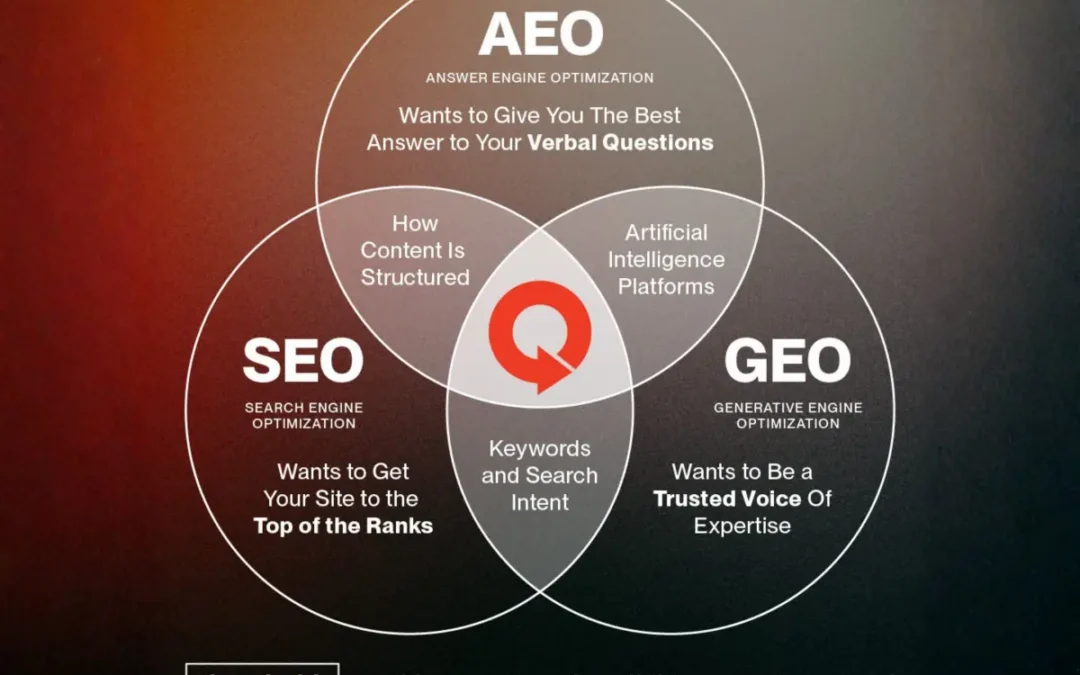
moving toward answer engine optimization (AEO).
Continuing to measure digital health through legacy keywords and top-of-funnel traffic metrics creates a dangerous blind spot. While those metrics may look productive on a monthly dashboard, they fail to capture whether your brand is being recommended in the AI-generated summaries where modern buyers are making decisions.
The transition from SEO to AEO is an architectural and philosophical shift. It requires auditing how your expertise is structured, evaluating whether your data is machine-readable, and fundamentally changing how you define online visibility.
The question is no longer where your website ranks on a page. The question is whether the AI engines trust your brand enough to use your answers.
are you AIO ready? a quick diagnostic quiz.
1. how does your content handle direct questions?
-
A. We hide answers deep within long-form, narrative blog posts to maximize time-on-site metrics.
-
B. We have a few FAQ sections, but our content is mostly structured around broad industry keywords.
-
C. We actively use clear Q&A formatting, bulleted summaries, and bold text at the top of pages to give immediate, direct answers to user queries.
2. what does your site’s schema markup look like?
-
A. What is schema markup?
-
B. We use basic article or organization schema, but we haven’t updated our structured data strategy in years.
-
C. We use robust, advanced schema markup (like FAQ, Product, and SameAs profiles) to explicitly tell AI engines exactly what our data means.
3. how do you define and measure digital search success?
-
A. We strictly track traditional keyword rankings and organic traffic volume to individual URLs.
-
B. We track rankings but are starting to notice a drop in traffic despite maintaining our top spots.
-
C. We track brand share-of-voice inside AI-generated summaries (like Google AIO, Perplexity, and ChatGPT) alongside traditional traffic.
4. what is the primary source of authority behind your content?
-
A. We use ghostwriters or generic copy heavily focused on keyword density, with no clear author bios.
-
B. Our company blog publishes articles under a generic “Admin” or corporate brand account.
-
C. Our content is authored or explicitly reviewed by verified, real-world subject matter experts with robust digital footprints and clear author biographies.
5. how conversational is your keyword targeting strategy?
-
A. We target short, fragmented head terms like “enterprise CRM software.”
-
B. We target mid-tail keywords, but our phrasing still feels designed for an old-school search bar.
-
C. We optimize for long-tail, natural language questions and multi-turn prompts like, “what is the best enterprise CRM software for a distributed remote healthcare team?”
grading the results.
-
mostly A’s: legacy optimizer. Your strategy is firmly rooted in the 2010s keyword playbook. Because AI engines prioritize structured data, explicit answers, and deep trust, your content is at a high risk of being bypassed by AI Overviews.
-
mostly B’s: transitional spectator. You are aware that the landscape is changing and have some foundational elements in place, but you are still treating AI visibility as an afterthought to traditional SEO ranking.
-
mostly C’s: AIO pioneer. Congratulations. You recognize that search is shifting from links to answers. Your content is structured, authoritative, and machine-readable—primed to be synthesized by modern answer engines.
If you landed mostly in the A or B category, it’s time to rethink your digital architecture before your organic visibility disappears behind an AI summary. You can see how we audit and transition brands for this exact shift by exploring our AI Optimization Service Page.
by threshold | Mar 26, 2026 | AI, AI Marketing, Digital Marketing
Most teams aren’t short on tools. They’re short on a clear way to connect tools to real outcomes.
If you’re a CMO, marketing director, or hands-on practitioner and wondering what you’re supposed to be doing with all this AI stuff, we’re here to tell you.
The path to AI-ready engagement is less about buying the perfect platform and more about building a simple, repeatable framework.
step 1: anchor in one business problem.
Start with a focused question, not a tech wish list. For example:
- “We are losing too many leads between tour and lease.”
- “Our call center is flooded with repeat questions.”
- “Our cross-sell and renewal efforts are not landing.”
Tie that problem to a hard metric such as occupancy rate, deposit-to-lease conversion, call volume, NPS, or revenue per account. This anchors your AI initiatives in real impact, not experimentation for its own sake.
step 2: map the journey and data you actually have.
Document the journey around that problem:
- Where do people first show up?
- What touchpoints do they interact with?
- Where do they drop off or get frustrated?
Then audit your data:
- What are you capturing today, and in which systems?
- What is reliable, and what is messy or missing?
- Which tools already offer AI features you are underusing?
Often, you don’t need more tools. You need to connect the ones you have.
step 3: layer in the right tech for that journey.
Resist the urge to “buy AI” as a category. Instead, design a small stack tailored to your chosen journey. Examples:
- Add a chatbot on a key conversion page with a clear job, such as tour booking, application support, or lead capture.
- Use predictive scoring in your CRM or marketing platform to prioritize follow-ups.
- Apply AIO principles to upgrade the content on landing pages, FAQs, and nurture flows that support this journey.
The rule: every new feature must have a clear role in moving your core metric.
step 4: test, learn, then scale.
Define a simple test plan:
- Create a time frame, for example, 60 to 90 days.
- Set a primary metric, such as conversion rate, time to first response, volume of resolved chats, or reduced churn.
- Include guardrails such as easy access to human support, clear disclosures, and opt-out options.
Launch a contained pilot. Then:
- Keep what works.
- Fix what breaks.
- Turn off what adds friction.
Only once you have a repeatable pattern can you roll it out to more journeys, properties, or regions. That’s how AI moves from scattered features to a true engagement engine.