 Laura Robbins, Corporate Marketing Manager
key takeaways.
the fintech threat is a perception problem:
Fintechs win by exploiting the experience gap and trust paradox, stealing market share through superior speed, transparency, and value alignment. Traditional financial institutions must realize they cannot simply build their way out; they must strategically out-market fintechs on value and trust to shift customer perception.
strategy must be hyper-personalized and authentic:
The path to winning requires leveraging rich customer data via AI-powered hyper-personalization to deliver the next best action. Simultaneously, institutions must deploy bold, trust-first branding that is highly authentic, transparent, and actively highlights social responsibility to connect with digital-native consumers.
marketing demands a frictionless experience:
Success requires extending the marketing strategy into operational processes to eliminate brand friction across the entire customer lifecycle. The goal is a seamless, unified experience where digital convenience is matched by the availability of human trust for complex issues, making your institution the effortless choice.
The narrative of financial institutions is being rewritten by disruption. Fintech companies are actively dismantling traditional revenue streams by exploiting the friction points that legacy systems created. The question is no longer if this is happening, but how quickly you will deploy a strategic defense.
the silent erosion: where fintechs are winning.
Fintechs—from challenger banks to online lenders—have mastered simplicity, speed, and hyper-personalization. They’ve capitalized on three key weaknesses inherent in the traditional banking model:
the experience gap:
Customers, particularly the digital-native Generation Z, prioritize seamless, mobile-first experiences. Fintechs deliver this instantly (e.g., Venmo, digital account opening). Traditional banks struggle to keep up due to core system debt and complex processes that often lead to user frustration. This extends to product features: Fintechs offer flexible payment options (like embedded installment plans) and goal-based saving tools (named savings buckets), which traditional banks often lack.
the segment scramble:
Fintechs offer category-killer solutions by laser-focusing on niche, underserved segments (e.g., faster small business loan approvals, robo-advisors). They are capturing high-value, profitable relationships that traditionally belonged to banks.
the trust paradox:
While banks own historical trust, fintechs build contemporary credibility through radical transparency and superior service (e.g., clear fee structures, 24/7 digital support). They are nurturing customer loyalty at a speed traditional banks simply cannot match. Fintechs also win by showcasing clear alignment with customer values, turning financial services into a form of community building and identity expression.
This erosion threatens your two most valuable assets: brand power and the fundamental customer relationship.
the mistaken strategy: product vs. perception.
Many financial institutions believe the answer is to simply build a new app or launch a singular digital product. This is a crucial mistake. You are treating a perception problem with a product solution.
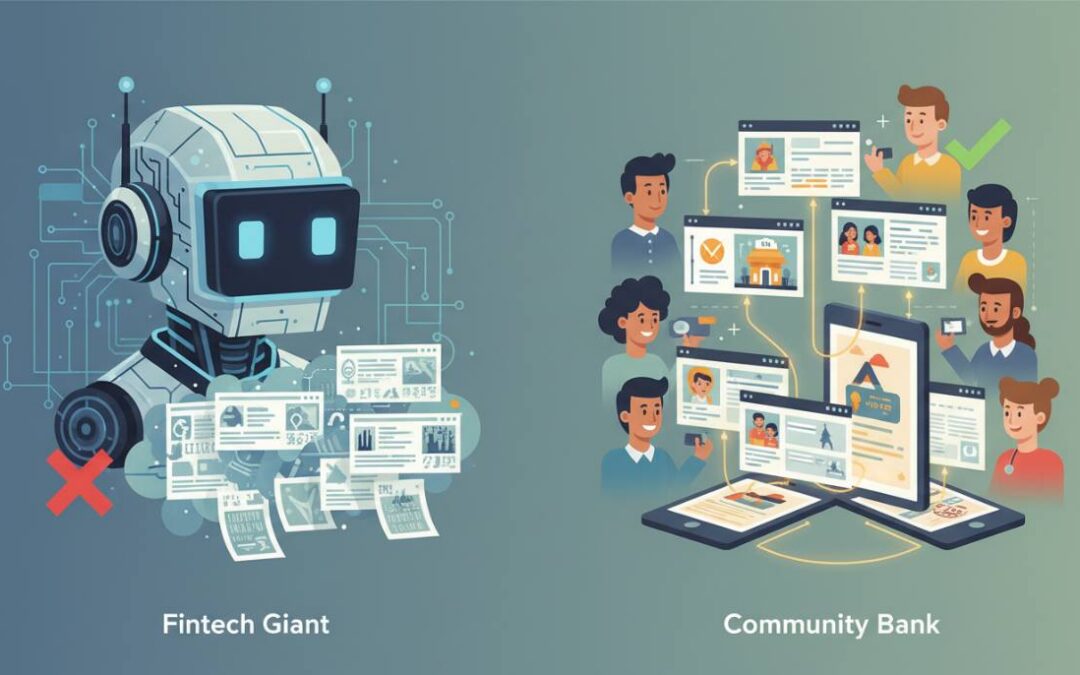
Fintechs are winning because their marketing and branding strategy makes their customer experience feel simpler, faster, and more aligned with modern life.
You can’t out-innovate a start-up on speed; you must strategically out-market them on value and trust.
reclaiming the customer narrative.
Winning against fintech requires financial institutions to bridge the gap between their established foundation of trust and capital and the digital-first expectations of today’s consumer—Threshold’s specialty.
This bridge is built upon four interconnected strategic pillars:
1. identity resolution & hyper-personalization.
The advantage of traditional institutions lies in their rich, historical customer data. The strategy is to deploy AI-powered identity resolution to create a complete, 360-degree customer view. This enables the execution of truly hyper-personalized marketing campaigns that proactively address customer needs, leveraging the data you already own.
2. content-to-credibility pipeline.
Traditional banks must shift from transactional messaging to acting as a trusted advisor. This involves developing a robust content strategy (including thought leadership, interactive tools, and videos) that addresses customers’ core financial anxieties. This content must be easily digestible and entertaining, delivered directly within the mobile app or through social channels, focusing on critical topics such as debt, saving for retirement, and budgeting. This process enables you to establish your authority and credibility in the market, making your institution the default source of reliable financial knowledge.
3. frictionless brand experience.
Marketing must extend beyond campaigns into operational processes. This means mapping the institution’s entire customer lifecycle to eliminate brand friction. The ideal modern experience acknowledges that while digital must be exceptional, Gen Z still values the peace of mind that a physical branch provides for complex issues. The strategic goal is to ensure that all marketing collateral, digital assets, and customer communications speak with a unified, simplified voice, making it effortless for customers to choose and transact with you, from application to everyday service.
4. bold, trust-first branding.
Your brand image must communicate security while embracing modern relevance. Institutions must adopt bold, trust-first branding that demands authenticity, as younger consumers can easily spot performative marketing. By utilizing community marketing and social engagement strategies to emphasize social responsibility, environmental sustainability, and ethical leadership, financial institutions can be positioned as approachable, supportive pillars in their customers’ lives, effectively countering the often impersonal nature of many fintechs.
The war for the future of finance is a war for customer relevance. You have the history, the capital, and the regulatory advantage. Now, you need the marketing agility to match the disruption.
expert application: proof of concept.
For a financial institution, every strategic goal is an investment in your mission and the financial health of your members. Success is measured not just in growth, but in the sustained trust and security you provide.
To demonstrate the power of this multi-layered framework, consider Dannemora Federal Credit Union (DFCU), a smaller credit union client that was facing intense competition from large, well-known digital banks. With the population of DFCU’s field of membership being limited to Clinton, Essex, Franklin, and St. Lawrence Counties in New York, the strategic imperative was to attract new members efficiently. (Check out our Case Study here.)
DFCU engaged Threshold to develop a strategy focused on three clear goals: