
by threshold | Sep 9, 2026 | Financial Marketing, Thought Leadership
 Laura Robbins, Corporate Marketing Manager
A 2026 credit union and financial services marketing trend: members are deciding whether to trust you before they ever talk to a human. Here’s what that means for your digital experience.
Quick answer: Financial institutions don’t lose trust because their websites lack information, but rather because visitors can’t quickly answer three questions: Do you understand me? Can I trust you? What should I do next? Adding more pages, more disclosures, and more explanation rarely fixes this. Simplifying the path to those three answers does. This is one of the clearest financial services marketing trends shaping digital strategy in 2026: institutions are shifting budget and attention from content volume to experience clarity.
why trust is the real battleground in financial services marketing.
In financial services, trust is everything.
It’s the reason members choose one institution over another. It’s the reason they stay. And increasingly, it’s the reason they decide before ever speaking to a human. A shift that’s become one of the defining credit union marketing trends of the past few years, as more of the member journey moves online and self-serve.
Yet most financial institution websites still treat trust as a content problem.
- if we explain more, we’ll feel more credible
- if we add more pages, we’ll cover our bases
- if we say everything, we’ll reassure everyone.
That instinct is understandable. And it’s wrong.
more content rarely equals more trust.
Many bank and credit union websites are packed with:
- long explanations
- dense navigation
- legal and compliance language front and center
None of this is inherently bad. But when clarity suffers, confidence erodes, and confidence is the entire product being sold on a homepage.
Visitors leave your website because they can’t quickly answer three basic questions:
- do you understand me?
- can I trust you?
- what should I do next?
When those answers aren’t immediate, hesitation creeps in. And hesitation kills conversion, whether the goal is a loan application, an account opening, or a scheduled appointment.
digital trust is built in small moments.
Trust online is a series of small, compounding signals:
- clear headings that speak human, not institutional
- straightforward explanations without jargon
- navigation that feels obvious, not clever
- reassurance without overwhelm
In financial services, confidence comes from calm. When digital experiences feel heavy, confusing, or overly cautious, visitors subconsciously ask: “If this is hard, what else will be?”
That single, subconscious question is why so many financial institution websites underperform despite significant investment. It’s rarely a content gap. It’s a clarity gap.
interpretation is the problem.
Regulation doesn’t require confusion.
Some of the most effective financial institution websites manage to:
- meet compliance standards
- communicate clearly
- guide users confidently
They don’t hide behind disclaimers. They don’t bury next steps. They understand that clarity reduces risk, it doesn’t create it. Compliance and clarity aren’t in tension; treating them as if they are is what produces the dense, defensive digital experiences members are trying to avoid.
why this matters in 2026 and beyond.
Members today compare:
- banks to fintechs
- credit unions to apps
- your digital experience to the last good one they had. Anywhere, in any industry
They don’t mentally separate “financial UX” from “digital UX.” They just decide who feels easier to trust. This is arguably the most important of the current financial services marketing trends to internalize: your competition for trust isn’t just the bank down the street, it’s the last well-designed app your member used, full stop.
the takeaway for marketing leaders.
Trust is built by:
- saying the right things
- in the right order
- with the right amount of reassurance
If your website feels thorough but underperforms, the issue may be clarity. And clarity is something you can fix.
faq: digital trust in financial services marketing.
what builds trust on a financial institution’s website?
Clear, fast answers to who you serve, how you help, and what to do next, reinforced by trust signals (testimonials, security cues, human tone) that feel authentic rather than promotional.
does adding more content improve conversion for banks and credit unions?
Not usually. More content often increases cognitive load without increasing confidence. Visitors convert when they can act quickly, not when they’ve read everything available.
how does compliance language affect member trust?
Compliance content itself isn’t the problem, where and how it appears is. Disclosures that support understanding (placed contextually, worded plainly) build trust; disclosures that dominate the page or interrupt the flow erode it.
what’s the biggest digital marketing trend for credit unions right now?
A shift from content volume to experience clarity. Simplifying the homepage-to-conversion path so members can answer “do you understand me, can I trust you, what’s next” within seconds.

by threshold | Aug 27, 2026 | Digital Marketing, Financial Marketing, General
Privacy changes have changed the retargeting playbook. For multifamily teams and community banks, the right answer is not chasing third-party cookies. It’s building a first-party data strategy that ties digital touchpoints to physical promo fulfillment and CRM activation. Here is a crisp, practical guide you can implement this month.
why cookieless retargeting matters now.
Browsers and platforms have made third-party cookies unreliable. Apple privacy updates and tighter browser limits mean traditional retargeting campaigns will lose reach and accuracy. That hits high-intent channels for leasing and banking hardest. If you want predictable conversions, you need data you own and a way to turn it into action without relying on external trackers.
the threshold playbook: a 6-step roadmap for cookieless retargeting.
This playbook pairs first-party data capture with fulfillment-triggered touchpoints. It is built for speed, compliance, and measurable lift. Use it for multifamily retargeting strategies or community bank digital marketing.
1. capture first-party signals at every touchpoint.
Start by collecting reliable identifiers. That includes email, phone, device data from your site, leasing portal activity, form submissions, and on-branch signups. For banks, add account opening forms and in-branch events. For apartments, add floor plan downloads, tour bookings, and waitlist signups. Make sure every form asks permission for contact and stores consent flags in your CRM.
2. build a privacy-first data layer and CRM schema.
Design a unified record per lead. Link web behavior, offline interactions, promo fulfillment history, and consent status. Use hashed identifiers for matching so you can activate audiences without exposing raw PII. For community bank digital marketing, document retention policies and encryption standards so your team can answer audits quickly.
3. segment and score for intent.
Turn first-party signals into audience segments. Examples:
- Multifamily high intent: scheduled a tour in the last 14 days and viewed 3 or more floor plans.
- Bank high intent: started account form and visited rate page more than twice.
Score leads by recency and depth of activity. These segments feed your retargeting channels and your fulfillment triggers.
4. activate without third-party cookies.
Use server-side activation and CRM-to-platform connections. Send hashed emails and phone numbers to platforms that accept first-party lists for matching. Run contextual and cohort-based ads for broader reach while using your matched lists for high-intent follow-up. Keep ad creative tight and message consistent with the fulfillment touchpoint you plan to send.
5. use promo fulfillment as a retargeting trigger.
This is where Threshold stands out. Branded welcome kits, on-site swag, and mailed offers do double duty. They act as offline confirmations of interest and as signals to your CRM to move leads into higher-touch sequences. Practical examples:
- Multifamily: When a prospect schedules a tour, immediately send a small welcome kit. Once the kit ships, update the CRM to fire SMS reminders and an email with a virtual tour link.
- Community bank: A new account applicant receives a branded debit card sleeve and welcome packet. When fulfillment completes, trigger a personalized financial education drip and a cross-sell ad cohort.
Promo fulfillment improves conversion and provides a clean event you can use for privacy-compliant remarketing without cookies.
6. measure, attribute, and iterate.
Define simple KPIs. For multifamily: tour-to-lease rate, cost per lease, and time-to-lease. For banks: account funding rate, new deposit volume, and cost per funded account. Use CRM event timestamps to attribute conversions to fulfillment triggers and first-party ad activations. Run A/B tests where you split segments between a promo fulfillment path and a control path to quantify uplift.
practical play examples.
short campaign for a lease-up.
Capture emails on new community landing pages with an incentivized floor plan download. Schedule tours and immediately send a branded tote or keychain. When the tote ships, push that audience to your matched list and a contextual ad buy. Send a lease incentive email 3 days after fulfillment. Measure signed leases within 30 days.
community bank onboarding funnel.
When an online applicant submits an ID, mark consent and stage in the CRM. Ship a welcome packet with printing of account number and a small branded notebook. On shipment, trigger a personalized video email explaining next steps and a matched-audience ad that highlights local branch services. Track funded accounts within 15 days.
compliance and security notes.
Keep consent records with timestamps. Hash PII before sending to ad platforms. Limit access to raw customer data and document your retention schedule. For community banks, align with your compliance officer and keep a clear audit trail for any third-party vendors handling fulfillment or data matching.
quick implementation checklist.
- audit current first-party signals and consent flows
- create a single CRM record for each lead and a hashing process for PII
- map segments and scoring rules tied to fulfillment triggers
- set up server-side activations and matched list uploads
- select promo SKUs that match the audience and budget
- instrument measurement events and a simple A/B test
Cookieless retargeting is not theory. It is practical work you can start this week. Threshold combines bank-grade data processes, rapid creative execution, and promo fulfillment to make these campaigns real fast. Want to run a pilot for a lease-up or new account drive next month? Yep, we can do that.

by threshold | Jul 9, 2026 | Financial Marketing, General, Thought Leadership
For decades, credit union marketing followed a predictable formula: offer a highly competitive auto loan rate, blast it across local media, and wait for members to walk through the branch doors to open an account.
But the landscape has fundamentally shifted.
One of the most defining financial services marketing trends today is that your potential members are making up their minds long before they ever step into a physical branch or pick up the phone. Digital trust isn’t built at a desk over a handshake; it is formed, tested, and finalized online.
If your marketing strategy is still relying on the physical branch to do the heavy lifting of building trust, you’re losing members to inertia.
your real competitor isn’t big banks. it’s “the fog.”
When looking at current credit union marketing trends, executives often point to megabanks with massive tech budgets as the primary threat. However, the real opponent is much quieter. It’s what we call the “digital fog”—the unexamined, “good enough” banking relationship that keeps consumers frozen in place.
Banking habits are formed by convenience, not active daily choices. A checking account opened out of necessity in college quietly turns into a savings account, which later turns into a mortgage. The consumer isn’t necessarily happy with their current financial institution; they are simply inert.
By the time a consumer realizes they need a new financial product, they don’t look around. They default to whatever is already in front of them unless something cuts through the fog.
the shift from conversion to reflection.
Traditional financial marketing attempts to blast through this inertia with aggressive offers: “Refinance today for 4.9% APR!” or “Get $200 for opening a checking account!” But in an era where digital trust is paramount, pushing for an immediate conversion often triggers skepticism. Modern credit union marketing needs to reverse the sales funnel. Instead of pushing an Offer → Rate → CTA, the new paradigm focuses on Clarity → Reflection → Permission → Action.
To build digital trust before a conversation happens, your marketing must prompt self-reflection. Instead of telling them why you are great, ask the questions that make them audit their current financial institution:
- Was your current bank account built for who you are now, or who you were five years ago?
- When was the last time your financial institution evolved alongside your life changes?
- If you had to choose your bank today, would you choose the one you currently have?
By encouraging consumers to look closely at their unexamined banking habits, you clear the fog and position your credit union as the clear, trusted alternative.
5 steps to build digital trust long before the branch visit.
To capitalize on these credit union marketing trends, your digital footprint must be engineered for trust, clarity, and reflection. Here is how to execute it:
- audit and map default consumer behavior.
Before you can interrupt a consumer’s inertia, you need to understand it. Audit your digital touchpoints. Where are consumers acting purely out of habit, and where are they making conscious choices? Tailor your messaging to meet them at those critical crossroads.
- target “thinning-fog” moments.
Human beings rarely rethink their banking relationship during a normal, quiet week. They rethink it during major life transitions—moving to a new city, getting married, changing jobs, or having a child. Your digital marketing should be highly segmented to reach people experiencing these life milestones, which is when the fog naturally lifts, and they are actively looking for guidance.
- design digital experiences for reflection, not just transactions.
Does your website immediately demand an application form, or does it offer tools for self-discovery? Interactive calculators, financial wellness assessments, and transparent, jargon-free content help a user figure out their own financial standing. When a user reaches a conclusion on their own using your tools, they hand you their trust.
- sequence clarity before the ask.
Earn the right to ask for their business. If your landing pages skip straight to a complex application form without establishing clarity on why this move benefits them, drop-off rates will skyrocket. Give them the clarity they need to make an informed decision first; the conversion will follow naturally.
- protect and compound the trust you build.
Once a digital user decides to take action and finally reaches out—whether via a web chat, a digital application, or a branch visit—the experience must match the promise. Credit unions have a massive structural advantage over megabanks: authentic, community-driven trust. Ensure your digital onboarding process is seamless, warm, and validates the choice they made hours or days ago on their smartphone.
the takeaway.
Digital trust is invisible, but its impact on your bottom line is massive. If your credit union is waiting to build a relationship until someone sits down at a loan officer’s desk, you are missing the vast majority of the market.
By shifting your financial marketing strategy to cut through the inertia, prompt deep reflection, and deliver digital clarity, you ensure that when a member finally does talk to you, they’ve already decided you’re the right choice.

by threshold | Jun 23, 2026 | AI, AI Marketing, Digital Marketing, Financial Marketing, General
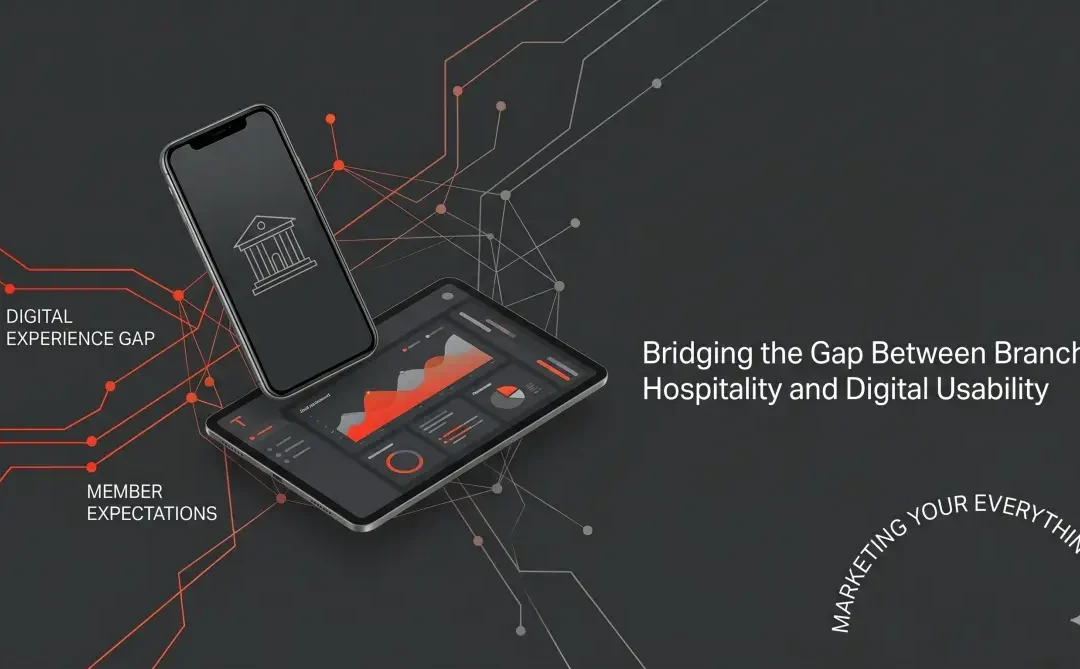
For decades, community banks and credit unions built their reputations on the branch experience. A warm greeting, a handshake, and deep roots in the community were the ultimate differentiators. If a member walked through the physical doors, they were guaranteed a high-touch, frictionless experience.
But when that same member opens your mobile app or visits your website? The experience often feels completely disconnected.
In modern financial services, member growth is rarely a product problem. Your auto loan rates are competitive. Your checking accounts offer great rewards. Your mortgage terms are solid. Growth is a visibility and experience problem. If your digital channels are clunky, hidden behind poor search visibility, or fragmented by disconnected user journeys, your excellent products simply don’t matter.
To win modern consumers, financial institutions must close the painful gap between the warm hospitality of the physical branch and the cold reality of their current digital presence.
quick summary: the digital banking expectations gap.
- the Vvsibility bottleneck: Growth fails because high-quality loan and deposit products are buried behind poor SEO, slow page speeds, and bad navigation.
- the experience standard: Consumers do not compare your mobile deposit or loan application to the credit union down the street—they compare it to Uber, Amazon, and Netflix.
- the solution: Financial institutions must evolve from passive informational websites into highly personalized, interconnected digital acquisition engines.
1. shifting from product pages to frictionless conversion funnels.
Traditional banking websites operate like digital brochures. They feature endless rows of tabs listing interest rates, disclosure agreements, and compliance text. While this information is necessary, it treats a visitor like a browser rather than an active applicant.
When a consumer walks into a branch to open an account, an expert employee guides them through the paperwork step-by-step. Digitally, that same journey is often replaced by an endless, unoptimized PDF form or a jarring redirect to a third-party core processor system. Closing the gap means auditing every digital touchpoint to eliminate clicks, pre-fill data fields where possible, and ensure a user can apply for a loan natively from any device in under three minutes.
Modern data engines allow national megabanks to anticipate consumer needs with eerie accuracy. If a consumer browses a house on Zillow, their banking app serves a personalized mortgage calculator an hour later.
Community institutions have a wealth of first-party member data sitting idle in core processing silos. True digital personalization means utilizing that data to alter the web experience dynamically. If an existing member with a high checking balance visits your homepage, they shouldn’t see a generic hero banner for a basic checking product—they should immediately be served a targeted high-yield CD offer or an auto-refinance prompt tailored to their financial footprint.
3. prioritizing search and answer engine visibility (AEO).
Because financial research is increasingly moving away from traditional Google results and moving toward AI platforms and conversational answer engines, visibility is your primary acquisition battleground.
If a consumer asks an AI assistant, “What is the best high-yield savings account near me with low fees?” your institution must be semantically structured to be pulled as the definitive answer. This requires structuring your website data cleanly, answering complex consumer questions directly on your pages, and making sure your core value propositions live in high-density text fields easily scraped by search crawlers. Thankfully, that’s something we can do for you.
4. the omnichannel handoff: ending the fragmented journey.
One of the largest friction points in regional banking is the broken handoff between digital and physical channels. If a member begins a mortgage application online, hits a snag, and decides to call or walk into a branch, they expect the staff to know exactly where they left off.
Too often, internal team silos mean the branch staff has zero visibility into online abandonment. True digital excellence means connecting your marketing automation, digital application portals, and branch CRM systems. When your digital engine communicates flawlessly with your physical staff, you provide the seamless, omnichannel experience consumers now demand.
the strategic imperative for leadership.
Closing the digital experience gap requires a cultural shift. Digital can no longer be treated as an operational IT expense; it must be funded and managed as your primary, highest-producing branch. By prioritizing frictionless conversion, deeply integrating your member data, and structuring your content for modern search visibility, you can translate your legendary in-branch service into an unstoppable digital growth engine.
frequently asked questions about digital banking expectations.
what is the biggest mistake regional banks make on their websites?
The biggest mistake is treating the website as a static brochure rather than a dynamic sales funnel. Banking websites must prioritize clean user experience, fast page load speeds, and direct paths to native account opening platforms.
how do credit unions compete with megabanks digitally?
While regional credit unions may lack the massive development budgets of national banks, they can win by focusing on hyper-local SEO, optimizing for conversational AI search queries (AEO), and using targeted, first-party member data to personalize the digital funnel.
why do online loan applications suffer from high abandonment rates?
High abandonment is usually driven by technical friction, such as excessive form fields, a lack of mobile optimization, or jarring redirections to unsecured-looking third-party portals during the application process.
by threshold | Apr 14, 2026 | Digital Marketing, Financial Marketing
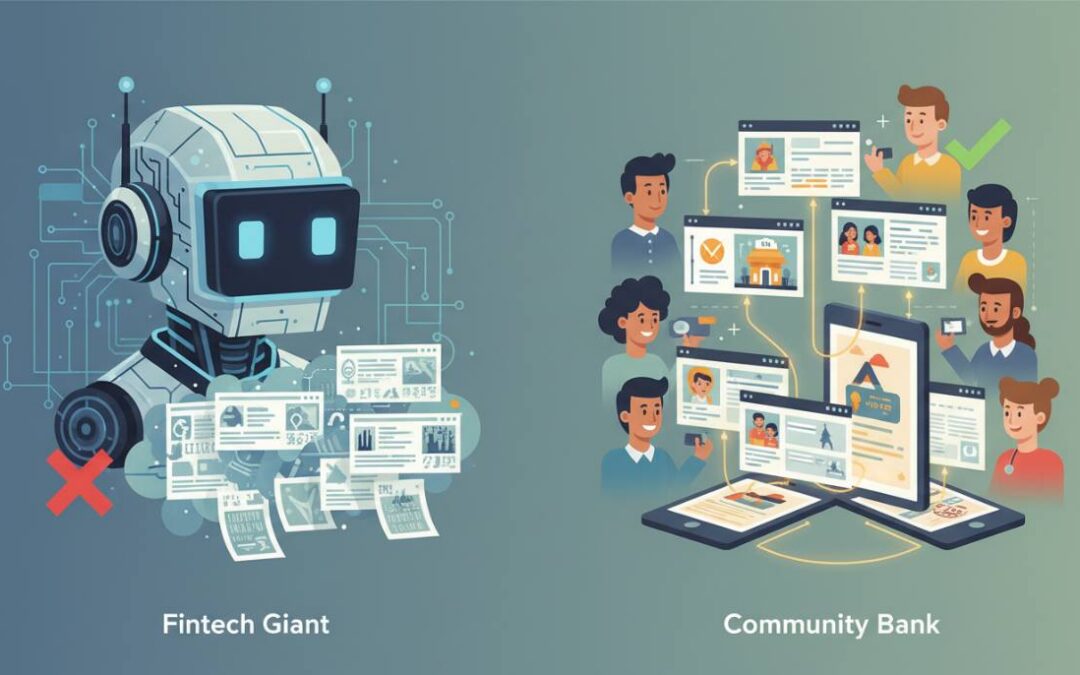
Fintech giants spend billions trying to convince your neighbors that an algorithm understands their lives better than a local banker does. They have the massive budgets and the sleekest apps, but they often miss the mark on the one thing that actually drives a conversion: authentic connection. While the big bots are busy running the same generic ads from coast to coast, community banks have a secret weapon. You know the streets, the schools, and the local economy better than any Silicon Valley server ever could. When you pair that local knowledge with high-speed, hyper-personalized digital creative, you don’t just compete. You win.
the automation gap in fintech marketing.
Most fintech marketing relies on massive data sets to blast out standardized messages. It is efficient, sure, but it is also cold. They use stock photos of people who look like they have never set foot in your town, and the copy feels like it was written by a committee in a high-rise. This creates a massive opening for community banks and credit unions.
When comparing fintech vs community bank marketing, the difference is often found in the “vibe” of the ad creative. A fintech ad feels like a transaction. A community bank ad should feel like a conversation. By focusing on hyper-local banking ads that reflect the actual life of your community, you build a level of trust that a national brand simply cannot replicate.
why hyper-personalized digital ad creative works.
Personalization is about more than just putting a customer’s name in a subject line. It is about showing them that you see what is happening in their world right now. Here is how local institutions are out-pacing the giants:
- reflecting local reality: If a local plant is hiring or a new housing development is breaking ground, your ads can speak directly to those specific milestones.
- visual familiarity: Using imagery of actual local landmarks or recognizable neighborhood aesthetics makes your community bank digital ads feel like they belong in the user’s feed.
- niche problem solving: Fintechs offer broad solutions. You can offer a loan product specifically designed for the challenges facing small businesses on your specific Main Street.
speed beats the algorithm.
One of the biggest hurdles for local banks has historically been the turnaround time for high-quality creative. In the past, by the time a campaign was approved and designed, the market had already shifted. That has changed. Today, the goal is to get high-volume, high-quality creative into the market fast.
When you can react to a local interest rate shift or a community event within 24 hours, you aren’t just a bank. You are a relevant part of the daily news cycle. This agility is exactly how credit union lead generation stays ahead of rigid national competitors who have to jump through months of corporate red tape to change a single headline.
The modern consumer doesn’t want a bank that just holds their money. They want a partner that understands their zip code.
scaling your creative without losing the human touch.
A common fear for marketing directors at community banks is that increasing the volume of digital ads will lead to a drop in quality or a “robotic” feel. It doesn’t have to be that way. The key is to build a system where personalized financial marketing is the standard, not a special project.
By using a dedicated creative partner who understands the regulatory landscape and the local culture, you can produce dozens of ad variations that feel hand-crafted. You get the speed of a fintech with the soul of a community institution. This balance of high-end design and local heart is what stops the scroll and gets the click.
ready to out-convert the giants?
You have the local trust and the community roots. All you need is the creative engine to tell that story at scale. Whether you are looking to boost your mortgage applications or grow your core deposits, we specialize in making the “impossible” turnaround times look easy. If you need high-volume, hyper-local digital ads that actually move the needle, we are here to help. Yep, we can do that.

by threshold | Feb 6, 2026 | Design, Financial Marketing
Strong brand identity for financial institutions is built through clear messaging, reassuring design, and guided digital experiences—not more content.
A strong brand identity is essential for financial institutions competing in today’s digital-first landscape.
Banks, credit unions, and financial service providers are no longer compared only to each other; they are compared to every clear, intuitive digital experience customers have anywhere. That comparison often begins with a website visit that lasts only seconds.
In financial services, trust is not built by publishing more content.
Trust is built through clarity, reassurance, and clear next steps.
A well-designed website and cohesive digital marketing strategy help financial institutions communicate confidence, guide decisions, and create lasting brand recognition — without overwhelming users.
This article outlines best practices for building a strong brand identity in financial services, with a focus on websites and digital marketing that convert trust into action.
key takeaways: building a strong brand identity for financial institutions.
- Trust is built through clarity, not content volume.
Clear messaging and guidance outperform dense information.
- Your website is the primary expression of your brand identity.
Design, messaging, and usability shape trust in seconds.
- Strong financial brands guide users, not just inform them.
Clear next steps reduce hesitation and increase confidence.
- Consistent digital branding builds recognition and credibility.
Alignment across web, email, and digital channels reinforces trust.
- Design quality directly affects perceived trustworthiness.
Clean, modern layouts signal stability and professionalism.
- Clarity is a competitive advantage in financial services.
Institutions that simplify decisions earn trust faster.
what is brand identity in financial services?
Brand identity in financial services refers to how a financial institution communicates trust, stability, and value across various digital touchpoints, including websites, digital marketing, and online experiences.
It includes:
- Messaging and tone
- Visual design and layout
- Navigation and usability
- How clearly next steps are presented
Together, these elements shape how customers and members feel about your institution before they ever speak to a human.
why brand identity matters for financial institutions.
A strong brand identity helps financial institutions:
- Build trust faster in a crowded market
- Differentiate from banks, credit unions, fintechs, and neobanks
- Increase engagement and conversion across digital channels
- Reinforce long-term loyalty and confidence
Research shows users form an opinion about a website in as little as 50 milliseconds, and nearly 94% of first impressions are design-related (The Financial Brand). That means brand trust often begins before a single paragraph is read.
trust is built through clarity, not content volume.
Many financial institutions assume trust grows by explaining everything.
In reality, more content often creates more hesitation.
Visitors don’t leave because they lack information. They leave because they can’t quickly answer three questions:
- Do you understand me?
- Can I trust you?
- What should I do next?
Clear headlines, plain language, and confident guidance reduce cognitive load and help users feel in control — a critical trust signal in regulated industries.
how websites shape brand trust in financial services.
A financial institution’s website is often the most influential brand touchpoint.
Outdated layouts, dense navigation, or unclear messaging subtly erode confidence. Conversely, modern, uncluttered design and intuitive structure signal stability and competence.
Effective financial institution websites:
- Use plain language instead of jargon
- Present information in a clear hierarchy
- Balance compliance with usability
- Guide users forward instead of overwhelming them
- Perform reliably across devices
Design quality isn’t cosmetic — it’s foundational to trust.
best practices for financial institution websites.
High-performing financial websites share a few consistent traits:
- Clear value propositions above the fold
- Consistent visual identity across pages
- Simple navigation that reduces decision fatigue
Reassuring calls to action that feel low-pressure
Compliance content that supports understanding, not interrupts it
Consistent branding across digital touchpoints can increase revenue by up to 23%, according to industry studies, by reinforcing familiarity and confidence.
the role of digital marketing in brand identity.
Digital marketing reinforces brand identity beyond the website.
Paid ads, email campaigns, landing pages, and social media should all reflect the same voice, values, and clarity users experience on the site itself. When messaging aligns across channels, users feel reassured they’re in the right place.
Strong digital brand consistency:
- Increases recognition
- Reduces hesitation
- Improves conversion efficiency
Lowers acquisition costs over time
In financial services, consistency equals credibility.
how clear brand identity improves conversion and growth.
A clear, confident brand identity does more than look good — it drives measurable outcomes.
Financial institutions with strong digital brand clarity often see:
- Higher engagement rates
Improved conversion performance
Shorter decision cycles
- Stronger customer and member loyalty
Clarity makes decisions easier — and easier decisions convert more often.
final thought.
In financial services, brand identity isn’t about saying more — it’s about saying the right things, clearly, and guiding users with confidence.
When your website and digital marketing work together to reduce friction and reinforce trust, brand identity becomes a powerful growth engine.