
the real reason your digital marketing underperforms. and a worksheet to fix it.

the real reason your digital marketing underperforms. and a worksheet to fix it.

laura headshot blogLaura Robbins, Corporate Marketing Manager


key takeaways.

  • digital marketing underperforms when SEO, paid media, content, and conversion are not aligned as a single strategy
  • websites directly impact search visibility, paid media performance, and conversion rates
  • channel-level optimization fails without shared goals and performance measurement
  • meaningful results come from system-level digital marketing optimization tied directly to ROI
  • in crowded industries like real estate and financial services, messaging must reduce friction, not reinforce category sameness

Digital marketing is everywhere.

Brands are running paid search campaigns, launching paid social ads, building content calendars, optimizing SEO, and automating email journeys.

And yet, your performance keeps stalling.

Leads plateau. Cost per acquisition rises. Traffic increases without meaningful growth.

The issue isn’t the effort you’re putting in. It’s the structure you’re following.
 

activity isn’t the same as performance.

Most digital strategies start with a channel plan:

  • paid search drives traffic
  • social builds awareness
  • content improves visibility
  • email nurtures engagement

But when these tactics operate in isolation, you get motion, not momentum

Paid campaigns can deliver clicks. But if your website doesn’t convert, those clicks disappear.

SEO can drive organic traffic. But if messaging mirrors the category narrative, visitors don’t feel compelled to act.

Social can build engagement. But without clear next steps, it doesn’t drive revenue.

Disconnected channels create disconnected results. Ain’t nobody got time for that. 
 

the hidden bottleneck? no system-level thinking

Digital marketing underperforms when it’s treated as a collection of tactics instead of a performance system.

High-performing strategies do something different. They align every channel—paid, organic, content, and website—around shared business goals.

Not impressions. Not clicks. Not “engagement.” Actual growth.

Here’s where most strategies break down:
 

1. campaigns are built in isolation.

Paid media, SEO, content, and conversion strategy often live in separate lanes. When each team optimizes independently, no one owns the system.
 

2. optimization happens too late.

Optimization shouldn’t be a post-launch adjustment. It should be continuous, refining creative, messaging, targeting, and landing pages based on real performance data.
 

3. measurement focuses on vanity metrics.

Impressions and clicks feel productive. But revenue, cost per acquisition, conversion rates, and lifetime value determine success.

Without shared metrics tied to business outcomes, digital becomes noise.
 

friction is the real enemy.

In crowded industries like real estate and financial institutions, the problem compounds.

Every multifamily property highlights amenities.
Every senior living community emphasizes care.
Every bank promotes service and rates.

When messaging reinforces the category’s default narrative, you create comparison, not clarity.

And clarity drives conversion.

For multifamily, the real friction is decision fatigue.
For senior living, it’s emotional reassurance.
For financial institutions, it’s a lifecycle friction between digital convenience and human trust.

If your digital marketing doesn’t reduce that friction at every stage—ad, click, landing page, follow-up—your performance will continue to suffer.
 

what our high-performing digital systems do differently.

They operate as a unified engine.

  • data drives every decision. Strategy is informed by analytics, not assumptions
  • channels are coordinated. SEO, paid search, social, and content work together to reduce waste and increase ROI
  • websites are built to convert. Messaging, UX, and calls to action align with campaign intent
  • optimization is continuous. Creative, targeting, and landing pages evolve based on measurable performance
  • metrics tie back to growth. Not just traffic, but also qualified leads, revenue impact, and cost-efficient acquisition

This is system-level digital marketing. And trust us, it performs.
 

your digital marketing reframe worksheet.

A practical exercise for real estate and financial institutions

If your digital marketing feels busy but not effective, this worksheet will help you diagnose where performance is breaking down and how you can fix it.

Work through this with your team. Be honest. The clarity often reveals itself quickly.
 

step 1: define the category’s default problem.

Every industry comes with assumptions.

What does your category assume everyone cares about?

  • multifamily → Amenities and lifestyle
  • senior living → Compassion and care
  • financial institutions → Rates and service

Now ask: What problem does your industry say it solves?
 

step 2: surface the deeper friction.

The surface problem is rarely the real one.

What emotional or operational tension actually slows decisions?

Examples:

  • multifamily → Decision fatigue, too many options
  • senior living → Family reassurance before commitment
  • financial institutions → Friction between digital convenience and human trust

Now ask: What tension actually causes hesitation for your audience?
 

step 3: identify where the industry falls short.

Most digital marketing mirrors the category narrative.

That’s where performance stalls.

Ask:

  • are we listing features instead of reducing friction?
  • are we generating traffic without guiding decisions?
  • are paid, SEO, and website messaging aligned?
  • are we measuring clicks instead of business outcomes?

Now define: Where does your current strategy reinforce sameness instead of clarity?
 

step 4: define the problem only you solve.

This is where positioning shifts.

Instead of competing inside the category frame, define the problem your organization is uniquely built to solve.

Examples:

  • multifamily → “We simplify the leasing journey.”
  • senior living → “We create reassurance before the tour.”
  • financial institutions → “We eliminate friction across the customer lifecycle.”

Now define: What problem are you truly built to solve, and how should that reshape your messaging, website, and campaigns?
 

step 5: align the system.

Now pressure-test your digital strategy.

Does your:

  • paid media reflect this new positioning?
  • SEO strategy reinforce this narrative?
  • website guide users clearly toward conversion?
  • measurement track outcomes tied to ROI?

If the answer isn’t clearly “yes,” you’ve found the gap.

Digital marketing underperforms when channels operate in isolation. It performs when messaging, media, and measurement align around the same friction point.


fix the system, not the symptoms.

Digital marketing won’t improve because you increase the budget.

It improves when you:

  • think systemically, not tactically
  • align messaging with real audience friction
  • tie every channel to measurable business outcomes
  • build optimization into the foundation — not the follow-up

That’s the difference between activity and acceleration.

If your digital strategy feels like a collection of disconnected tactics instead of a coordinated growth engine, it may be time to rethink the structure.
 

ready to build a performance system?

At Threshold, we design digital marketing strategies that align messaging, media, and measurement into one cohesive performance system.

Because measurable marketing doesn’t just look good, it exceeds the standard.

website innovation guide: why keeping your website current is critical. a case study.

website innovation guide: why keeping your website current is critical. a case study.

laura headshot blogLaura Robbins, Corporate Marketing Manager


Ditch the idea that your website is a sleepy expense. Think of it as your 24/7 digital sales machine and your most valuable secret weapon. 

Yet, many businesses treat it as a static property, accepting the invisible decay of performance, security, and user experience. Stagnation is fiscally irresponsible. Continuous website innovation is the single most effective way to secure your growth and guarantee your digital relevance.

Here’s the proof.
 

key takeaways.

  • A website that isn’t continuously updated loses conversions, visibility, and trust over time.
  • Website speed directly affects conversion rates, bounce rates, and search rankings.
  • Outdated websites significantly increase security and financial risk.
  • Flexible website systems outperform rigid templates in engagement and conversion.
  • Improving engagement and goal completion turns websites into measurable growth assets.
  • Continuous website innovation is more cost-effective than periodic full rebuilds.


the financial fallout of stagnation.

The cost of a neglected website is quantifiable, manifesting as lost revenue and escalating risk. These industry statistics are your warning signal:
 

1. the cost of slow performance.

The modern user has zero patience. The moment your site exceeds the two-second mark, you are bleeding traffic and profit. We don’t know about you, but two seconds seem to pass quickly

  • conversion crisis: A one-second delay in mobile load times can impact conversion rates by up to 20%. For B2B sites, a site loading in 1 second has a conversion rate 3 times higher than a site that loads in 5 seconds. Yowza.
  • bounce rate penalty: The probability of a user immediately abandoning your site (bouncing) increases by 32% as page load time goes from 1 second to 3 seconds.
  • seo failure: The average page speed of a first-page Google result is 1.65 seconds. If your site is slower, you are actively choosing to rank lower than your competitors. Nobody wants that.
  •  

    2. the catastrophic security risk.

    Yes, we said catastrophic. Hear us out. An outdated website is a liability waiting to happen. Unpatched, legacy platforms are prime targets, making a security breach a matter of when, not if.

    Property websites often integrate with leasing platforms, CRMs, payment portals, and third-party plugins. When those sites run on legacy systems or unpatched software, they become an easy entry point for attackers — putting resident data, payment information, and operational systems at risk. A single breach can impact multiple properties at once, triggering downtime, lost leasing momentum, remediation costs, and long-term damage to brand trust across an entire portfolio.

    For financial institutions, the stakes are even higher. Outdated web infrastructure exposes sensitive customer data and creates compliance risks across regulations such as GLBA, PCI-DSS, and FFIEC guidelines. A breach doesn’t just carry financial consequences — it can result in regulatory scrutiny, mandatory disclosures, reputational harm, and erosion of member trust that takes years to rebuild.
     

    3. the financial reality.

    • The global average cost of a data breach is $4.44 million, climbing to $10.22 million for U.S. organizations—figures that can be devastating for mid-market operators and community institutions.
    • Legacy platforms and outdated plugins are the most common attack vectors, often exploited simply because patches and updates were delayed or impossible to deploy quickly.
    • For smaller organizations, recovery costs typically range from $120,000 to $1.24 million, excluding lost business, operational disruption, or reputational fallout—a burden that can hinder growth or threaten long-term viability.

    In both industries, the takeaway is clear: security isn’t a one-time project. It’s the byproduct of a modern, well-maintained website ecosystem 
     

    case study: from stagnant to scalable with peakmade.

    What good is all this data? Here’s a real-world example of a Threshold client whose digital presence was limiting growth—not because of a lack of effort, but because the website itself had become a bottleneck.

    PeakMade, a multifamily real estate investment and management company, managed a portfolio of property websites that were functional but inflexible. Built on templated systems, these sites weren’t optimized to adapt, engage, or convert at scale. Threshold didn’t just redesign with nicer visuals — we focused on the core performance signals that actually drive business outcomes.
     

    before.

    PeakMade’s property websites relied on standardized templates that offered little room for optimization. Engagement plateaued, visitors didn’t linger, and the number of sessions was too few to result in meaningful actions. While the sites technically “worked,” they weren’t working hard enough for the business.
     

    after.

    We designed a flexible and scalable website system for PeakMade, aligning UX, content structure, and performance optimization across their entire portfolio. The result was a clear shift in how users interacted with the sites and how effectively those interactions translated into business value.

website innovation
METRIC INNOVATIVE WEBSITE PERFORMANCE BUSINESS IMPACT
Average Time on Site +33 seconds Visitors spent more time exploring listings and content, indicating stronger engagement and intent.
Engagement Rate +7.74% Increased interaction across pages signaled a more intuitive, compelling experience.
Goal Conversion Rate +77.61% Significantly more visitors completed key actions, directly increasing the effectiveness of marketing and leasing efforts.
Portfolio Scalability Unified, flexible system Teams gained the ability to improve and evolve sites without rebuilding from scratch.


Using the Entrata designs and limited plugins was costing PeakMade properties conversions. By working in conjunction with Threshold, these four website templates not only look better than the previous property websites, but they also provide a much-improved user experience that consistently results in better website engagement and higher lease numbers.


your website cannot wait.

The case of PeakMade is a vivid reminder: Your website is a competitive tool. The longer you wait to innovate, the more expensive the catch-up will be, and the more market share you will surrender to competitors who prioritize continuous improvement.

Stop viewing your website as a fixed asset. Start treating it as a dynamic, high-yield investment.

threshold’s 2025 year-end marketing roundup.

threshold’s 2025 year-end marketing roundup.

the work behind the awards.

At the start of 2025, we were clear on what “good” needed to look like:

⭕ launch websites and campaigns that actually move leasing, accounts, and deposits

⭕ prove impact with real numbers, not just nice creative

⭕ keep things fast and affordable enough for lean internal teams

By the end of the year, we had student housing projects that fully leased ahead of opening, financial campaigns that beat growth goals, and property websites delivering multi-digit conversion lifts.

The awards were a bonus. The real story is the work.

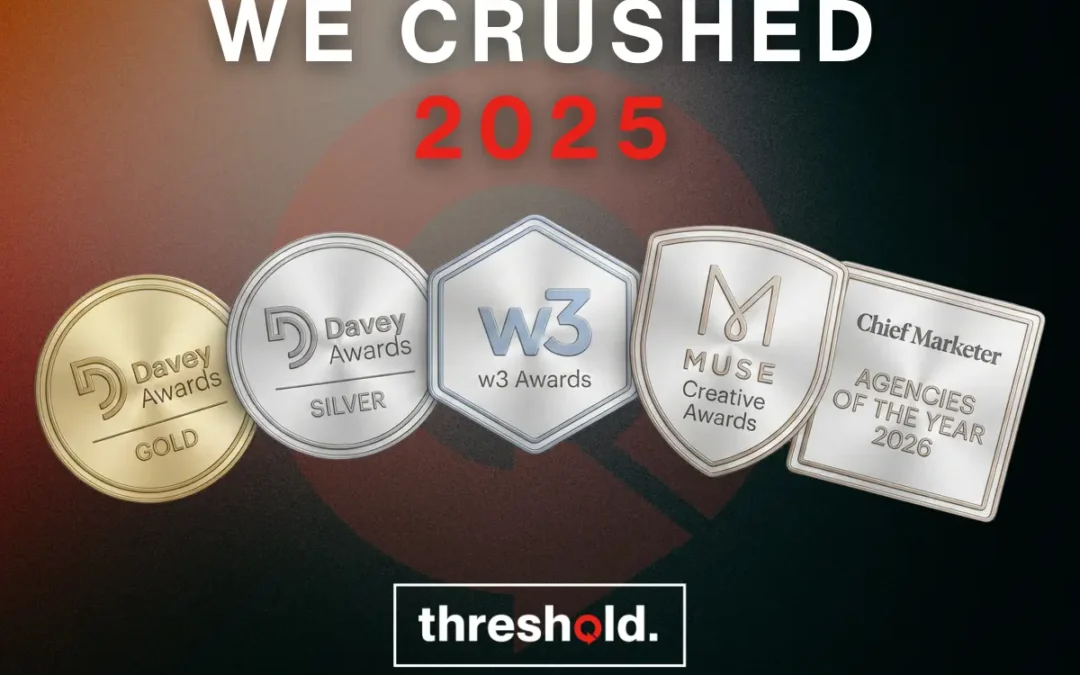
Below are a few of the projects that defined 2025 for Threshold, and the results that earned recognition from Davey Awards, w3 Awards, MUSE Awards, and a spot on Chief Marketer’s 2026 Agencies of the Year list.

Gateway 737: from zero brand to 100% leased.

Client: Holder Properties
Vertical: Student housing
Project: Full brand build, website, and leasing strategy for a 940-bed community in Columbia, SC

the challenge.

Gateway 737 started in 2024 with no name, no brand, no website, and no renewals to lean on. It would open in August 2025 in a competitive University of South Carolina market, surrounded by established communities with years of word-of-mouth.

The brief was simple and unforgiving:
“Build a brand and digital presence that lets a brand-new property compete like a market leader.”

what we did.

named and branded the community from the ground up, including logo, color system, and messaging that speaks to USC student life

launched a high-converting landing page early, then a full site focused on fast floor-plan discovery, mobile UX, and clear CTAs

turned every physical touchpoint into media, from brochures to a construction trailer that transformed into a leasing lounge

focusing on organic engagement and cultural resonance—via on-campus events, strong social media, and an authentic brand—rather than high media spending.

the results.

The leasing numbers tell the story:

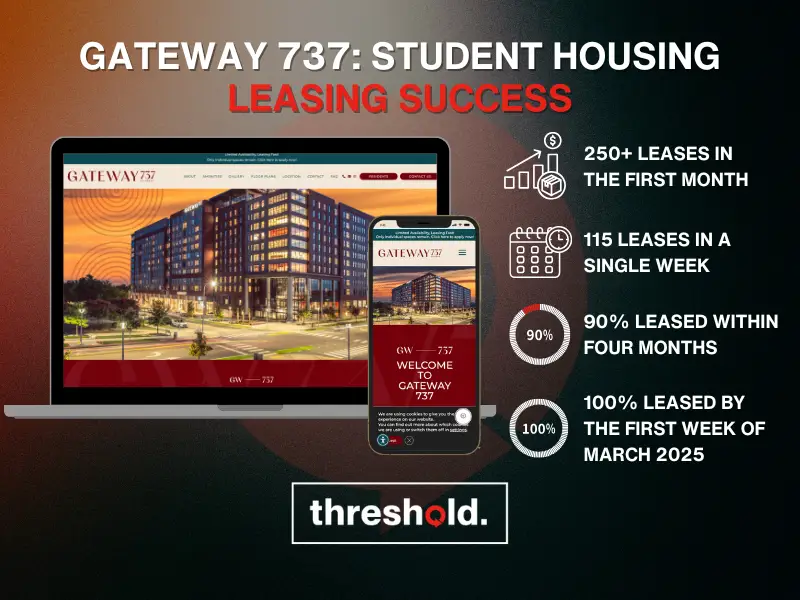
⭕ 250+ leases in the first month (27.5% leased)

⭕ 115 leases in a single week

⭕ 90% leased within four months of pre-leasing (Sept–Dec 2024)

⭕ 100% leased by the first week of March 2025, months before doors opened

For a brand-new property with zero renewals, that is a rare outcome. Gateway 737 quickly climbed near the top of its market’s pre-leasing charts.

In late 2025, that same work earned:

Davey Awards Silver for Gateway 737: Student Housing Website

⭕ w3 Silver Award in Real Estate Websites

gateway 737

Dannemora Federal Credit Union: beating growth goals in a tough market.

Client: Dannemora Federal Credit Union (DFCU)
Vertical: Financial – credit unions
Project: Full-funnel digital acquisition campaign

DFCU serves members across four upstate New York counties. Competing against national digital banks and fintechs, they needed to:

⭕ grow new checking accounts and deposits

⭕ stay compliant and on-brand

⭕ maximize value from a finite media budget

the strategy.

Threshold built a multi-stage campaign focused on Kasasa Cash Back checking, with:

⭕ upper-funnel awareness and engagement on Meta and Google Display

⭕ high-intent search campaigns to capture active account shoppers

⭕ tight geographic and behavioral targeting to avoid wasted spend

⭕ persistent retargeting to move warm prospects from “interested” to “opened account”

the results.

Within 12 months, DFCU saw:

⭕ 34% lift in new accounts (596 new accounts against a 20% growth goal)

⭕ 24% lift in deposits, adding $2.4M in new deposits

⭕ search CTR roughly 3x higher than industry benchmarks

This is what “performance marketing” means for financial institutions: measurable member and deposit growth, not just impressions.

Threshold is a go-to partner for banks and credit unions, serving more than 200 financial institutions nationwide with integrated branding, digital, and website work.

Maxwell Downtown Brooklyn: urban lifestyle, conversion built in.

Client: Maxwell Downtown Brooklyn
Vertical: Multifamily
Project: Branding-first website for a new Brooklyn community

Maxwell sits in one of the most competitive rental markets in the country. Prospects compare it to dozens of buildings within a short subway ride and make decisions quickly on mobile.

The site we launched for Maxwell focused on three things:

  1. neighborhood and lifestyle first – visuals and copy anchor the building in the energy of Downtown Brooklyn, not just unit specs
  2. clear paths to action – simple journeys from homepage to floor plans, availability, and tour booking
  3. speed and accessibility – lightweight build, mobile-first layouts, and trust-building content architecture

In 2025, that work earned a Gold Davey Award in the Real Estate Website category

We are also seeing this type of build become the new baseline for our property work: lifestyle-driven, but ruthlessly focused on getting prospects to the next step in the leasing journey.

recognition that followed the work.

None of these projects were built to chase trophies. But it matters when outside judges see the same quality and performance our clients experience day to day.

In 2025, that translated into:

Davey Awards Gold – Maxwell Downtown Brooklyn, Real Estate Website

Davey Awards Silver – Gateway 737, Student Housing Website

w3 Silver Award – Gateway 737, Real Estate Website

MUSE Creative Silver Award – Straits Row Apartments, Website – Real Estate

Chief Marketer 2026 Agencies of the Year – Threshold listed among the industry’s top marketing agencies, highlighting the quality and consistency of our work across clients

We also renewed our Great Place to Work® Certification for 2025, which we love most because good culture shows up in the work: engaged teams, smoother collaboration, and ideas that go a layer deeper for clients.

what this means for your 2026 marketing.

Looking back at 2025, a few patterns show up across all of this work:

the briefs were specific. Grow leases fast, grow deposits by a certain percentage, and hit pre-leasing targets.

the work was practical. Websites and campaigns were built to do a job: get someone from curiosity to conversion.

the measurement was intentional. From leasing velocity to cost per conversion, we built every project with a feedback loop.

If you are leading marketing for a real estate brand, a bank or credit union, or another growth-minded organization, here is the simple lens we use:

Can we tie this project to numbers you care about, then design the creative, media, and web experience around that?


If the answer is yes, we are probably a good fit.