
by threshold | Jul 9, 2021 | Digital Marketing, Marketing, Tech/Web, Thought Leadership
 Written by Alfred Perez, Digital Success Manager
In 2010, 1.8 billion people had access to high-speed internet. Six years later it was 3 billion. Now, experts are forecasting that the entire world—and its roughly 8 billion people—will have high-speed internet access as early as 2022. With all that connectivity, much of our lives take place fully online already. These realities paved the way for new approaches to work when the COVID-19 pandemic hit: many businesses have shifted their attention to working remotely and/or a hybrid approach.
According to Review 42, before the coronavirus hit, 4.7 million people were already working remotely. Once the pandemic hit, 88% of the organizations, worldwide, made it mandatory or encouraged their employees to work-from-home. One benefit to employers and employees of this approach is that the rise in the availability to work-from-home offers the employees the option of living in cheaper, outskirt cities rather than being tethered near the office to avoid commutes.
WFH, The New Normal
The longer this pandemic forces people to work remotely, the more businesses are looking to expand their remote offerings and policies for current and future employees.
- In April 2020, a Gallup survey revealed that 60% respondents said that they’d prefer to work remotely as much as possible once coronavirus is under control.
- In August 2020, a report by CNN polled about 800 employers. 83% of respondents said they would have more flexible remote work policies after the pandemic.
- In September of 2020, Reuters surveyed about 1,200 Chief Information Officers (CIOs) in which they said they expect 34.4% of their employees to be permanently remote for 2021.
How Apartment Communities Can Adapt to This Shift
To stay competitive, owners and managers should consider providing amenities and services to appeal to potential residents who work-from-home and tailor their marketing messaging with this focus.

There are 3 main focuses that owners, management, and apartment marketers can use to attract residents who work-from-home:
- Tools and resources like high-speed internet or fiber internet. 92% of residents would like to have high speed internet in their apartments. 76% were interested in having USB ports in the wall.
- Allow the potential resident to visualize living and working there. Apartment marketing constantly adapts to the current situation and right now, it’s work-from-home. Examples include virtual staging tools to stage balconies or workspaces in vacant apartments, large windows for ample light, amenity spaces where residents can plug in and get to work, and rooftops and courtyards for a fresh video call backdrop. There has also been a correlation between work-from-home residents and being a pet owner so try incorporating apartment ads and messaging on your website related to that as well.
- Don’t forget about your current residents when you’re out looking for new ones. Current residents are more likely to renew and they are the best source for referrals. People crave human interaction and work-from-home residents are no exception. Adapting the community spaces to be more work-from-home friendly and hosting community events will help retain work-from-home residents.
Remote Work Is Not Going Anywhere
The pandemic threw a screwball in just about every business, but one thing is for sure, we learned how to adapt because of the rise in technology advancements. By allowing employees to work-from-home, businesses have lower overhead costs and studies show that employees are also more productive. We’re more connected than ever and businesses can still operate remotely in full effect. When the pandemic has gone away, we know working remotely will stay. That means the adaptations you make to your apartment marketing strategy will be beneficial even after the pandemic wanes.
by threshold | Jul 6, 2021 | Creative, Design, Digital Marketing, General, Marketing, Tech/Web
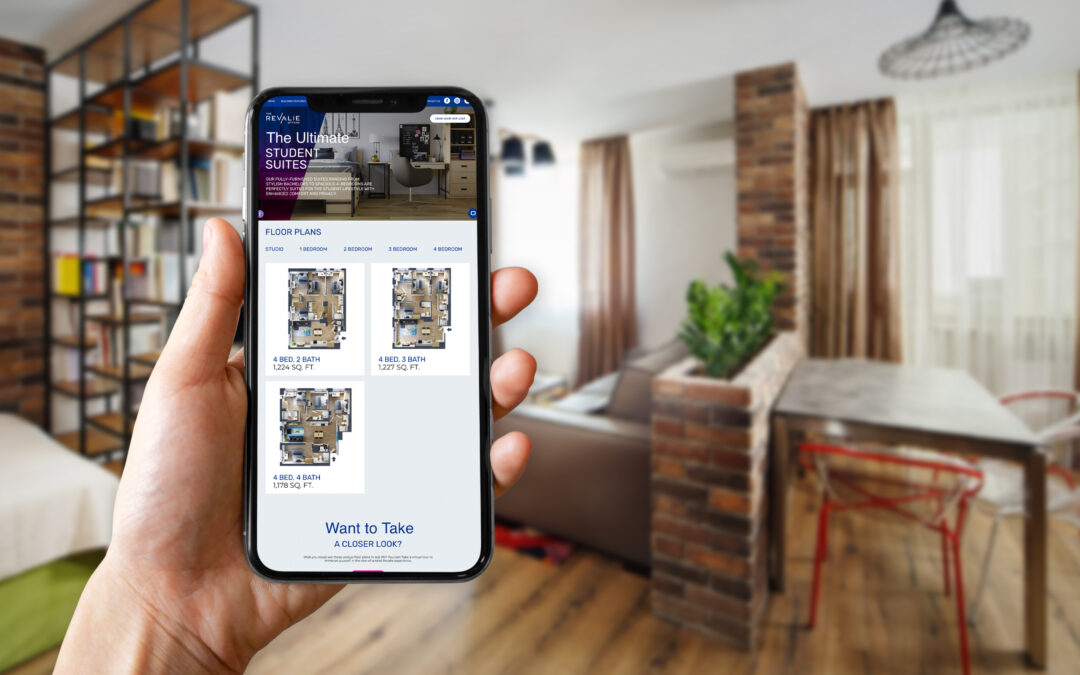
Floor plans: every apartment marketing team needs them, but how important are they really? You might be surprised at how big a role floor plan graphics have to play in your digital real estate marketing strategy. Not only can a lack of floor plan graphics result in poor UX on your website, but it can also rob you of key branding and marketing opportunities that help drive qualified leads and conversions.
Here are some of the key ways floor plan images can make or break your digital real estate marketing results.
Prospects Refine Their Apartment Search Based on Floor Plans
Keyword research shows that, no matter what your market or your target audience is, people are searching specifically for floor plans based on the number of bedrooms. It’s part of what makes ILS platforms like Zillow and ApartmentFinder so popular; users can refine their search by the number of bedrooms and bathrooms. But when they take their search to Google, they refine their search manually by typing in search terms like “3-bedroom apartments in Austin” or “studio apartments Austin.”

These search habits have a lot to teach us about user intent: from the very beginning of their apartment search, the number of bedrooms is central to their housing decision. When a prospect encounters difficulty in gathering detailed floor plan information about your property, they’re that much more likely to bounce from your website or disqualify your property as they move into the consideration phase of the digital renter’s journey.
And the more information prospects can learn from these floor plans, the more likely they are to recognize your property as a viable option and take the next step by scheduling a tour or starting an application. In other words, 3-D floor plans, floor plans with dimensions, and higher-resolution floor plan graphics help result in more qualified leads coming in through your web presence.
Floor Plan Images Can Be Used Throughout Your Digital Real Estate Marketing
Floor plans aren’t just for your brochure or your website (although you should definitely use them there!). Floor plan images also provide fodder for additional digital marketing platforms like Google My Business posts, social media posts, and ad images or video. And the higher quality these floor plans are, the more versatile they will be.
Say, for example, that one of your floor plans has a high vacancy rate while others are sold out. Having high quality floor plan images means you can easily promote that specific floor plan through your posts and stories on Instagram and Facebook. You could also run an ad campaign featuring the floor plan graphic alongside interior photos or renderings. Carousel ads and video ads work particularly well for this purpose.
Floor Plans and Site Plans Add Branding Opportunities
Floor plans aren’t just a convenient way to convey information. They’re also an opportunity to show users that you’re committed to providing a positive user experience, which also signals that they can expect a positive renter experience at your community. Plus, floor plans and site plans can be used in creative ways to highlight your brand personality. Doing so ensures that your units don’t blend in among all your competitors offering similar unit types.

Everything from brand colors and patterns to unique messaging can be added to your floor plan design. You could show off your branding through the floor plan design itself or by adding a branded border or background. You could even implement a unique hover state on each floor plan image on your website, if you have the ability to do so. Whatever tactic you choose, the more you can signal that your apartments are unique to your community, the more likely it is that your prospects will pay attention and eventually reach out to schedule a tour or start an application.
High-Quality Floor Plans Signal Modernity and Reliability
Not all floor plan graphics are created equal. A low-quality, low-detail floor plan image can be almost as bad as no floor plan at all. Your floor plan images should be accurate to scale, have good color contrast (which is particularly essential for prospects with color blindness or other vision impairments), and match the look-and-feel of your brand. If they feature easy-to-read dimensions, room labels, and amenity labels for sought-out features like in-unit washer and dryer and walk-in closets, that’s even better. Best of all, 3-D floor plans help bring your apartments to life complete with interior design elements and a clearer sense of scale for the viewer.

For the sake of argument, let’s compare the two floor plan images above. While the 3-D floor plan on the right does not include labels or dimensions, it still does a much better job of portraying the scale, features, and personality of the one-bedroom apartment it represents. A user viewing this floor plan can imagine themselves living there and feels confident that the unit comes with the amenities that are important to them, since they are clearly visible in the image. Meanwhile, floor plans like the one of the left don’t inspire much confidence in the user viewing them. Why? Not only does it lack detailed labels or dimensions, it also makes it challenging for the viewer to understand how large each room will feel, how modern the unit is, and what amenities it has. The apartment on the left could be fantastic, but it comes across as lackluster and illegible, making it less likely that a user will continue exploring this community for long enough to fall in love.
Those are just some of the key ways that floor plan graphics can make or break your digital real estate marketing results. For more information on how you can improve your digital marketing results, check out our post on How To Improve UX on Your Property Website (and increase conversions) or take a scroll through the Digital Buyer’s Journey For Real Estate.

by threshold | Jun 1, 2021 | Creative, Design, Marketing, Tech/Web, Thought Leadership
 Written by Chelsea Friel, Graphic Designer
Designing with accessibility at the forefront has never been more important, but it can be daunting to determine whether or not your website is in compliance with regulations. In 2020 alone, over 3500 digital accessibility lawsuits were filed, including federal and state ADA lawsuits, and an estimated 56 million people in the U.S. are currently living with a disability. As we look to expand our services in the real estate and housing market, it’s paramount that we keep accessibility top of mind in our work. The goal is to improve our practices to make our designs as accessible as possible for the widest audience, and to make usability as high a priority as visual appeal.
What Does Web Accessibility Look Like?
To be frank, the word “compliance” doesn’t exactly bring to mind a font of creative flights of fancy. It usually summons images of black Arial text neatly organized on a white background, which is fine for doing your taxes but less than ideal for promoting your sparkling new multifamily property. In truth, adhering to Web Content Accessibility Guidelines (WCAG, from here on out) is pretty easy to incorporate alongside our existing design practices. WCAG ratings are ranked from A to AAA, in a sort of “good, better, best” system. If A is the rank for a solidly usable website, then AAA is the gold standard of accessibility.
Similarly to how we build successful brands that thrive in the wild, the process of establishing an accessible web presence requires some collaboration between designers, copywriters, and developers. By keeping a few helpful guidelines in mind, each team’s work contributes to a fully accessible real estate website that anyone can (and will want to) use, regardless of their level of ability.
A Helpful Guide for Accessible Design
Contrast
When establishing a color palette, high contrast is critical for usability. When considering moderate to severe visual impairment, the ideal contrast ratio is between 1 to 3 and 1 to 4.5, depending on the size and the boldness of the text. The larger and thicker the characters, the lower the ratio can be while maintaining legibility to the eye, or to a screen reader. Any important copy should be designed with the highest contrast possible to ensure greater visibility for users.

Chrome extensions such as Spectrum can help you determine how user-friendly your website is by showing you alternate versions of your website based on various visual abilities.
Alternate Indicators
On the topic of visual acuity, consider using alternate methods of establishing a hierarchy of content apart from color changes. If a piece of text changes color when a user hovers, the addition of a line under the text serves as an additional cue that the copy can be clicked or is interactive in some way. Other visual indicators can be icons, boxes, or typeface changes (such as semibold to bold or black) to indicate to the user that they’re on the right track.

Charts and graphs can also present a challenge. Apart from using distinct colors to designate a data set, one solution is to incorporate texture or patterns into the design to further differentiate the information presented to the user. Trello has a plugin that can convert graphs using color blindness–friendly patterns to help aid legibility for all users, while maintaining the overall look and feel of the design.
Alt Text & ARIA Labels
Used to describe an image when it is unavailable to the user, alt text and ARIA labels should provide as much detail as possible. Describe what’s happening in the image instead of opting for the file name or a bland categorization of the subject like “man” or “house.” For folks who use screen readers to navigate websites, this attention to image descriptions provides a much clearer idea of what is in the design and what the website is trying to convey. This can be a key factor in whether or not they pursue your property further, depending on how well you describe the photo of the premises or the neighborhood using these tags and labels.

Content and Type Hierarchy
When writing copy for a website, simpler is better. Important messages should be short and to the point, while conveying all of the essential information a user needs to know right off the bat. WCAG recommends limiting a line of text to 80 characters or fewer, and to avoid writing overly complicated or lengthy sentences. Designers and copywriters should work in tandem to draft copy that looks beautiful in the design, excites the user with its content, and can be read by as many people as possible, regardless of the tools they use to view the website.
UI and Navigation
Users of varying abilities frequently use keyboard navigation to explore websites, and care should be taken to establish a logical flow of information. Good design is obvious, and a user shouldn’t have to spend time deciphering how to move through a website to find what they need. Clean focus states, clear and easy-to-remedy error states, and concise links makes a site more accessible to all, and provides a better user experience across the board.
Designing for Everyone
Accessibility should always be as high a priority as creating a beautiful design. A visually stunning website that can only be accessed by half of our users is ultimately a design failure, and our goal should be to be as inclusive as possible in our work. As we continue to go above and beyond for our clients and our audience, normalizing accessibility practices deepens our understanding of who we serve, and provides a more inclusive space where all are welcome.

by threshold | May 20, 2021 | Digital Marketing, General, Marketing, Tech/Web, Thought Leadership
 Written by David Belachew, Digital Marketing Strategist
Ever since Apple’s announcement of their all new App Tracking Transparency feature (ATT) last summer, anxiety has been rampant for digital real estate marketers in the multi-family housing industry. ATT will require app developers and partners such as Facebook and Google, to ask users permission “to track their actions across other third party apps, websites, or offline properties for targeted advertising or advertising measurement purposes.” Within the first week of the launch of ATT on April 28th, over 96% of iOS 14 users have chosen to opt out of app tracking.
Initially, digital real estate marketers were all fearful of the impact of losing valuable tracking data from these users. Without this information, digital real estate marketers will have a more difficult time assessing the performance of their digital campaigns and will likely have less data to rely on when making budget allocation decisions.
However, in response to the feedback shared by advertisers from some of Apple’s largest partners, Apple rolled out a tool called SKAdNetwork, which will allow advertisers to “measure the success of their ad campaigns while maintaining the privacy of their users.”
In conjunction with SKAdnetwork, both Facebook and Google have rolled out new features and policy updates that will also balance both the privacy concerns of users and ad attribution concerns of their digital advertising partners.
We recommend that digital real estate marketers who actively use Facebook and Google advertising platforms follow these platforms’ new guidelines to offset the negative impact of the ATT on their campaigns. With that in mind, this blog will provide you with some valuable tips on how you can improve the performance of your digital campaigns and confidently report on online behavior of iOS 14 users on your real estate website.
Use Diverse Sources Of Remarketing
As more users choose to opt out of tracking on their iOS 14 devices, both Google and Facebook expect to have a smaller pool of users from their website remarketing audiences. This means that getting the desired results from campaigns whose objective is to remarket users based on their online activity on your property’s website will become more difficult.
With that being said, we recommend that digital real estate marketers diversify their retargeting audience sources to improve the reach and performance of their remarketing campaigns. These sources may include, but are not limited to users that:
- Viewed a specific percentage of a real estate marketing video asset, including from YouTube and Facebook videos, or videos embedded on your property’s website
- Engaged or commented on an organic post from your property’s Facebook or Instagram page
- Clicked on the call to action button from your property’s Facebook or Instagram ad
By expanding your retargeting sources beyond just your website visitors, you will lessen the likelihood of losing the opportunity to promote your property to iOS14 users.

CRM Tool Integration
Even as Google and Facebook implement new attribution modeling techniques that will estimate the volume of conversion actions generated from iOS14 users, both companies have been vague about how large of a negative impact ATT will have on reported conversion attribution from campaigns on their advertising platforms.
With that being said, there are several tools from popular CRM platforms in the housing industry that have the ability to fire native events directly to leading tag management and analytics platforms such as Google Tag Manager and Google Analytics.
These leading CRMs and tools include, but are not limited to:
- Setmore – A popular scheduling tool used by property managers to schedule in-person and virtual tours with prospects
- RentCafe – A popular CRM used by property managers to help develop their property’s website, provide an applicant and resident portal for the property, and help improve resident retention
- Knock Doorway Bot – Similar to the G5 bot, this bot, developed by Knock, helps pre-qualify users by providing them pricing and floor plan availability and also encourages users to schedule virtual or in-person tours and complete a contact form submission.
Integrate Your Google Analytics and Google Ads Accounts
As mentioned above, integrating your CRM with a compatible analytics platform can go a long way to understanding user behavior on your property’s website. However, if you use Google Analytics (GA) to track and report on traffic activity on your property’s website, there are several actions you can take now to better understand the performance of your campaign across most platforms, which will allow you to make smarter optimization decisions.

From contact form submissions to completed applications, you can create Goals from your Google Analytics account to measure valuable actions taken by users on your property website. Once these goals are created, you can measure the volume of goal completions across multiple channels, such as organic, paid search, paid social, display, etc.
You can also transfer your GA goals as conversion actions into your Google Ads account. Once you complete your conversion configuration on Google Ads, these conversion actions can be reported and optimized from your paid search and display campaigns and may lead to a higher volume of qualified leads generated on your website.
Another added benefit of linking your Google Analytics account to your Google Ads account is that you can better fine-tune your website remarketing audiences. You can configure your remarketing audience by focusing on users who visited a minimum threshold of pages on your website, spent a specific amount of time on-site, and so much more. These remarketing audiences will ensure that your display campaigns will only target users who are more likely to convert on your website while filtering out users who have shown little interest in your property.

by threshold | Apr 12, 2021 | Digital Marketing, General, Marketing, Tech/Web, Thought Leadership
With Facebook preparing to implement an update to their platform related to iOS 14, many advertisers are wondering what the update means for real estate marketing. To summarize it briefly, this update will affect the treatment of 3rd party data tracking, effectively limiting its use on the Facebook platform. This change comes as no surprise for many in the advertising space, since it coincides with a general rise in user concerns around data privacy that have made 3rd party data use a hot-button topic in recent months, even among some lawmakers. Facebook is just one of multiple platforms that have responded to this trend by distancing themselves from 3rd party data tracking or removing it from their platform entirely.
So how does the iOS 14 update affect digital apartment marketing strategies on Facebook? Here are the details:
Facebook Users Will Have a Chance to Opt In to Data Tracking
Facebook has worked with iOS 14 to develop an opt-in approach to 3rd party data tracking. While the update is already part of the code of iOS 14, at the time of writing this post, the update hasn’t been pushed live yet. Facebook announced that it would push this update live sometime in Q1 2021.
Once the update does go live, Apple users will see a prompt on their phone asking if they want to allow Facebook to track their data after they have left the Facebook app. Unless a user opts in when they receive this prompt, Facebook will not gather 3rd party data about that user from other apps, nor will it share their Facebook data with other apps.

Facebook Will Limit Conversion Tracking
Facebook has also developed a tool called Aggregated Event Measurement, which limits domains to 8 conversion events that can be used for campaign optimization. This means if you want to track conversions based on an action taken outside of Facebook (e.g. filling out a contact form on your property website), you’ll only be able to take data from 8 of those outside-Facebook conversions into account when it comes to understanding audience behavior and optimizing your ads for further conversions.
This will not impact optimization strategies which optimize and report on fewer than 8 conversion events on domains outside of Facebook, but for those who prefer to optimize based on larger aggregates, this update may impact the information available for an informed optimization strategy, leading to less precise optimizations.
Even if you optimize based on conversion events within the Facebook platform (e.g. ad clicks), it is still best practice to verify your domains in case you ever need to use the Aggregated Event Measurement tool to optimize over multiple conversion events on domains outside of Facebook (like your property website).
How These Changes Will Impact Facebook Apartment Marketing
Luckily, due to previous platform changes directed specifically at housing, finance, and credit ads, many apartment marketing teams are already a step ahead of the game compared to other industries that have been enjoying more advertising flexibility. Still, Facebook ads for apartments could be impacted in certain key ways.
Depending on how your team is optimizing Facebook ads and whether your strategy relies heavily on 3rd party data tracking, these changes could have anywhere from no impact at all to significant impact on your Facebook ad performance. Here are some of the main areas that could be affected.
- Retargeting campaigns that rely on data about a user’s behavior outside of Facebook (e.g. visiting a property website) would not reach users that have chosen to opt out of 3rd party tracking. However, apartment marketers can still retarget users who have interacted with a property’s other ads or posts on Facebook, because this relies solely on 1st party data.
- Conversion tracking will be limited and conversions may go under-reported as a result. This does not necessarily mean that fewer conversions are occurring, but it does mean real estate marketers will have less information for the purposes of campaign optimization.
While these changes will impact some of the flexibility you have with digital ad campaigns, there are ways to avoid a significant dip in performance as a result of these platform changes. We recommend relying on digital advertising strategies that focus on 1st party data (actions taken on the Facebook platform) rather than on 3rd party data (a user’s behavior outside of Facebook) moving forward, especially as these platform changes are unlikely to be the last restriction on 3rd party data tracking we’ll see in upcoming months and years.