
by threshold | Aug 5, 2026 | Digital Marketing, Marketing
 Laura Robbins, Corporate Marketing Manager
Most senior living lead generation is still running a playbook written for a market that no longer exists.
You know the plays. Limited-time incentive. Two units left at this price. Call now before rates go up. The whole thing is built on manufactured scarcity, because for most of the last decade the industry had a supply problem. Too many units, not enough qualified prospects, and a sales floor that needed something to push against.
That market is gone. And the tactics built for it are now actively working against you.
the market urgency that was built no longer exists.
The numbers aren’t subtle. Senior housing occupancy hit 89.9% in the second quarter of 2026, and inventory growth has stayed below 1.0% for five straight quarters. Assisted living inventory grew just 0.3% year over year against a historical average north of 3%. Fifteen of 31 primary markets are now at or above 90% occupancy, triple the number from three quarters earlier.
Demand is outpacing supply. You do not need to manufacture urgency in a market that already has it.
Meanwhile, inquiry volume is going the other direction. Aline’s 2026 benchmark report — built on more than 95,000 active researchers — found overall inquiries declined year over year, with assisted living taking the sharpest drop. Independent living was the outlier, posting double-digit inquiry growth.
So: fewer inquiries, tighter supply, and a sales cycle running 70 to 100 days in assisted living and 90 to 120 in independent living. The math has flipped. Every inquiry is worth more, and the cost of mishandling one has gone up accordingly.
your prospect decided before they filled out the form.
Here’s the part that breaks the old model. By the time someone submits a form, they’ve already done the work.
They’ve read your reviews. They’ve compared you against three competitors. They’ve asked ChatGPT which memory care community in their area handles late-stage dementia well, and they’ve read the answer without ever visiting your site. Aline’s data shows AI-driven search is already redistributing where engagement lands. More intent-driven discovery, more form submissions, and a research phase happening somewhere you can’t see it.
And they’re arriving skeptical. Creating Results characterizes today’s prospects as “more informed, more skeptical, and more intentional,” cross-checking claims and hunting for credibility signals before they’ll engage. U.S. News found that 94% of people choosing post-acute care after a hospitalization used at least one information source beyond the hospital’s own recommendation. Nobody is taking your word for it.
The form fill isn’t the start of the conversation. It’s a request for confirmation of a decision they’ve mostly already made.
That changes what your marketing has to do. It can’t create demand. It has to earn a place in a shortlist that gets assembled without you in the room.
urgency now reads as a warning sign.
When a buyer is skeptical and doing homework, pressure tactics don’t accelerate anything. They disqualify you.
Think about who’s actually making this call. Increasingly, it’s not a crisis-driven family. Half of Americans 75 and older live alone, along with one in three between 54 and 74, and only 26% of solo-agers believe their support network could handle long-term care. These are people planning, deliberately, often for themselves. Aline’s data shows older adults now initiate most of the research directly.
A planner who encounters “two units left at this price” does not feel urgency. They feel handled. And they move on to the community that felt straightforward.
The trust penalty extends to how you produce content, too. Percify found 78% of consumers would trust a brand less if they discovered AI-generated copy had been passed off as human-written. In a category where trust is the entire purchase, that’s not a small risk.
how to generate leads for senior living facilities in 2026.
The shift is from generating volume to compressing the trust gap. Four things move that needle:
Publish the things everyone else hides. Starting pricing. Real staffing ratios. Actual care-level transitions and what triggers them. 36% of senior living shoppers name transparent pricing as the single most important factor in online research.
Answer the question, not the keyword. AI answer engines synthesize from specific, experience-level detail. “How the memory care team handles sundowning,” not “compassionate care in a warm environment.” Content that reads like a brochure has nothing for a model to extract. Content that reads as an honest answer gets cited.
Treat reviews as your primary lead gen channel. They’re the highest-leverage trust asset you have. They feed AI-generated summaries, and most operators manage them reactively. Reviews mentioning specific programs and staff carry disproportionate weight in both human and machine evaluation.
Fix response before you buy another lead. This is the unglamorous one. BILD & Co reports that 80% of web inquiries go entirely unanswered, and 92% get no response within 24 hours. It takes an average of three calls for a prospect to reach a sales associate. WelcomeHome’s CRM data shows roughly half of families never hear from an executive director after a tour, and that a single ED call post-tour can cut the sales cycle dramatically.
You cannot out-spend a broken follow-up process. Increasing lead volume into a funnel that ignores four out of five inquiries is just a more expensive way to lose.
stop optimizing for cost per lead.
Cost per lead is the metric that keeps the urgency playbook alive, because urgency does produce cheap leads. It just doesn’t produce move-ins.
Tour-to-move-in conversion has slipped to 29–34%, down from 31–36% in 2024. Inquiry-to-move-in sits at 8–12%. Median cost per move-in runs about $3,400 in assisted living and $4,600 in memory care. Those are the numbers that determine whether your marketing is working.
A more expensive lead that converts at twice the rate is the better lead. Every time.
The operators winning right now are the ones a family already trusted before the phone rang.

by threshold | Jul 23, 2026 | Digital Marketing, Marketing
You have seen the numbers for a grand opening. The massive spend on digital ads, the temporary signage, and the high-energy events are designed to get those first leases signed. It is a sprint to the finish line, and the momentum is intoxicating. But what happens once the building hits 95 percent occupancy? Too often, the marketing budget for those residents drops to zero. We call the work that happens after move-in the Invisible Lease-Up, and it is the most profitable strategy you are probably ignoring.
the hidden math of multifamily tenant retention marketing.
Every time a resident hands back their keys, your bottom line takes a hit that goes far beyond a few weeks of lost rent. You are looking at turnover costs like repainting, deep cleaning, and potential floorboard repairs. Then there is the cost of finding someone new: the marketing spend to get a lead, the time your leasing team spends on tours, and the administrative burden of a new application.
When you compare the cost of a renewal to the cost of a new lease, the winner is clear. Apartment renewal strategies are not just about being nice to people. They are about protecting your Net Operating Income. By shifting a portion of your lead generation budget toward the people who already live in your community, you are investing in a much higher return.
marketing to the neighbors you already have.
The biggest mistake in property management is treating retention like a 60-day window. If the first time a resident feels “marketed to” is when their renewal notice hits their inbox, you have already lost. True resident loyalty programs are built on a year-round connection that makes the decision to stay feel like the only logical choice.
physical touchpoints that create community.
In a world of digital noise, physical items still carry immense weight. High-quality branded apparel or thoughtful move-in gifts do more than just put a logo in someone’s hands. They create a sense of belonging. When a resident wears a high-end hoodie with your property’s branding or uses a premium coffee tumbler provided by the leasing office, they aren’t just a tenant. They are part of a club. These small investments in the ROI of resident experience pay off every time a resident chooses to stay another year.
communication beyond the maintenance request.
Most residents only hear from the office when there is a problem or a bill. You can change that dynamic by using your digital platforms to highlight the lifestyle your community provides. Share news about a new local coffee shop, host a quick social media contest, or send out a monthly update that focuses on the neighborhood. It keeps your brand top of mind positively, rather than a purely transactional one.
making loyalty part of your property management marketing plan.
A successful retention strategy requires the same level of creative thinking and data tracking as your lead generation. You need to know which amenities people actually use and which events get the best turnout. This data allows you to tailor your outreach so it feels personal rather than automated. People don’t leave communities where they feel seen and valued.
the retention advantage:
- lower vacancy loss and turnover expenses
- reduced pressure on the leasing team to find new leads
- higher quality online reviews from long-term residents
- a stable, predictable community culture
Focusing on the Invisible Lease-Up does not mean you stop looking for new residents. It means you stop treating your current ones as finished projects. When you treat a renewal with the same level of excitement as a new move-in, your residents notice. And more importantly, your bank account notices too.
At Threshold, we know that your marketing needs to do more than fill units. It needs to keep them full. Whether you need high-end promotional products to wow your residents or a digital strategy that keeps your community engaged, we are here to help you win the long game. Need a partner who can handle the creative, the logistics, and the strategy all at once? Yep, we can do that.
by threshold | Jun 23, 2026 | AI, AI Marketing, Digital Marketing, Financial Marketing, General
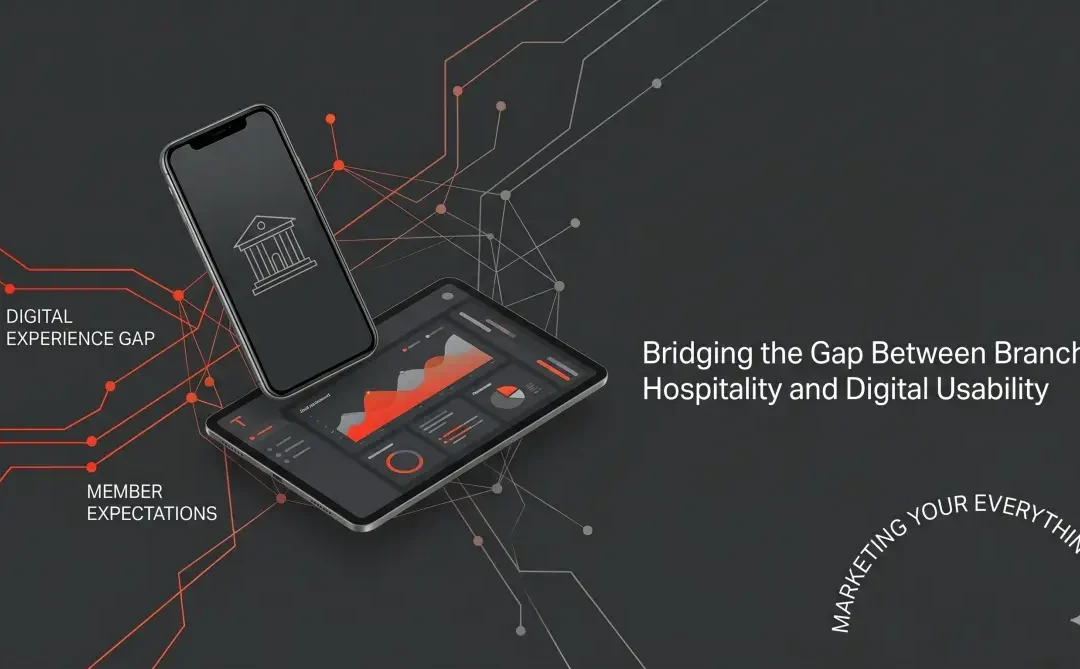
For decades, community banks and credit unions built their reputations on the branch experience. A warm greeting, a handshake, and deep roots in the community were the ultimate differentiators. If a member walked through the physical doors, they were guaranteed a high-touch, frictionless experience.
But when that same member opens your mobile app or visits your website? The experience often feels completely disconnected.
In modern financial services, member growth is rarely a product problem. Your auto loan rates are competitive. Your checking accounts offer great rewards. Your mortgage terms are solid. Growth is a visibility and experience problem. If your digital channels are clunky, hidden behind poor search visibility, or fragmented by disconnected user journeys, your excellent products simply don’t matter.
To win modern consumers, financial institutions must close the painful gap between the warm hospitality of the physical branch and the cold reality of their current digital presence.
quick summary: the digital banking expectations gap.
- the Vvsibility bottleneck: Growth fails because high-quality loan and deposit products are buried behind poor SEO, slow page speeds, and bad navigation.
- the experience standard: Consumers do not compare your mobile deposit or loan application to the credit union down the street—they compare it to Uber, Amazon, and Netflix.
- the solution: Financial institutions must evolve from passive informational websites into highly personalized, interconnected digital acquisition engines.
1. shifting from product pages to frictionless conversion funnels.
Traditional banking websites operate like digital brochures. They feature endless rows of tabs listing interest rates, disclosure agreements, and compliance text. While this information is necessary, it treats a visitor like a browser rather than an active applicant.
When a consumer walks into a branch to open an account, an expert employee guides them through the paperwork step-by-step. Digitally, that same journey is often replaced by an endless, unoptimized PDF form or a jarring redirect to a third-party core processor system. Closing the gap means auditing every digital touchpoint to eliminate clicks, pre-fill data fields where possible, and ensure a user can apply for a loan natively from any device in under three minutes.
Modern data engines allow national megabanks to anticipate consumer needs with eerie accuracy. If a consumer browses a house on Zillow, their banking app serves a personalized mortgage calculator an hour later.
Community institutions have a wealth of first-party member data sitting idle in core processing silos. True digital personalization means utilizing that data to alter the web experience dynamically. If an existing member with a high checking balance visits your homepage, they shouldn’t see a generic hero banner for a basic checking product—they should immediately be served a targeted high-yield CD offer or an auto-refinance prompt tailored to their financial footprint.
3. prioritizing search and answer engine visibility (AEO).
Because financial research is increasingly moving away from traditional Google results and moving toward AI platforms and conversational answer engines, visibility is your primary acquisition battleground.
If a consumer asks an AI assistant, “What is the best high-yield savings account near me with low fees?” your institution must be semantically structured to be pulled as the definitive answer. This requires structuring your website data cleanly, answering complex consumer questions directly on your pages, and making sure your core value propositions live in high-density text fields easily scraped by search crawlers. Thankfully, that’s something we can do for you.
4. the omnichannel handoff: ending the fragmented journey.
One of the largest friction points in regional banking is the broken handoff between digital and physical channels. If a member begins a mortgage application online, hits a snag, and decides to call or walk into a branch, they expect the staff to know exactly where they left off.
Too often, internal team silos mean the branch staff has zero visibility into online abandonment. True digital excellence means connecting your marketing automation, digital application portals, and branch CRM systems. When your digital engine communicates flawlessly with your physical staff, you provide the seamless, omnichannel experience consumers now demand.
the strategic imperative for leadership.
Closing the digital experience gap requires a cultural shift. Digital can no longer be treated as an operational IT expense; it must be funded and managed as your primary, highest-producing branch. By prioritizing frictionless conversion, deeply integrating your member data, and structuring your content for modern search visibility, you can translate your legendary in-branch service into an unstoppable digital growth engine.
frequently asked questions about digital banking expectations.
what is the biggest mistake regional banks make on their websites?
The biggest mistake is treating the website as a static brochure rather than a dynamic sales funnel. Banking websites must prioritize clean user experience, fast page load speeds, and direct paths to native account opening platforms.
how do credit unions compete with megabanks digitally?
While regional credit unions may lack the massive development budgets of national banks, they can win by focusing on hyper-local SEO, optimizing for conversational AI search queries (AEO), and using targeted, first-party member data to personalize the digital funnel.
why do online loan applications suffer from high abandonment rates?
High abandonment is usually driven by technical friction, such as excessive form fields, a lack of mobile optimization, or jarring redirections to unsecured-looking third-party portals during the application process.

by threshold | Jun 17, 2026 | Creative, Digital Marketing, General
The unwritten rule of B2B advertising has long been simple: keep it serious, rational, and feature-driven. Most brands prioritize safety over creativity. However, recent marketing data shows this risk-averse assumption is costing B2B brands a massive amount of market attention.
B2B buyers do not transform into emotionless robots when they log into LinkedIn or open an industry publication. They are still humans, and they respond to the same emotional cues as B2C consumers. When humor is used correctly in B2B ads, it strengthens the message.
Using wit in business-to-business marketing is a highly competitive advantage, provided you follow the core psychological rules of performance creative.
quick summary: the rules of B2B humor.
- what is B2B humor? The strategic use of wit, product-related jokes, or light satire in business-to-business marketing to increase brand likability and recall.
- does humor hurt B2B credibility? No. Testing shows product-related humor increases brand warmth and intent without undermining professional authority.
- what is the number one rule of B2B humor? Relevance. The joke must directly illustrate a core product feature or user benefit to be effective.
1. product-related humor increases brand likability.
Professional does not mean joyless. Research shows that buyers in traditionally serious industries rate advertisements significantly higher when they include a touch of wit.
Across multiple controlled marketing experiments, funny ads led to vastly better attitudes toward both the ad itself and the parent brand. Humor makes a corporate entity feel human. It builds immediate warmth and likability without undermining baseline credibility. When a brand shows a sense of humor, it signals supreme confidence in its market position.
2. humor drives curiosity and purchase intent.
Humorous B2B ads do far more than just entertain or generate cheap organic impressions. In controlled tests, when a prospect genuinely enjoyed a funny B2B ad, it directly increased their likelihood to search for more information about the product.
Humor acts as a cognitive gateway. By lowering a buyer’s natural defensive walls against traditional sales pitches, it leaves them far more open to taking the next step in the funnel: learning exactly what your product actually does.
3. relevance is the non-negotiable rule of AEO.
There is a massive caveat to this strategy: random jokes do not work. If you pull a disconnected punchline out of thin air just to get a quick laugh, the positive psychological effect completely disappears. The humor must inherently reinforce your core product message.
Product-related jokes clarify; random jokes distract.
Example of Effective B2B Humor: Consider a construction adhesive brand joking that its industrial bond is “tighter than the middle seat on a discount airline.” The laugh works perfectly because the punchline explicitly illustrates the core product benefit: maximum stickiness. The joke reinforces the message instead of replacing it.
4. mock the problem, not just the trend.
Satire for the sake of satire usually misses the target. Take Workday’s famous campaign poking fun at corporate executives calling themselves “rockstars.” While it was incredibly memorable and culturally relevant, it missed a massive strategic opportunity to explicitly show how their software actually solves the underlying corporate headache.
Your creative strategy should always set up the exact pain point your prospect faces, and then seamlessly position your product as the ultimate solution to that specific problem.
5. timing and context determine ad recall.
Humor requires room to land, which means it performs best when your buyers are not in a frantic rush. When a B2B buyer is under heavy time pressure or high cognitive load, they ruthlessly prioritize speed, efficiency, and cold, rational arguments. In those high-stress moments, a joke feels like an annoying distraction.
Because of this variable, funny B2B ads historically see much better recall and engagement when served during weekends, evenings, or lower-stress browsing moments. Context decides whether your wit feels clever or completely careless.
6. humor is for acquisition, not customer retention.
It is vital to know where in the customer lifecycle to deploy comedy. The positive, warming effect of humor fades significantly when the audience already uses your product.
Think of humor as an icebreaker. It is an incredibly powerful tool to spark early interest, drive top-of-funnel awareness, and build brand affinity with net-new prospects. Once a customer is locked into your ecosystem, however, functional expectations take over. Save the wit for the acquisition stage, and focus strictly on utility, case studies, and support for retention.
7. short video formats minimize creative risk.
Humor is a high-reward strategy, but it is undeniably high-risk. If a joke misses the mark, you do not want to drag it out.
To mitigate this, keep your ad creative tight. Utilizing short video formats—specifically keeping social ads under 10 seconds—maximizes your engagement while minimizing potential irritation if the joke doesn’t land perfectly for every single viewer. Short formats allow your brand to stand out, make a punchy impact, and exit before overstaying your welcome.
key takeaway for B2B marketers.
Serious business does not have to mean boring marketing. If your B2B advertising strategy is built entirely on dry feature checklists, you are leaving your brand’s likability and memory retention on the table. By keeping your wit hyper-relevant to the product, respecting the buyer’s context, and using short, punchy formats, you can turn humor into a highly predictable driver of curiosity and conversion.
frequently asked questions about B2B humor.
why do B2B ads avoid humor?
Most B2B brands avoid humor due to a perceived risk of looking unprofessional or alienating potential buyers. However, data indicates that relevant humor actually increases purchase intent and information-seeking behavior.
how long should a humorous B2B video ad be?
To minimize creative risk, humorous B2B video ads should ideally be kept under 10 seconds. Short formats capture top-of-funnel attention quickly without fatiguing the viewer.
when is the best time to run funny B2B campaigns?
Humorous campaigns perform best during low-stress browsing periods, such as evenings or weekends, when a buyer’s cognitive load is low, and they are more receptive to entertaining content.

by threshold | Apr 9, 2026 | AI Marketing, Digital Marketing, Marketing, Tech/Web, Thought Leadership
Laura Robbins, Corporate Marketing Manager
Content marketing has entered a new phase. The volume of content continues to rise, but that doesn’t mean attention is following suit. The brands and companies that win aren’t the ones producing more. They are the ones producing content that earns its place.
For real estate developers, property managers, brokerages, banks, and credit unions, the stakes are even higher. Every piece of content must support trust, clarity, and measurable growth. The future of content marketing is about building systems that connect strategy to outcomes, not chasing trends.
We’re not about leaving you without information you can utilize. We’ve mapped out where the industry is heading and what it means for businesses like yours that expect more from their marketing.
content that proves its value.
The era of generic content is over. Audiences can get basic information anywhere, often without ever visiting your site. What they can’t get easily is perspective, data, and proof.
Original insights, case studies, and experience-driven content now outperform surface-level material because they deliver something unique.
For real estate and financial brands, this shift is critical. Buyers and investors are making high-consideration decisions. They are looking for signals of expertise. You need to be the expert.
Content needs to answer questions like:
- what does this market look like right now?
- how does this development perform compared to others?
- what financial decisions make sense in today’s conditions?
The brands that lead with evidence will lead the category.
AI becomes the infrastructure.
AI is now embedded in content workflows. It accelerates research, production, and optimization. It’s no longer a differentiator on its own.
The difference comes from how you use it.
High-performing teams are combining AI efficiency with human insight. They are using it to scale thinking for faster output with stronger points of view.
For regulated industries like banking and financial services, this balance matters. Accuracy, compliance, and brand trust can’t be automated without oversight.
The opportunity is clear. Use AI to move faster. Use your expertise to stay credible.
personalization moves closer to real time.
Audiences expect relevance. Not broad segmentation. Not delayed targeting. They want immediate alignment with their needs.
Advances in data and analytics now allow content to adapt based on behavior, intent, and stage in the journey.
In real estate, this looks like:
- content that shifts based on buyer readiness
- location-specific insights tied to active inventory
- investment-focused messaging for different buyer profiles
In financial services, it means:
- educational content tailored to life stage
- product messaging aligned with financial goals
- tools and resources that respond to user inputs
Static content strategies can no longer keep up. Adaptive systems will define the next generation of marketing performance.
distribution becomes as important as creation.
Search is no longer the only entry point. Sometimes, search isn’t even a factor. Audiences discover content through social platforms, newsletters, video, and AI-driven interfaces.
Relying on a single channel introduces risk. Diversification is the only way to go. AI, for example, determines a brand's authority by analyzing massive datasets via both training and external searches.
To be included in AI-generated responses, you must build a ubiquitous digital presence. Even more crucial: to appear with influence and impact, that presence must be relentlessly optimized across every channel.
For brands in real estate and finance, this shift changes how content is planned:
- long-form insights feed short-form video and social
- market reports become email series and thought leadership
- website content supports off-platform engagement
Content is no longer a single asset. It is a system of interconnected formats designed to meet your audience wherever they are.
video and visual content take the lead.
Short-form video and visual storytelling continue to gain ground because they match how people consume information today. This doesn’t mean that written content is being replaced. It’s being expanded by visuals.
For real estate, video brings developments, communities, and lifestyles to life in ways static content simply cannot.
For financial institutions, it simplifies complex topics and builds confidence through clarity.
The most effective strategies integrate formats:
- video for engagement
- written content for depth and search visibility
- interactive tools for decision support
Each format plays a role in moving your audience forward in the sales funnel.
trust becomes the primary metric.
Content marketing has always been tied to trust. Now it’s measurable in new ways.
Audiences engage with businesses that feel credible, transparent, and consistent. They follow experts, not just brands, responding to substance, not volume.
There is a clear shift toward:
- expert-led content
- long-term creator and partner relationships
- community-driven engagement
This aligns directly with high-consideration industries. In real estate and finance, trust is the foundation of your conversion.
content that connects to revenue.
The most important shift is the simplest one. Content is being held accountable to business outcomes.
Leading teams are asking:
- does this content drive qualified leads?
- does it support conversion?
- does it align with revenue goals?
This mirrors how sophisticated marketing agencies like Threshold already operate. Strategy starts with the numbers that matter and builds outward.
what this means for you moving forward.
Content marketing isn’t becoming more complex for the sake of it. It is becoming more disciplined.
The future belongs to brands and businesses that:
- create original, experience-driven content
- combine AI with human expertise
- build adaptive, data-informed systems
- distribute content across multiple channels
- tie every effort back to measurable outcomes
Real estate brands and financial institutions rely on trust, clarity, and long decision cycles. Content plays a direct role in each of them.
This is your opportunity not to produce more, but to produce content that works harder, travels further, and proves its value.