by threshold | Oct 1, 2026 | Digital Marketing, General, Thought Leadership
 Laura Robbins, Corporate Marketing Manager
key takeaways.
- The gap between click and lease is the stretch of the leasing funnel no one owns: what happens after a prospect clicks an ad and before they sign a lease.
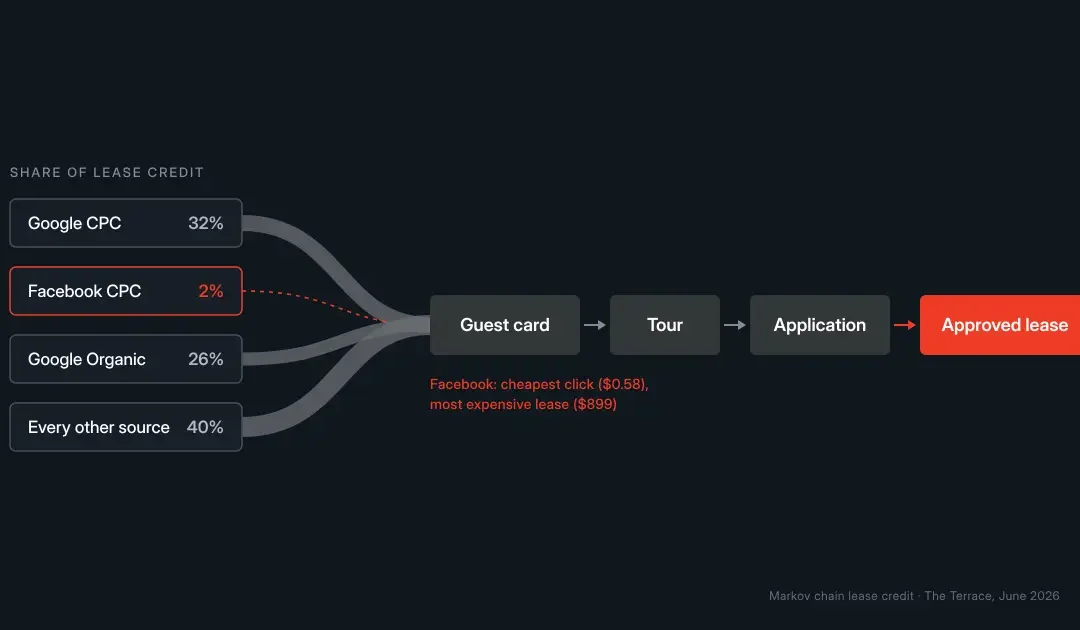
- At The Terrace, an apartment community Threshold tracked in June 2026, Facebook had the cheapest clicks ($0.58) but the most expensive leases ($899 per approved lease). Google search cost $3.75 per click and $500 per lease.
- Most marketing reports stop at the lead, so budget decisions get made on cost per click instead of cost per lease.
- Closing the gap usually means reallocating the budget you already have, not spending more.
Marketing rarely fails loudly. It leaks, and most reports can’t see where.
At The Terrace, Facebook delivered the cheapest clicks on the board: $0.58 each, about 6.5× cheaper than Google search. When Threshold followed those clicks all the way to signed leases, Facebook turned out to be the most expensive channel the property paid for: $899 per approved lease, compared with $500 for Google.
A report that stopped at clicks would have called Facebook the best deal going.
what is the gap between click and lease?
The gap between click and lease is everything that happens between a prospect clicking an ad and signing a lease: the landing page, the guest card, the tour, the application, and the approval. It’s where most leasing budgets leak, because no single team owns it and no standard report measures it.
Property marketing is usually split across three teams:
- Digital teams own reach, targeting, and cost per click
- Website teams own design, floor plans, photos, and content
- Leasing teams own the tour, the application, and the lease
Each one can be “working.” Together, they often aren’t. Ad platforms know who clicked. The property management system knows who signed. Nothing connects the two.
why do good property websites still underperform?
Property websites underperform when they aren’t built for the campaigns driving traffic. A site can have professional photography, virtual tours, and fast load times and still lose prospects because the page doesn’t match what earned the click.
Common examples in multifamily, student housing and senior living:
- An ad for a move-in special lands on a homepage where the special is nowhere in sight
- A search for a pet-friendly two-bedroom lands on a generic floor plans page
- A student housing pre-leasing campaign lands on a page that doesn’t show which floor plans are still available
- In senior living, the adult child doing the research lands on content written only for the resident
- Scheduling a tour takes several clicks, a form, and a callback
Nothing feels wrong, but nothing pulls the prospect forward either. A prospect with three other properties open in other tabs doesn’t wait to be pulled.
why is the click the most expensive moment in leasing?
The click is the moment when a prospect’s intent is clearest, their expectations are highest, and their attention is shortest. If the landing page doesn’t immediately confirm they’re in the right place and make the next step obvious, momentum is lost, and the prospect returns to a listing site.
The next step should be unmistakable: check availability, schedule a tour, or submit a guest card. No amount of bid optimization upstream can win back a prospect who left at this point.
why can’t most marketing reports see the gap?
Most marketing reports stop at the lead. They show clicks, cost per click, and sometimes guest cards, but not which guest cards became tours, applications, or signed leases, because that data lives in the property management system. As a result, budget goes to the channels with the cheapest clicks, not the cheapest leases.
When Threshold connected website analytics, ad platform data, and Entrata (The Terrace’s property management system) for June 2026, the full funnel looked like this:
- 7,001 website visits
- 161 guest cards (2.9% of website users)
- 35 approved leases (about 1 in 5 guest cards)
- $179 in blended ad spend per approved lease
Channel by channel, the picture changed:
- Organic search earned 25.8% of lease credit on $0 in ad spend.
- Listing sites earned 11.5% of lease credit (Apartment Guide 6.0%, CoStar 5.5%), a figure you can now weigh against their commissions.
- ChatGPT already appeared as a lead source, earning 1.5% of lead credit, tied with Bing.
None of that is visible in a report that ends at the click.
what is click-to-lease attribution?
Click-to-lease attribution tracks every prospect from their first website visit through guest card, tour, application, and approved lease, then credits each marketing channel for its role in producing signed leases. It connects ad platforms, website analytics, and the property management system into one report, so cost per lease can be calculated channel by channel.
Threshold’s model uses Markov chain attribution, which works in three steps:
- Map every path: chart each route prospects took from first click to signed lease.
- Remove a channel: take one channel out of the map and recalculate the odds of conversion.
- Measure the drop: the leases that disappear are that channel’s credit.
Unlike last-click attribution, this credits every touchpoint for what it contributed, not just the final one.
why doesn’t more optimization fix the problem?
Optimizing one channel can’t fix a broken handoff between channels. When digital, website, and leasing data aren’t connected, teams tune the part they own while the gap between them stays open.
That shows up as:
- Channels that look cheap getting more budget, even when they don’t sign leases
- Landing page fixes waiting in a queue behind other priorities
- Learning loops stretching from days to months
Performance plateaus. The team is capable, but no one can see the whole system.
how do you close the gap between click and lease?
You close the gap by running digital, website, and leasing as one system, measured against signed leases instead of clicks. In practice:
- Campaign intent shapes the landing experience, so the special in the ad is the first thing on the page
- The next step is obvious: check availability, schedule a tour, apply
- Every channel is measured to the signed lease, not the click
- Budget follows leases, not traffic
- Insights arrive in days, not quarters
Most importantly, someone owns the outcome (occupancy), not just a channel.
does closing the gap require more ad spend?
No. Closing the gap usually means reallocating existing budget, not increasing it. At The Terrace, the biggest opportunity was moving dollars from the channel with the cheapest clicks (Facebook) to the channel with the cheapest leases (Google search), and protecting the organic search that was signing leases for free.
Same budget, pointed at what actually fills units.
the takeaway.
If your campaigns are driving traffic but not move-ins, the problem may not be targeting, creative, or budget. It may be that no one owns the gap between click and lease, or can even see it.
Close that gap, and occupancy tends to follow.
frequently asked questions.
What’s the difference between cost per click and cost per lease?
Cost per click is ad spend divided by clicks. Cost per lease is ad spend divided by the approved leases a channel is credited with. The two can point in opposite directions: at The Terrace, Facebook was 6.5× cheaper per click than Google but 1.8× more expensive per lease.
Why would the cheapest click produce the most expensive lease?
Low-cost clicks often come from prospects with lower intent. They browse but rarely submit a guest card, tour or apply. A channel can drive lots of cheap traffic and still contribute very few signed leases.
What data does click-to-lease attribution use?
It uses data most properties already have: website analytics for sessions and sources, ad platforms for spend and clicks, and the property management system (such as Entrata) for guest cards, applications, and approved leases.
Are listing sites (ILSs) worth their commissions?
It depends on how many leases they produce. Click-to-lease attribution shows each listing site’s share of lease credit, which you can compare directly against the commission it charges. At The Terrace, listing sites earned 11.5% of lease credit in June 2026.
Is ChatGPT sending prospects to apartment websites?
Yes. At The Terrace, ChatGPT earned 1.5% of lead credit in June 2026, the same share as Bing. Attribution reporting makes it possible to spot new channels like this the month they appear.
Does this apply to student housing and senior living?
Yes. The funnel stages and names differ (pre-leasing in student housing, move-ins and family decision-makers in senior living), but the gap is the same: what happens between the click and the signed lease is rarely owned or measured.
by threshold | Aug 27, 2026 | Digital Marketing, Financial Marketing, General
Privacy changes have changed the retargeting playbook. For multifamily teams and community banks, the right answer is not chasing third-party cookies. It’s building a first-party data strategy that ties digital touchpoints to physical promo fulfillment and CRM activation. Here is a crisp, practical guide you can implement this month.
why cookieless retargeting matters now.
Browsers and platforms have made third-party cookies unreliable. Apple privacy updates and tighter browser limits mean traditional retargeting campaigns will lose reach and accuracy. That hits high-intent channels for leasing and banking hardest. If you want predictable conversions, you need data you own and a way to turn it into action without relying on external trackers.
the threshold playbook: a 6-step roadmap for cookieless retargeting.
This playbook pairs first-party data capture with fulfillment-triggered touchpoints. It is built for speed, compliance, and measurable lift. Use it for multifamily retargeting strategies or community bank digital marketing.
1. capture first-party signals at every touchpoint.
Start by collecting reliable identifiers. That includes email, phone, device data from your site, leasing portal activity, form submissions, and on-branch signups. For banks, add account opening forms and in-branch events. For apartments, add floor plan downloads, tour bookings, and waitlist signups. Make sure every form asks permission for contact and stores consent flags in your CRM.
2. build a privacy-first data layer and CRM schema.
Design a unified record per lead. Link web behavior, offline interactions, promo fulfillment history, and consent status. Use hashed identifiers for matching so you can activate audiences without exposing raw PII. For community bank digital marketing, document retention policies and encryption standards so your team can answer audits quickly.
3. segment and score for intent.
Turn first-party signals into audience segments. Examples:
- Multifamily high intent: scheduled a tour in the last 14 days and viewed 3 or more floor plans.
- Bank high intent: started account form and visited rate page more than twice.
Score leads by recency and depth of activity. These segments feed your retargeting channels and your fulfillment triggers.
4. activate without third-party cookies.
Use server-side activation and CRM-to-platform connections. Send hashed emails and phone numbers to platforms that accept first-party lists for matching. Run contextual and cohort-based ads for broader reach while using your matched lists for high-intent follow-up. Keep ad creative tight and message consistent with the fulfillment touchpoint you plan to send.
5. use promo fulfillment as a retargeting trigger.
This is where Threshold stands out. Branded welcome kits, on-site swag, and mailed offers do double duty. They act as offline confirmations of interest and as signals to your CRM to move leads into higher-touch sequences. Practical examples:
- Multifamily: When a prospect schedules a tour, immediately send a small welcome kit. Once the kit ships, update the CRM to fire SMS reminders and an email with a virtual tour link.
- Community bank: A new account applicant receives a branded debit card sleeve and welcome packet. When fulfillment completes, trigger a personalized financial education drip and a cross-sell ad cohort.
Promo fulfillment improves conversion and provides a clean event you can use for privacy-compliant remarketing without cookies.
6. measure, attribute, and iterate.
Define simple KPIs. For multifamily: tour-to-lease rate, cost per lease, and time-to-lease. For banks: account funding rate, new deposit volume, and cost per funded account. Use CRM event timestamps to attribute conversions to fulfillment triggers and first-party ad activations. Run A/B tests where you split segments between a promo fulfillment path and a control path to quantify uplift.
practical play examples.
short campaign for a lease-up.
Capture emails on new community landing pages with an incentivized floor plan download. Schedule tours and immediately send a branded tote or keychain. When the tote ships, push that audience to your matched list and a contextual ad buy. Send a lease incentive email 3 days after fulfillment. Measure signed leases within 30 days.
community bank onboarding funnel.
When an online applicant submits an ID, mark consent and stage in the CRM. Ship a welcome packet with printing of account number and a small branded notebook. On shipment, trigger a personalized video email explaining next steps and a matched-audience ad that highlights local branch services. Track funded accounts within 15 days.
compliance and security notes.
Keep consent records with timestamps. Hash PII before sending to ad platforms. Limit access to raw customer data and document your retention schedule. For community banks, align with your compliance officer and keep a clear audit trail for any third-party vendors handling fulfillment or data matching.
quick implementation checklist.
- audit current first-party signals and consent flows
- create a single CRM record for each lead and a hashing process for PII
- map segments and scoring rules tied to fulfillment triggers
- set up server-side activations and matched list uploads
- select promo SKUs that match the audience and budget
- instrument measurement events and a simple A/B test
Cookieless retargeting is not theory. It is practical work you can start this week. Threshold combines bank-grade data processes, rapid creative execution, and promo fulfillment to make these campaigns real fast. Want to run a pilot for a lease-up or new account drive next month? Yep, we can do that.
by threshold | Aug 18, 2026 | Digital Marketing
Every student housing operator knows the feeling. It is early July, the fall semester is weeks away, and the preleasing number is not where it should be. The spring rush is over, the students who planned have already signed, and the leasing calendar says the busy season is behind you.
Most properties respond by bracing for a soft opening. A few decide July is worth fighting for, and those are the ones that surprise everybody.
why july feels like a dead end.
Student housing runs on an annual cycle that front-loads almost everything. Renewals and early signings dominate the fall and winter, the spring brings the last big wave of decision-making, and by summer most operators have accepted whatever number they are holding.
That assumption is where properties lose ground. There are still students looking in July. Plans fall through, roommate groups break up, transfers arrive, and students who spent the spring undecided finally start searching. The pool is smaller, but it is real, and it is competitive precisely because so few properties are still actively bidding for it.
the instinct that makes it worse.
When leasing slows, budgets tighten. Marketing spend gets pulled back to protect the bottom line, campaigns go quiet, and the property stops appearing in exactly the searches those late shoppers are running.
The property has now made its own forecast come true. Nobody sees the community, so nobody tours it, so the leases do not materialize, which confirms that July was a lost cause.
what actually moves the number.
Late-season leasing rewards precision. A student searching for housing three weeks before move-in has high intent and a short decision window. Reaching that person takes a few things working together:
- Search capture at the moment of intent. Someone typing “student apartments near campus” is ready to act. Paid search puts the community in front of them immediately, without waiting on organic rankings to catch up.
- Social prospecting to create demand. Search finds people already looking. Meta campaigns reach students and parents who have not started yet, which matters when the searching pool is thin.
- Geofencing around the places that matter. Campus, competitor properties, and the corridors students actually travel.
- Daily visibility into what is working. A monthly report cannot help a property in July. Knowing which source produced which lead, while there is still time to act on it, is what separates a recovered season from a missed one.
That last point is the one operators underestimate. Lead volume alone does not fill a building. Knowing which leads convert, which communities need attention, and where the next dollar should go is what turns activity into signed agreements. We have watched this play out on a property that started from zero, and the client credited the analytics layer the most.
a property that proved it.
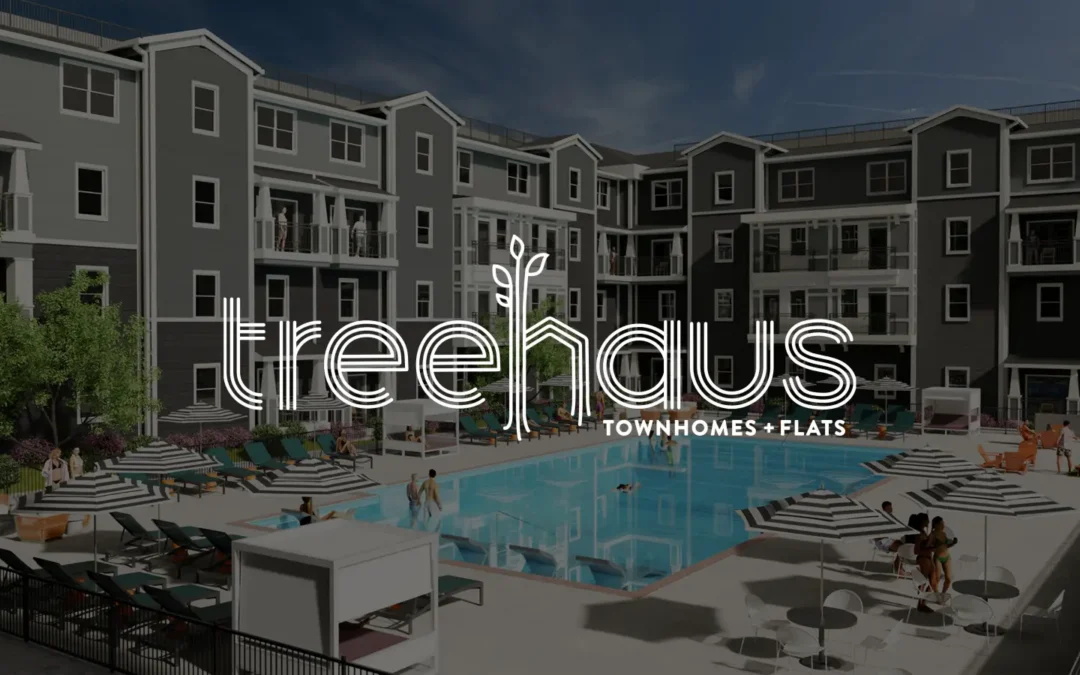
Treehaus Townhomes & Flats, a new community serving Clemson University, came to Threshold as an underperforming property in one of the most competitive student housing markets in the Southeast. It had no digital marketing program running and a full building to fill before its fall 2026 opening.
Threshold launched a full-funnel program across Google, Meta, and geofencing, paired with leasing analytics the on-site team could act on daily. By mid-July 2026, the property had reached 74.39% pre-leased for the 2026–2027 academic year, and it posted its strongest leasing month of the season during the period when leasing usually goes quiet.
“It’s been a battle in an extremely competitive market, but we are 1000% convinced Threshold’s analytics have given us a competitive advantage in the market.” – Roger Phillips, Texla Housing Partners, Inc.
Read the full Treehaus case study for the complete breakdown, including the lease totals, the daily numbers behind the turnaround, and how the strategy came together.
the takeaway.
A slow season is not a verdict. It is usually a signal that the property is invisible to the people still shopping. The properties that recover are the ones that keep showing up in the searches happening right now, and that can see clearly enough to move budget toward whatever is working this week.
If your property is behind and the calendar is working against you, let’s talk about what a real leasing analytics engine can do for your community.

by threshold | Aug 5, 2026 | Digital Marketing, Marketing
Laura Robbins, Corporate Marketing Manager
Most senior living lead generation is still running a playbook written for a market that no longer exists.
You know the plays. Limited-time incentive. Two units left at this price. Call now before rates go up. The whole thing is built on manufactured scarcity, because for most of the last decade the industry had a supply problem. Too many units, not enough qualified prospects, and a sales floor that needed something to push against.
That market is gone. And the tactics built for it are now actively working against you.
the market urgency that was built no longer exists.
The numbers aren’t subtle. Senior housing occupancy hit 89.9% in the second quarter of 2026, and inventory growth has stayed below 1.0% for five straight quarters. Assisted living inventory grew just 0.3% year over year against a historical average north of 3%. Fifteen of 31 primary markets are now at or above 90% occupancy, triple the number from three quarters earlier.
Demand is outpacing supply. You do not need to manufacture urgency in a market that already has it.
Meanwhile, inquiry volume is going the other direction. Aline’s 2026 benchmark report — built on more than 95,000 active researchers — found overall inquiries declined year over year, with assisted living taking the sharpest drop. Independent living was the outlier, posting double-digit inquiry growth.
So: fewer inquiries, tighter supply, and a sales cycle running 70 to 100 days in assisted living and 90 to 120 in independent living. The math has flipped. Every inquiry is worth more, and the cost of mishandling one has gone up accordingly.
your prospect decided before they filled out the form.
Here’s the part that breaks the old model. By the time someone submits a form, they’ve already done the work.
They’ve read your reviews. They’ve compared you against three competitors. They’ve asked ChatGPT which memory care community in their area handles late-stage dementia well, and they’ve read the answer without ever visiting your site. Aline’s data shows AI-driven search is already redistributing where engagement lands. More intent-driven discovery, more form submissions, and a research phase happening somewhere you can’t see it.
And they’re arriving skeptical. Creating Results characterizes today’s prospects as “more informed, more skeptical, and more intentional,” cross-checking claims and hunting for credibility signals before they’ll engage. U.S. News found that 94% of people choosing post-acute care after a hospitalization used at least one information source beyond the hospital’s own recommendation. Nobody is taking your word for it.
The form fill isn’t the start of the conversation. It’s a request for confirmation of a decision they’ve mostly already made.
That changes what your marketing has to do. It can’t create demand. It has to earn a place in a shortlist that gets assembled without you in the room.
urgency now reads as a warning sign.
When a buyer is skeptical and doing homework, pressure tactics don’t accelerate anything. They disqualify you.
Think about who’s actually making this call. Increasingly, it’s not a crisis-driven family. Half of Americans 75 and older live alone, along with one in three between 54 and 74, and only 26% of solo-agers believe their support network could handle long-term care. These are people planning, deliberately, often for themselves. Aline’s data shows older adults now initiate most of the research directly.
A planner who encounters “two units left at this price” does not feel urgency. They feel handled. And they move on to the community that felt straightforward.
The trust penalty extends to how you produce content, too. Percify found 78% of consumers would trust a brand less if they discovered AI-generated copy had been passed off as human-written. In a category where trust is the entire purchase, that’s not a small risk.
how to generate leads for senior living facilities in 2026.
The shift is from generating volume to compressing the trust gap. Four things move that needle:
Publish the things everyone else hides. Starting pricing. Real staffing ratios. Actual care-level transitions and what triggers them. 36% of senior living shoppers name transparent pricing as the single most important factor in online research.
Answer the question, not the keyword. AI answer engines synthesize from specific, experience-level detail. “How the memory care team handles sundowning,” not “compassionate care in a warm environment.” Content that reads like a brochure has nothing for a model to extract. Content that reads as an honest answer gets cited.
Treat reviews as your primary lead gen channel. They’re the highest-leverage trust asset you have. They feed AI-generated summaries, and most operators manage them reactively. Reviews mentioning specific programs and staff carry disproportionate weight in both human and machine evaluation.
Fix response before you buy another lead. This is the unglamorous one. BILD & Co reports that 80% of web inquiries go entirely unanswered, and 92% get no response within 24 hours. It takes an average of three calls for a prospect to reach a sales associate. WelcomeHome’s CRM data shows roughly half of families never hear from an executive director after a tour, and that a single ED call post-tour can cut the sales cycle dramatically.
You cannot out-spend a broken follow-up process. Increasing lead volume into a funnel that ignores four out of five inquiries is just a more expensive way to lose.
stop optimizing for cost per lead.
Cost per lead is the metric that keeps the urgency playbook alive, because urgency does produce cheap leads. It just doesn’t produce move-ins.
Tour-to-move-in conversion has slipped to 29–34%, down from 31–36% in 2024. Inquiry-to-move-in sits at 8–12%. Median cost per move-in runs about $3,400 in assisted living and $4,600 in memory care. Those are the numbers that determine whether your marketing is working.
A more expensive lead that converts at twice the rate is the better lead. Every time.
The operators winning right now are the ones a family already trusted before the phone rang.

by threshold | Jul 23, 2026 | Digital Marketing, Marketing
You have seen the numbers for a grand opening. The massive spend on digital ads, the temporary signage, and the high-energy events are designed to get those first leases signed. It is a sprint to the finish line, and the momentum is intoxicating. But what happens once the building hits 95 percent occupancy? Too often, the marketing budget for those residents drops to zero. We call the work that happens after move-in the Invisible Lease-Up, and it is the most profitable strategy you are probably ignoring.
the hidden math of multifamily tenant retention marketing.
Every time a resident hands back their keys, your bottom line takes a hit that goes far beyond a few weeks of lost rent. You are looking at turnover costs like repainting, deep cleaning, and potential floorboard repairs. Then there is the cost of finding someone new: the marketing spend to get a lead, the time your leasing team spends on tours, and the administrative burden of a new application.
When you compare the cost of a renewal to the cost of a new lease, the winner is clear. Apartment renewal strategies are not just about being nice to people. They are about protecting your Net Operating Income. By shifting a portion of your lead generation budget toward the people who already live in your community, you are investing in a much higher return.
marketing to the neighbors you already have.
The biggest mistake in property management is treating retention like a 60-day window. If the first time a resident feels “marketed to” is when their renewal notice hits their inbox, you have already lost. True resident loyalty programs are built on a year-round connection that makes the decision to stay feel like the only logical choice.
physical touchpoints that create community.
In a world of digital noise, physical items still carry immense weight. High-quality branded apparel or thoughtful move-in gifts do more than just put a logo in someone’s hands. They create a sense of belonging. When a resident wears a high-end hoodie with your property’s branding or uses a premium coffee tumbler provided by the leasing office, they aren’t just a tenant. They are part of a club. These small investments in the ROI of resident experience pay off every time a resident chooses to stay another year.
communication beyond the maintenance request.
Most residents only hear from the office when there is a problem or a bill. You can change that dynamic by using your digital platforms to highlight the lifestyle your community provides. Share news about a new local coffee shop, host a quick social media contest, or send out a monthly update that focuses on the neighborhood. It keeps your brand top of mind positively, rather than a purely transactional one.
making loyalty part of your property management marketing plan.
A successful retention strategy requires the same level of creative thinking and data tracking as your lead generation. You need to know which amenities people actually use and which events get the best turnout. This data allows you to tailor your outreach so it feels personal rather than automated. People don’t leave communities where they feel seen and valued.
the retention advantage:
- lower vacancy loss and turnover expenses
- reduced pressure on the leasing team to find new leads
- higher quality online reviews from long-term residents
- a stable, predictable community culture
Focusing on the Invisible Lease-Up does not mean you stop looking for new residents. It means you stop treating your current ones as finished projects. When you treat a renewal with the same level of excitement as a new move-in, your residents notice. And more importantly, your bank account notices too.
At Threshold, we know that your marketing needs to do more than fill units. It needs to keep them full. Whether you need high-end promotional products to wow your residents or a digital strategy that keeps your community engaged, we are here to help you win the long game. Need a partner who can handle the creative, the logistics, and the strategy all at once? Yep, we can do that.