by threshold | Oct 1, 2026 | Digital Marketing, General, Thought Leadership
 Laura Robbins, Corporate Marketing Manager
key takeaways.
- The gap between click and lease is the stretch of the leasing funnel no one owns: what happens after a prospect clicks an ad and before they sign a lease.
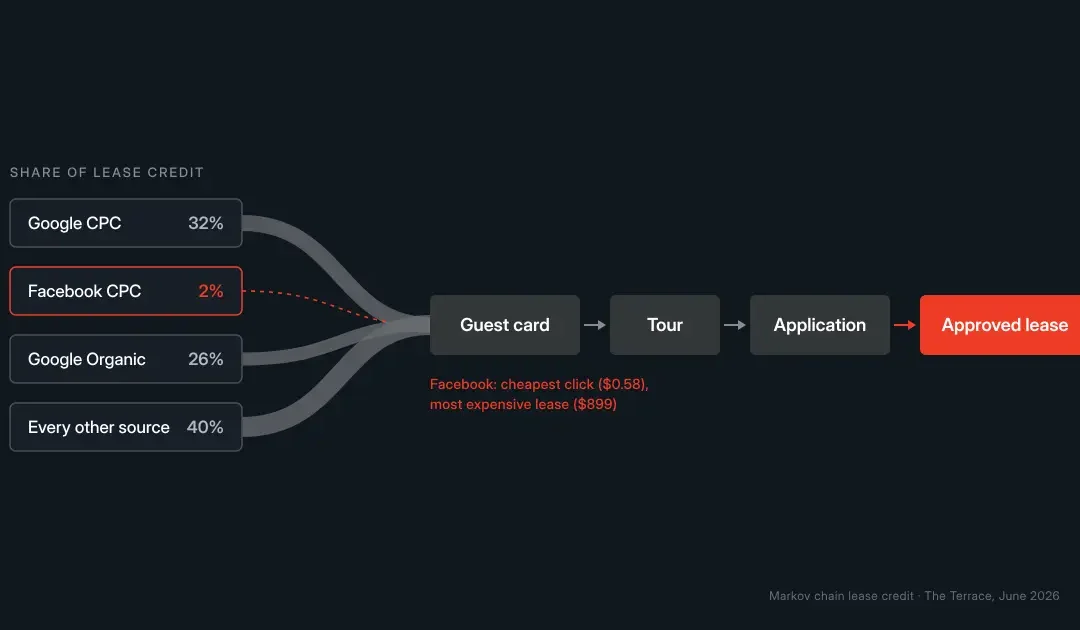
- At The Terrace, an apartment community Threshold tracked in June 2026, Facebook had the cheapest clicks ($0.58) but the most expensive leases ($899 per approved lease). Google search cost $3.75 per click and $500 per lease.
- Most marketing reports stop at the lead, so budget decisions get made on cost per click instead of cost per lease.
- Closing the gap usually means reallocating the budget you already have, not spending more.
Marketing rarely fails loudly. It leaks, and most reports can’t see where.
At The Terrace, Facebook delivered the cheapest clicks on the board: $0.58 each, about 6.5× cheaper than Google search. When Threshold followed those clicks all the way to signed leases, Facebook turned out to be the most expensive channel the property paid for: $899 per approved lease, compared with $500 for Google.
A report that stopped at clicks would have called Facebook the best deal going.
what is the gap between click and lease?
The gap between click and lease is everything that happens between a prospect clicking an ad and signing a lease: the landing page, the guest card, the tour, the application, and the approval. It’s where most leasing budgets leak, because no single team owns it and no standard report measures it.
Property marketing is usually split across three teams:
- Digital teams own reach, targeting, and cost per click
- Website teams own design, floor plans, photos, and content
- Leasing teams own the tour, the application, and the lease
Each one can be “working.” Together, they often aren’t. Ad platforms know who clicked. The property management system knows who signed. Nothing connects the two.
why do good property websites still underperform?
Property websites underperform when they aren’t built for the campaigns driving traffic. A site can have professional photography, virtual tours, and fast load times and still lose prospects because the page doesn’t match what earned the click.
Common examples in multifamily, student housing and senior living:
- An ad for a move-in special lands on a homepage where the special is nowhere in sight
- A search for a pet-friendly two-bedroom lands on a generic floor plans page
- A student housing pre-leasing campaign lands on a page that doesn’t show which floor plans are still available
- In senior living, the adult child doing the research lands on content written only for the resident
- Scheduling a tour takes several clicks, a form, and a callback
Nothing feels wrong, but nothing pulls the prospect forward either. A prospect with three other properties open in other tabs doesn’t wait to be pulled.
why is the click the most expensive moment in leasing?
The click is the moment when a prospect’s intent is clearest, their expectations are highest, and their attention is shortest. If the landing page doesn’t immediately confirm they’re in the right place and make the next step obvious, momentum is lost, and the prospect returns to a listing site.
The next step should be unmistakable: check availability, schedule a tour, or submit a guest card. No amount of bid optimization upstream can win back a prospect who left at this point.
why can’t most marketing reports see the gap?
Most marketing reports stop at the lead. They show clicks, cost per click, and sometimes guest cards, but not which guest cards became tours, applications, or signed leases, because that data lives in the property management system. As a result, budget goes to the channels with the cheapest clicks, not the cheapest leases.
When Threshold connected website analytics, ad platform data, and Entrata (The Terrace’s property management system) for June 2026, the full funnel looked like this:
- 7,001 website visits
- 161 guest cards (2.9% of website users)
- 35 approved leases (about 1 in 5 guest cards)
- $179 in blended ad spend per approved lease
Channel by channel, the picture changed:
- Organic search earned 25.8% of lease credit on $0 in ad spend.
- Listing sites earned 11.5% of lease credit (Apartment Guide 6.0%, CoStar 5.5%), a figure you can now weigh against their commissions.
- ChatGPT already appeared as a lead source, earning 1.5% of lead credit, tied with Bing.
None of that is visible in a report that ends at the click.
what is click-to-lease attribution?
Click-to-lease attribution tracks every prospect from their first website visit through guest card, tour, application, and approved lease, then credits each marketing channel for its role in producing signed leases. It connects ad platforms, website analytics, and the property management system into one report, so cost per lease can be calculated channel by channel.
Threshold’s model uses Markov chain attribution, which works in three steps:
- Map every path: chart each route prospects took from first click to signed lease.
- Remove a channel: take one channel out of the map and recalculate the odds of conversion.
- Measure the drop: the leases that disappear are that channel’s credit.
Unlike last-click attribution, this credits every touchpoint for what it contributed, not just the final one.
why doesn’t more optimization fix the problem?
Optimizing one channel can’t fix a broken handoff between channels. When digital, website, and leasing data aren’t connected, teams tune the part they own while the gap between them stays open.
That shows up as:
- Channels that look cheap getting more budget, even when they don’t sign leases
- Landing page fixes waiting in a queue behind other priorities
- Learning loops stretching from days to months
Performance plateaus. The team is capable, but no one can see the whole system.
how do you close the gap between click and lease?
You close the gap by running digital, website, and leasing as one system, measured against signed leases instead of clicks. In practice:
- Campaign intent shapes the landing experience, so the special in the ad is the first thing on the page
- The next step is obvious: check availability, schedule a tour, apply
- Every channel is measured to the signed lease, not the click
- Budget follows leases, not traffic
- Insights arrive in days, not quarters
Most importantly, someone owns the outcome (occupancy), not just a channel.
does closing the gap require more ad spend?
No. Closing the gap usually means reallocating existing budget, not increasing it. At The Terrace, the biggest opportunity was moving dollars from the channel with the cheapest clicks (Facebook) to the channel with the cheapest leases (Google search), and protecting the organic search that was signing leases for free.
Same budget, pointed at what actually fills units.
the takeaway.
If your campaigns are driving traffic but not move-ins, the problem may not be targeting, creative, or budget. It may be that no one owns the gap between click and lease, or can even see it.
Close that gap, and occupancy tends to follow.
frequently asked questions.
What’s the difference between cost per click and cost per lease?
Cost per click is ad spend divided by clicks. Cost per lease is ad spend divided by the approved leases a channel is credited with. The two can point in opposite directions: at The Terrace, Facebook was 6.5× cheaper per click than Google but 1.8× more expensive per lease.
Why would the cheapest click produce the most expensive lease?
Low-cost clicks often come from prospects with lower intent. They browse but rarely submit a guest card, tour or apply. A channel can drive lots of cheap traffic and still contribute very few signed leases.
What data does click-to-lease attribution use?
It uses data most properties already have: website analytics for sessions and sources, ad platforms for spend and clicks, and the property management system (such as Entrata) for guest cards, applications, and approved leases.
Are listing sites (ILSs) worth their commissions?
It depends on how many leases they produce. Click-to-lease attribution shows each listing site’s share of lease credit, which you can compare directly against the commission it charges. At The Terrace, listing sites earned 11.5% of lease credit in June 2026.
Is ChatGPT sending prospects to apartment websites?
Yes. At The Terrace, ChatGPT earned 1.5% of lead credit in June 2026, the same share as Bing. Attribution reporting makes it possible to spot new channels like this the month they appear.
Does this apply to student housing and senior living?
Yes. The funnel stages and names differ (pre-leasing in student housing, move-ins and family decision-makers in senior living), but the gap is the same: what happens between the click and the signed lease is rarely owned or measured.

by threshold | Mar 17, 2026 | Digital Marketing, General, Marketing
a case study in real estate marketing.
Real estate marketing is one of the most competitive environments in digital advertising today. Rising cost-per-click, crowded search results, and aggressive local competition make it increasingly difficult for real estate teams to generate consistent, cost-effective leads.
Simply running ads isn’t enough. To succeed, paid media must do more than generate traffic — it must deliver measurable growth while improving marketing efficiency.
At Threshold, we build scalable digital growth engines designed to outperform industry benchmarks across every key paid media metric.
Because average performance isn’t good enough.
the challenge.
Real estate teams face constant pressure to generate high-quality leads while keeping advertising costs under control.
Increasing competition across Google Search and social platforms means that many advertisers struggle to maintain performance as costs rise and engagement declines.
The goal of this campaign was clear:
- Increase engagement with prospective buyers and sellers
- Improve conversion efficiency across paid media campaigns
- Reduce overall cost-per-acquisition
- Consistently outperform industry benchmarks
we don’t do average.
We recently analyzed performance across our portfolio, and the results were hard to ignore. In January 2026 alone, our digital campaigns significantly outperformed industry benchmarks.
By combining strategic audience targeting, compelling creative, advanced bid management, and ongoing campaign optimization, we generated:
- More qualified clicks
- Higher conversion efficiency
Significantly lower acquisition costs
The result is a marketing engine that drives stronger performance while maximizing advertising efficiency.
the results.
google search campaign performance.
Compared to industry benchmarks, the campaign delivered exceptional improvements across all major metrics.
- 58% higher click-through rate (CTR)
- 75% higher conversion rate (CR)
- 43% lower cost-per-click (CPC)
- 77% lower cost-per-acquisition (CPA)
Higher engagement and stronger conversion performance mean that more high-intent prospects are interacting with property listings and marketing content, while overall advertising costs continue to decline.
meta (paid social) campaign performance.
The campaign also delivered significant gains across Meta’s paid social platform.
- 76% higher click-through rate
- 88% lower cost-per-click
Lower traffic costs, combined with stronger engagement, allow campaigns to reach more potential buyers and sellers without increasing spend, expanding the sales pipeline while maintaining efficiency.
google premier partner recognition.
Threshold was once again awarded Google Premier Partner Status, the highest and most exclusive tier within the Google Partners program.
This distinction is awarded annually to the top 3% of participating digital marketing agencies, recognizing advanced Google Ads expertise and exceptional client performance.
For our clients, this means working with a team that has proven capabilities in driving measurable results across paid media campaigns.
the bottom line.
These results aren’t incremental improvements.
They’re decisive performance gains.
When strategy, creative, targeting, and bid management align, real estate marketers don’t just compete — they outperform.
The right digital strategy transforms paid media from a cost center into a scalable lead generation engine.
ready to discover your growth opportunity?
Let Threshold uncover the growth potential for your brand and business.

by threshold | Nov 26, 2024 | Digital Marketing, General, Marketing, Thought Leadership
 Taylor Dickmann
In 2024, local SEO is no longer just an option for real estate businesses—it’s essential. With the growing importance of online search in the real estate industry, competition for visibility is fiercer than ever. Potential renters and buyers are using search engines to find properties near them, making local SEO a powerful tool for ensuring your listings appear in the right searches. To stay competitive and round out their digital presence, real estate businesses must master local SEO strategies to improve their rankings, attract qualified leads, and drive more traffic.
the importance of local SEO for real estate businesses.
Local SEO focuses on optimizing your business’s online presence to appear in geographically related searches. For real estate, this is crucial, as prospective tenants or buyers are almost always searching for properties in specific areas. Local SEO helps real estate agencies, apartment complexes, and property managers stand out in search results, particularly on Google, which dominates the market for search.
In 2024, where virtual tours, online leasing, and mobile search have become the norm, the competition to rank highly in local searches has intensified. Appearing in Google’s coveted “Local Pack” (the top three local results that appear with a map) can drastically increase visibility and bring more qualified traffic to your website or property listings. A well-optimized local SEO strategy can make sure your business is found by the right people at the right time, driving both leads and conversions.
optimizing google business profile.
One of the most powerful tools in local SEO is the Google Business Profile (GBP). GBP helps businesses manage their presence across Google Search and Google Maps, providing essential information to prospective renters right in the search results.
tips for optimizing your google business profile:
- Complete All Information: Ensure your GBP is fully filled out with accurate details. Include your business hours, address, phone number, and website. Be sure to add up-to-date photos of your properties to make a strong first impression.
- Use Keywords in Descriptions: Optimize your profile description with location-specific keywords, such as “luxury apartments in [city]” or “student housing near [university].” This helps your business show up in relevant local searches.
- Encourage and Manage Reviews: Google reviews significantly impact local rankings and consumer trust. Encourage satisfied tenants or buyers to leave positive reviews and respond professionally to any feedback, whether it’s good or bad. Engaging with reviews shows you are active and care about your customers.
localized content and keywords.
Creating localized content is key to improving your local SEO. This involves developing content that speaks directly to the needs and interests of your target audience in specific locations. For real estate, this could mean creating neighborhood guides, blogs about local amenities, or highlighting events in the area.
tips for localized content:
- Location-Specific Pages: If you manage properties in multiple areas, create individual landing pages for each location. These pages should be optimized with local keywords and include information relevant to that specific area.
- Localized Blog Content: Writing about local events, neighborhood highlights, and property-related topics with local keywords can further boost your visibility in search results.
mobile optimization & voice search.
With the rise of mobile-first indexing, Google now prioritizes websites that are optimized for mobile devices. For real estate businesses, where many users browse listings on their smartphones, ensuring your website is mobile-friendly is crucial for both user experience and SEO.
mobile optimization best practices:
- Ensure Website Responsiveness: Your site should automatically adjust to fit different screen sizes. This ensures users have a seamless experience, whether they’re viewing your site on a phone, tablet, or desktop.
- Improve Page Speed: Slow-loading websites can hurt both your user experience and your SEO rankings. Use tools like Google PageSpeed Insights to identify ways to speed up your site.
- Optimize for Voice Search: With the increasing use of voice-activated assistants like Siri and Google Assistant, optimizing for voice search can give you a competitive edge. Voice search queries tend to be longer and more conversational, so make sure your content addresses common questions like “What’s the best neighborhood for families in [city]?” or “Affordable apartments near [landmark].”
to wrap things up.
Mastering local SEO is critical for real estate businesses looking to increase visibility and attract more local leads in 2024. By optimizing your Google Business Profile, creating localized content, building local backlinks, and ensuring your site is mobile-friendly, you can improve your search rankings and stay ahead of the competition. With the right strategies in place, local SEO can drive more traffic to your site, generate high-quality leads, and ultimately help you close more deals.
how Threshold can help with local SEO.
At our agency, we specialize in local SEO strategies tailored specifically for the real estate industry. We offer comprehensive Google Business Profile (GBP) management, ensuring your profile is fully optimized with accurate information, engaging photos, and location-specific keywords. Our team also manages daily GBP posts, keeping your profile active and relevant.
Additionally, if you partner with us on your website, we ensure responsiveness and fast page speed, as well as other technical SEO tactics that play a role in local rankings. Our expertise in mobile optimization and technical SEO ensures your website performs well on all devices, helping you stay competitive in today’s mobile-first world.
Let us help you master local SEO and drive growth in 2024.

by threshold | Nov 24, 2023 | Digital Marketing, General, Marketing
 Ava Page
Welcome to the ultimate Pay-Per-Click (PPC) guide to help you excel in your next marketing campaign (hopefully with us)! At Threshold Agency, we know that mastering PPC advertising
is like discovering a treasure trove for your marketing strategy.
Ready to dive into this guide? We’ll uncover the secrets and strategies that’ll turn your PPC game into a winning streak.
understanding the basics of ppc.
PPC is like planting seeds that instantly sprout into visibility and clicks. This advertising method charges you for every click your ad receives, making it a swift way to capture attention.
But the real magic lies in how you wield this power strategically.
keyword research and selection.
In the quest for the perfect keywords, think of yourself as a detective on a thrilling case. Use tools like Google Keyword Planner or SEMrush to uncover those hidden gems —
keywords with high searches and low competition. The longer the keyword, the more precise your aim.
crafting compelling ad copy.
Think of your ad copy as your knight in shining armor—bold, captivating, and irresistible! Weave in those chosen keywords naturally, flaunt your unique selling points,
and don’t forget the battle cry—a compelling call-to-action (CTA). Test different versions to see which holds the strongest impact.
optimizing landing pages.
So, you’ve lured them in with your ad—now what? Your landing page should be the treasure map that guides them to their bounty. Keep it relevant, user-friendly,
and armed with persuasive content that converts visitors into allies.
bid management and budget allocation.
Managing your bids
is like a strategic duel—constantly maneuvering to claim the winning spot. Keep a watchful eye on performance data, adjust bids, and allocate your budget
wisely to champion those high-performing keywords and audiences.
utilizing ad extensions.
Ad extensions are like adding secret compartments to your ad, offering more treasures to your audience. Site links, callouts, location extensions, and structured snippets —
these are the secret weapons that make your ad shine brighter.
tracking and analytics.
The tools you definitely need to make sure you have in your kit? Analytics, like Google Analytics and Google Ads. Dive deep into data to unravel trends, understand your
audience’s journey, and make informed decisions to steer your campaign toward success.
remarketing and retargeting.
It’s time to bring back those adventurers who have had a glimpse of the goods but haven’t committed. Tailor your ads to their interests or actions, encouraging them to
return and claim their reward – your brand!
continuous testing and optimization.
Think of PPC as a grand experiment—constantly mix, test, and refine. Tiny tweaks could unleash a tidal wave of success over time.
overwhelmed? don’t be.
This may seem like a lot of information, and even more setup and maintenance. After all, you’re busy running your brand! But, there’s no need to fret.
This is kind of our thing. Let us get your marketing where it needs to be. After all, we’re the ones who can market your everything.
to sum things up.
With these strategies under your belt, you’re on the brink of PPC mastery! At Threshold, we specialize in crafting tailored PPC strategies that take your brand on an
exhilarating journey to success.
Ready to embark on this adventure together? Reach out to us today.
before you go.
For more tips and information about marketing your everything, take a look at the rest of our blogs, right here on our website!
You can also subscribe to our email newsletter (it’s got some great stuff), and follow us on Instagram, Facebook, or LinkedIn!
about the author.
Ava is the SEO & Paid Media Specialist at Threshold.
In her role, she is responsible for the content creation and management of all Threshold and PromoShak social channels and strategies, blog content, SEO maintenance,
and aids in digital marketing activation. She’s kind of a jack-of-all-trades.
When she’s not busy creating content, you can usually find her picking out new plants, island-hopping, watching Duke basketball, or spending time with her fur babies.

by threshold | Oct 24, 2023 | Creative, Digital Marketing, General, Marketing
 Ava Page
We’re about to dive headfirst into the exciting world of copywriting – the secret sauce behind high-performing websites, ads, and social media content.
If you’re looking to boost your online presence and turn casual visitors into loyal customers, you’ve come to the right place.
the power behind words.
In the digital age, where attention spans are shorter than ever, your words matter more than you might think. Every word on your website, in your advertisements, and on your social media profiles should work like a magnet, pulling your audience in and compelling them to take action.
That’s the magic of high-converting copy.
why high-performing copy matters.
engagement.
Great copy sparks interest and keeps your audience engaged. It’s the bridge that connects your audience to your message.
conversions.
The ultimate goal of any online presence is to convert visitors into customers. High-performing copywriting can make that happen.
brand voice.
Your copy is your brand’s voice – it should be unique, relatable, and memorable.
Now, let’s roll up our sleeves and discover how you can create copy that works wonders for your business.
know your audience.
Before you put pen to paper (or fingers to keyboard), you must understand your audience inside and out.
Who are they? What problems do they face? How can your product or service solve those problems?
Tailor your message to speak directly to your audience’s pain points and desires.
embrace the AIDA formula.
AIDA stands for Attention, Interest, Desire, and Action. It’s a classic formula that works wonders for copywriting, like so:
attention.
The first step in creating high-performing copy is to capture your audience’s attention right from the start. Your headline or opening sentence is your first impression, and it needs to be compelling. Here’s how to do it:
create intrigue.
Start with something that piques curiosity or poses a thought-provoking question. For instance, “Are You Making These Common Mistakes in Your Marketing?”
interest.
Keep their interest alive by discussing their problems or needs.
power words.
Incorporate words that evoke emotion or excitement. Words like “ultimate,” “exclusive,” or “revolutionary” can add impact to your headline.
desire.
Show them how your product or service can fulfill their desires.
pain points.
Identify a problem your audience faces, and highlight it in your headline. People are drawn to solutions to their problems.
action.
Finally, ask for the action you want them to take, whether it’s signing up, buying, or sharing.
sense of urgency.
Encourage immediate action by introducing urgency, such as limited-time offers or deadlines.
keep things clear and concise.
In the online world, less is often more. Clear, concise copy is easy to read and understand. Avoid jargon and complex language. Instead, use simple words and short sentences that get your point across quickly.
tell your story.
Humans are wired to connect with stories. Weave narratives into your copy to make your brand more relatable and memorable. Share customer success stories or anecdotes that showcase your product or service’s value.
test and optimize.
Copywriting is an art, but it’s also a science. Don’t be afraid to A/B test different versions of your copy to see what resonates best with your audience. Use tools like Google Analytics to track the performance of your copy and make data-driven improvements.
keywords & SEO.
For web copy, don’t forget the importance of keywords. Research relevant keywords and incorporate them naturally into your content. This will not only make your content more search-engine friendly but also help you reach the right audience.
always proofread.
Nothing screams unprofessionalism like typos and grammatical errors. Always proofread and edit your copy to ensure it’s polished and error-free.
And, if you’re able, it’s always a plus to get a second set of eyes on your work to pick up on things you may have missed, or even to give you a suggestion on how to make something just a little better.
to sum it up.
High-conversion, high-performing copywriting isn’t just a skill – it’s an art that requires a deep understanding of your audience, a mastery of language, and a sprinkle of creativity.
By following these tips, you can transform your online presence, boost your conversions, and create a lasting impact in the digital world. Remember, it’s not just about words; it’s about the magic those words create.
So, go ahead, write with professionalism, craft with playfulness, and watch your conversions soar.
before you go.
For more tips and information about marketing your everything, take a look at the rest of our blogs, right here on our website!
You can also subscribe to our email newsletter (it’s got some great stuff), and follow us on Instagram, Facebook, or LinkedIn!
about the author.
Ava is the Content Marketing Specialist at Threshold.
In her role, she is responsible for the content creation and management of all Threshold and PromoShak social channels, blog content, and SEO maintenance, and aids in digital marketing strategies both internal and client-facing.
When she’s not busy creating content, you can usually find her picking out new plants, island-hopping, watching Duke basketball, or spending time with her fur babies.