by threshold | Aug 27, 2026 | Digital Marketing, Financial Marketing, General
Privacy changes have changed the retargeting playbook. For multifamily teams and community banks, the right answer is not chasing third-party cookies. It’s building a first-party data strategy that ties digital touchpoints to physical promo fulfillment and CRM activation. Here is a crisp, practical guide you can implement this month.
why cookieless retargeting matters now.
Browsers and platforms have made third-party cookies unreliable. Apple privacy updates and tighter browser limits mean traditional retargeting campaigns will lose reach and accuracy. That hits high-intent channels for leasing and banking hardest. If you want predictable conversions, you need data you own and a way to turn it into action without relying on external trackers.
the threshold playbook: a 6-step roadmap for cookieless retargeting.
This playbook pairs first-party data capture with fulfillment-triggered touchpoints. It is built for speed, compliance, and measurable lift. Use it for multifamily retargeting strategies or community bank digital marketing.
1. capture first-party signals at every touchpoint.
Start by collecting reliable identifiers. That includes email, phone, device data from your site, leasing portal activity, form submissions, and on-branch signups. For banks, add account opening forms and in-branch events. For apartments, add floor plan downloads, tour bookings, and waitlist signups. Make sure every form asks permission for contact and stores consent flags in your CRM.
2. build a privacy-first data layer and CRM schema.
Design a unified record per lead. Link web behavior, offline interactions, promo fulfillment history, and consent status. Use hashed identifiers for matching so you can activate audiences without exposing raw PII. For community bank digital marketing, document retention policies and encryption standards so your team can answer audits quickly.
3. segment and score for intent.
Turn first-party signals into audience segments. Examples:
- Multifamily high intent: scheduled a tour in the last 14 days and viewed 3 or more floor plans.
- Bank high intent: started account form and visited rate page more than twice.
Score leads by recency and depth of activity. These segments feed your retargeting channels and your fulfillment triggers.
4. activate without third-party cookies.
Use server-side activation and CRM-to-platform connections. Send hashed emails and phone numbers to platforms that accept first-party lists for matching. Run contextual and cohort-based ads for broader reach while using your matched lists for high-intent follow-up. Keep ad creative tight and message consistent with the fulfillment touchpoint you plan to send.
5. use promo fulfillment as a retargeting trigger.
This is where Threshold stands out. Branded welcome kits, on-site swag, and mailed offers do double duty. They act as offline confirmations of interest and as signals to your CRM to move leads into higher-touch sequences. Practical examples:
- Multifamily: When a prospect schedules a tour, immediately send a small welcome kit. Once the kit ships, update the CRM to fire SMS reminders and an email with a virtual tour link.
- Community bank: A new account applicant receives a branded debit card sleeve and welcome packet. When fulfillment completes, trigger a personalized financial education drip and a cross-sell ad cohort.
Promo fulfillment improves conversion and provides a clean event you can use for privacy-compliant remarketing without cookies.
6. measure, attribute, and iterate.
Define simple KPIs. For multifamily: tour-to-lease rate, cost per lease, and time-to-lease. For banks: account funding rate, new deposit volume, and cost per funded account. Use CRM event timestamps to attribute conversions to fulfillment triggers and first-party ad activations. Run A/B tests where you split segments between a promo fulfillment path and a control path to quantify uplift.
practical play examples.
short campaign for a lease-up.
Capture emails on new community landing pages with an incentivized floor plan download. Schedule tours and immediately send a branded tote or keychain. When the tote ships, push that audience to your matched list and a contextual ad buy. Send a lease incentive email 3 days after fulfillment. Measure signed leases within 30 days.
community bank onboarding funnel.
When an online applicant submits an ID, mark consent and stage in the CRM. Ship a welcome packet with printing of account number and a small branded notebook. On shipment, trigger a personalized video email explaining next steps and a matched-audience ad that highlights local branch services. Track funded accounts within 15 days.
compliance and security notes.
Keep consent records with timestamps. Hash PII before sending to ad platforms. Limit access to raw customer data and document your retention schedule. For community banks, align with your compliance officer and keep a clear audit trail for any third-party vendors handling fulfillment or data matching.
quick implementation checklist.
- audit current first-party signals and consent flows
- create a single CRM record for each lead and a hashing process for PII
- map segments and scoring rules tied to fulfillment triggers
- set up server-side activations and matched list uploads
- select promo SKUs that match the audience and budget
- instrument measurement events and a simple A/B test
Cookieless retargeting is not theory. It is practical work you can start this week. Threshold combines bank-grade data processes, rapid creative execution, and promo fulfillment to make these campaigns real fast. Want to run a pilot for a lease-up or new account drive next month? Yep, we can do that.
by threshold | May 25, 2026 | Digital Marketing, Marketing
Fairways at Star Ranch’s digital footprint was suffering from budget dilution under a previous agency. By leaning too heavily on broad, unmonitored automated setups, their budget was bleeding out into broad geographic radii and completely irrelevant search terms. They were chasing “vanity traffic” instead of real renters, causing their Cost Per Click (CPC) to balloon to an inefficient $4.46 while their Click-Through Rate (CTR) stagnated at 1.60%.
When Threshold stepped in, we knew we could fix the problem without a bigger budget.
the pivot: trading clicks for leases.
Our rescue strategy focused on stripping away the automated bloat and reintroducing hyper-targeted precision.
First, we phased out underperforming Performance Max and broad “Near Me” campaigns. While Performance Max generated plenty of lookers, its substandard 0.95% CTR proved it wasn’t reaching active prospects. In its place, we launched granular, dedicated Search campaigns designed to capture 100% of bottom-funnel demand exactly when a prospect searched for the property by name.
Next came account hygiene. We implemented an aggressive negative keyword scrubbing process, instantly stopping the cash bleed on high-cost terms that yielded zero engagement. By buying our own branded terms at an ultra-efficient $0.71 CPC, we allowed the property’s budget to work nearly six times harder than before.
from stagnant to skyrocketing: the results.
The turnaround was immediate. By moving away from surface-level clicks and focusing exclusively on the deep-funnel actions that drive physical property occupancy, the property saw a total performance reversal between the previous period (July–September 2025) and the Threshold period (October–December 2025):
-
Grand Total CPC dropped 43% to $2.53, landing perfectly within our target benchmark.
-
Total CTR jumped from 1.60% to a highly relevant 10.46%.
More importantly, the quality of lead generation completely transformed. Direct prospect calls skyrocketed from 11.10 under the previous agency to 185.95 with Threshold—a massive 1,575% increase. Meanwhile, tour schedules (the primary driver of physical occupancy) grew from 6.48 to 31.99, marking a 393% surge in high-intent leasing actions. This deep-funnel momentum carried over to bottom-funnel intent, where availability checks climbed 162%, rising from 382.17 to 1,001.95 events.
client satisfaction.
The data tells a compelling story, but the true validation of this structural rescue came from the team experiencing it firsthand on the ground.
“Threshold outperformed prior-year metrics as well as the months immediately preceding the transition across nearly every category we measured, including ROAS, click-through rates, lead-to-lease conversion ratios, overall conversions, and campaign engagement quality,” says Cortney Young, Regional Marketing Manager at Willow Bridge. “What impressed us most was that the improvements were not isolated to one metric—they were consistent across the full performance funnel.”
– Cortney Young, Regional Marketing Manager, Willow Bridge
By trading unmonitored automation for expert human strategy, The Fairways at Star Ranch filled their leasing office with high-value prospects ready to sign leases.
by threshold | May 14, 2026 | Digital Marketing, Marketing, Tech/Web
If you look at industry averages, a “good” digital campaign is often defined by steady traffic and a handful of leads. But for many businesses, those leads never seem to move the needle on the bottom line.
At Threshold, we have analyzed performance across our entire portfolio. In head-to-head comparisons against industry benchmarks, we have seen our systems deliver a 75% higher conversion rate and a 77% lower cost-per-acquisition.
These results are not the product of a secret algorithm or a higher budget. They are the result of closing the two most common points of failure in any marketing engine: Process and Ownership.
1. process: the difference between a click and a customer.
A marketing process is often treated as a series of handoffs. The ad team hands off to the website, and the website hands off to the sales team. Every handoff is a potential point of failure where a lead can be lost.
When we audited the growth of a financial partner, they set a goal for a 20% lift in customer acquisition. By refining the process—aligning geographic targeting with specific customer lifecycles—the actual result was a 27.5% lift.
how process drives results:
- operational integration: A website should not just be a digital brochure. It must be an operational tool that routes leads to the right person in seconds.
- speed to action: Research shows that responding to a lead within five minutes increases conversion probability exponentially. If your process includes manual data entry or delayed email notifications, your marketing spend is being wasted.
- seamless handoffs: We map the journey so that the data captured on the website is the exact data the sales team needs to close the deal.
2. ownership: ending the accountability vacuum.
The most common reason for a plateau in ROI is a lack of clear ownership. When one agency manages your ads, and another manages your website, no one is responsible for the performance of the entire system.
If your cost-per-click is low but your sales are stagnant, who is accountable? The media team will point to the website. The web team will point to the lead quality.
the threshold differentiator:
We move beyond channel management to system ownership. We take accountability for the entire digital ecosystem. This means we don’t just look at how your ads are performing; we look at how those ads are impacting your overall business goals.
By taking ownership of the full funnel, we recently achieved a 58% higher click-through rate compared to industry standards. This happened because we were managing the relationship between the creative, the landing page experience, and the final conversion.
stop investing in silos.
Technology alone cannot fix a broken process. More budget cannot fix a lack of ownership.
The brands that outperform their competitors are the ones that view digital marketing as a single, managed workflow. They have a documented process for every lead and a partner who takes ownership of every outcome.
Your marketing should be shattering benchmarks. Connect with Threshold to close your gaps and scale your growth.

by threshold | May 1, 2026 | Digital Marketing, Marketing, Thought Leadership
 Laura Robbins, Corporate Marketing Manager
Most marketing budgets underperform because the system behind them is disconnected.
Organizations invest in websites, paid media, SEO, AIO, content, and reporting—often with capable teams and trusted marketing partners in place—and still struggle to produce consistent returns. Lead flow feels uneven. Costs rise without a clear explanation. Performance becomes harder to predict.
The issue is not always visible in a dashboard.
It often shows up in what we call the alignment tax: the hidden cost organizations pay when their website, traffic strategy, messaging, and reporting are not working together.
what disconnected marketing really looks like.
Disconnected marketing rarely looks broken at first. On the surface, everything appears to be moving:
- the website is live and visually strong
- paid media is active
- SEO and AIO efforts are underway
- reports are being delivered
- internal teams and external partners are covering their scope
But strong activity doesn’t always produce strong system performance.
One team is focused on design. Another is focused on traffic. Another is focused on reporting. Each function may be doing its job well, but no one is fully accountable for how the entire marketing system performs together.
That’s when marketing becomes harder, slower, and more expensive than it should be.
where your marketing is breaking down.
Disconnected marketing typically creates drag in three places.
1. lost conversions you never see.
When websites, traffic sources, and conversion paths aren’t aligned around the same goal, small leaks start to affect performance.
Common signs include:
- paid traffic landing on pages that don’t match intent
- messaging that changes from ad to page to form
- pages that look polished but don’t clearly guide action
- conversion paths that create friction at the wrong moment
None of these issues looks catastrophic on its own. Together, they lower conversion efficiency month after month.
That’s how a few missed opportunities turn into a meaningful revenue problem.
2. slower learning loops.
Alignment isn’t only about execution. It’s about how quickly teams can learn and act.
When marketing systems are disconnected:
- paid media insights don’t shape website updates quickly
- website behavior doesn’t influence targeting fast enough
- reporting explains performance after the fact instead of improving the next move
- optimization cycles stretch from days into weeks
Speed matters because faster learning makes every marketing dollar more productive.
3. wasted spend that feels normal.
This is where disconnected marketing becomes especially expensive.
When systems aren’t aligned, inefficiency starts to feel routine. Teams begin to assume:
- this is just what marketing costs
- some channels are always difficult to make efficient
- better results require more budget
In reality, the issue is the misalignment between the parts of the system that should be reinforcing one another.
why marketing alignment is a financial issue.
Marketing alignment is often framed as a workflow improvement. That undersells the impact.
When the system is aligned:
- conversion rates improve without immediately increasing spend
- teams move faster from insight to execution
- performance becomes easier to explain and forecast
- budget works harder because fewer dollars are lost to friction
This isn’t just a process benefit. It’s a financial one.
At some point, leadership teams stop asking, “Which channel should we invest in next?” and start asking a better question:
Is our marketing system built to work together?
what aligned marketing looks like.
Aligned marketing doesn’t necessarily mean centralizing everything. It means building around shared goals, faster feedback, and clear ownership.
In practice, that looks like:
- websites and paid media built around the same conversion priorities
- messaging that stays consistent from first click to final action
- insights moving quickly between teams
- website improvements happening in days, not weeks
- performance visibility across the full journey
- clear ownership of outcomes, not just deliverables
That last point matters most.
Execution at the channel level is important. But stronger performance usually comes when someone owns how the entire system works together.
how to tell if you are paying the alignment tax.
A quick gut check for marketing leaders:
strategy and ownership.
- do your website and paid media efforts share the same primary conversion goal?
- is there clear ownership over total marketing performance, not just channel activity?
- can one person clearly explain how traffic becomes leads?
execution and speed.
- can website updates happen in days, not weeks?
- do paid media insights directly influence website changes?
- are landing pages built for specific audience intent?
measurement and clarity.
- can you see performance across channels in one place?
- do reports explain why something worked, not just what happened?
- can your team quickly identify the next highest-impact improvement?
cost and efficiency.
- do you know where spend is being wasted, not just where it is being allocated?
- does better performance usually require more budget?
- does your marketing operation feel heavier than it should?
If you answered “no” or “not sure” several times, the issue may be structural rather than budgetary.
the takeaway.
If marketing feels expensive but underwhelming, the problem may not be talent, tools, or effort. It may be that your marketing system is disconnected.
The good news is that alignment fixes often improve performance before they increase cost. When websites, digital marketing execution, reporting, and optimization work together, marketing becomes easier to scale, defend, and more efficient overall.
Is your marketing system working together or in silos?
If your website, paid media, and reporting are all active but results still feel harder to explain than they should, alignment may be the issue.
by threshold | Apr 14, 2026 | Digital Marketing, Financial Marketing
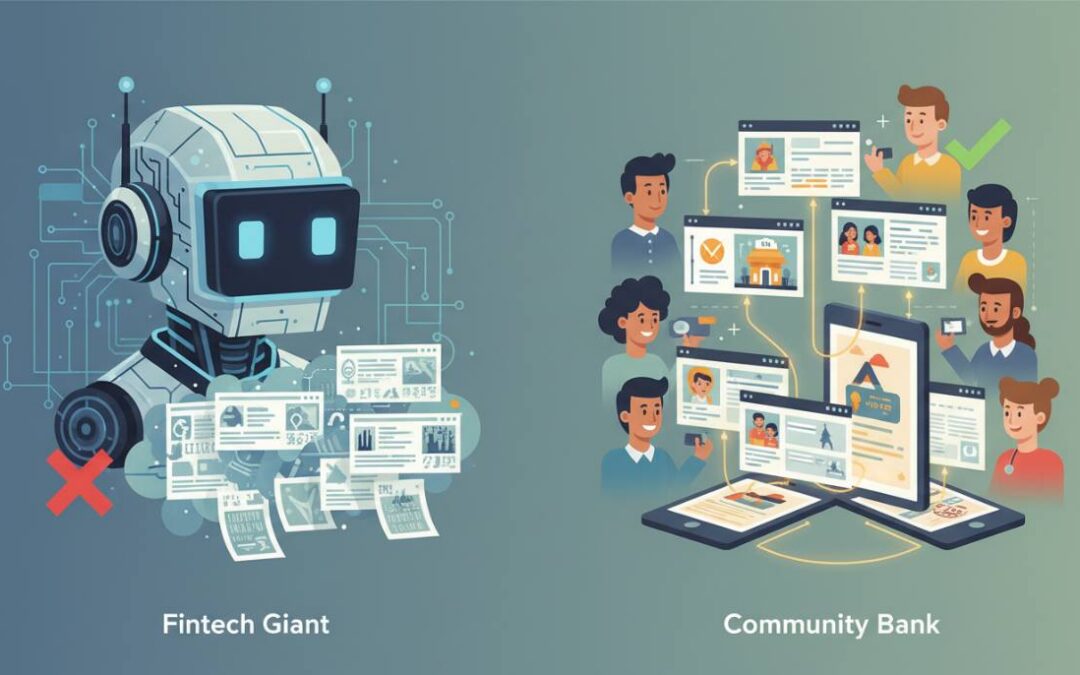
Fintech giants spend billions trying to convince your neighbors that an algorithm understands their lives better than a local banker does. They have the massive budgets and the sleekest apps, but they often miss the mark on the one thing that actually drives a conversion: authentic connection. While the big bots are busy running the same generic ads from coast to coast, community banks have a secret weapon. You know the streets, the schools, and the local economy better than any Silicon Valley server ever could. When you pair that local knowledge with high-speed, hyper-personalized digital creative, you don’t just compete. You win.
the automation gap in fintech marketing.
Most fintech marketing relies on massive data sets to blast out standardized messages. It is efficient, sure, but it is also cold. They use stock photos of people who look like they have never set foot in your town, and the copy feels like it was written by a committee in a high-rise. This creates a massive opening for community banks and credit unions.
When comparing fintech vs community bank marketing, the difference is often found in the “vibe” of the ad creative. A fintech ad feels like a transaction. A community bank ad should feel like a conversation. By focusing on hyper-local banking ads that reflect the actual life of your community, you build a level of trust that a national brand simply cannot replicate.
why hyper-personalized digital ad creative works.
Personalization is about more than just putting a customer’s name in a subject line. It is about showing them that you see what is happening in their world right now. Here is how local institutions are out-pacing the giants:
- reflecting local reality: If a local plant is hiring or a new housing development is breaking ground, your ads can speak directly to those specific milestones.
- visual familiarity: Using imagery of actual local landmarks or recognizable neighborhood aesthetics makes your community bank digital ads feel like they belong in the user’s feed.
- niche problem solving: Fintechs offer broad solutions. You can offer a loan product specifically designed for the challenges facing small businesses on your specific Main Street.
speed beats the algorithm.
One of the biggest hurdles for local banks has historically been the turnaround time for high-quality creative. In the past, by the time a campaign was approved and designed, the market had already shifted. That has changed. Today, the goal is to get high-volume, high-quality creative into the market fast.
When you can react to a local interest rate shift or a community event within 24 hours, you aren’t just a bank. You are a relevant part of the daily news cycle. This agility is exactly how credit union lead generation stays ahead of rigid national competitors who have to jump through months of corporate red tape to change a single headline.
The modern consumer doesn’t want a bank that just holds their money. They want a partner that understands their zip code.
scaling your creative without losing the human touch.
A common fear for marketing directors at community banks is that increasing the volume of digital ads will lead to a drop in quality or a “robotic” feel. It doesn’t have to be that way. The key is to build a system where personalized financial marketing is the standard, not a special project.
By using a dedicated creative partner who understands the regulatory landscape and the local culture, you can produce dozens of ad variations that feel hand-crafted. You get the speed of a fintech with the soul of a community institution. This balance of high-end design and local heart is what stops the scroll and gets the click.
ready to out-convert the giants?
You have the local trust and the community roots. All you need is the creative engine to tell that story at scale. Whether you are looking to boost your mortgage applications or grow your core deposits, we specialize in making the “impossible” turnaround times look easy. If you need high-volume, hyper-local digital ads that actually move the needle, we are here to help. Yep, we can do that.