
by threshold | Jan 16, 2026 | General
Most marketing teams are drowning in reports, yet somehow still flying blind.
Dashboards tell you what happened last week or last month, and then by the time you react, the opportunity has moved on.
Predictive analytics changes that dynamic by helping you act on what is likely to happen next, not what just passed.
from rearview mirror to headlights.
Traditional analytics is descriptive. It answers questions like:
→ What channels drove the most leads?
→ Which campaigns had the lowest CPA?
→ How did email perform last quarter?
Useful, but late.
Predictive analytics uses machine learning to answer a different set of questions:
→ Which leads are most likely to convert in the next 30 days?
→ Which customers are at the highest risk of churn?
→ Which offer or product is each segment most likely to respond to?
→ Where should we allocate the next dollar of budget for the highest impact?
Instead of simply measuring performance, you’re now forecasting it and adjusting ahead of time.
what this looks like in practice.
Across industries, the patterns are similar, even if the specifics change:
Real estate and student housing
→ Identify prospects whose behavior signals they are likely to sign a lease soon.
→ Prioritize them for personal outreach, tours, and high-intent retargeting.
Banks and financial institutions
→ Flag members likely to open a new account, apply for a loan, or roll over funds.
→ Trigger personalized offers and education before they start shopping with competitors.
Service-based and subscription brands
→ Detect early signals of disengagement, like reduced logins or lower engagement.
→ Offer a check-in, new feature education, or a loyalty perk before they cancel.
The power shift is simple:
→ You move from reacting to problems to quietly preventing them and amplifying your best opportunities.
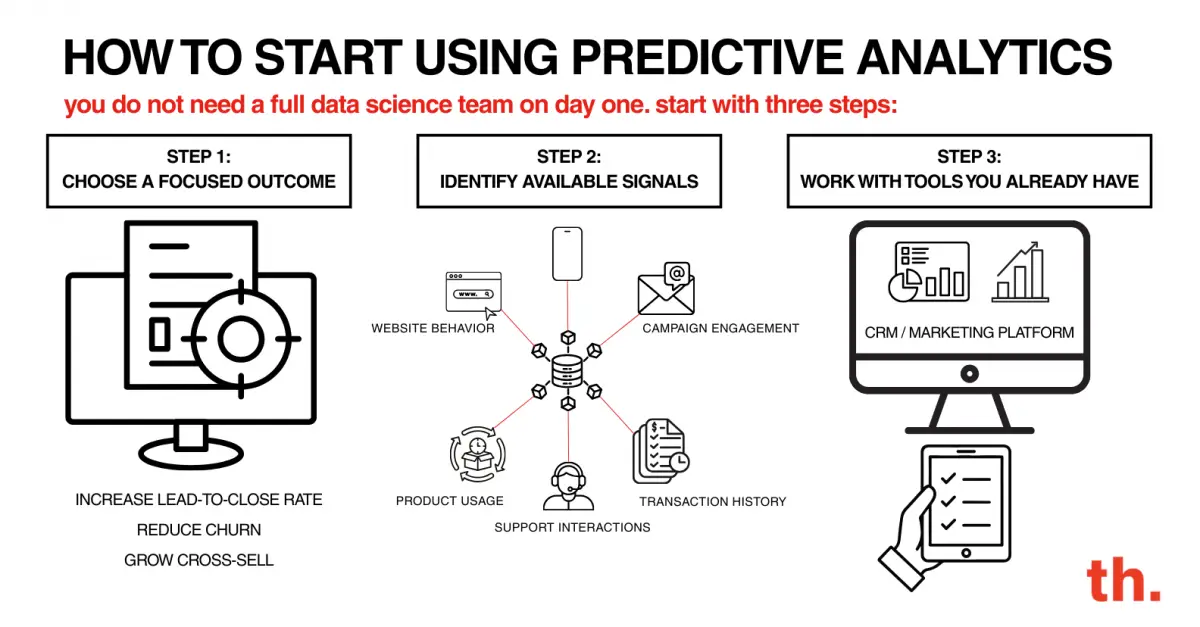
how to start using predictive analytics.
You do not need a full data science team on day one. Start with three steps:
- Choose a focused outcome. For example: “increase lead-to-close rate,” “reduce churn,” or “grow cross-sell for existing customers.”
- Identify available signals. Website behavior, product usage, campaign engagement, support interactions, and transaction history are usual starting points.
- Work with tools you already have. Many CRMs and marketing platforms now include predictive scoring and propensity models. Turn those on, validate them against reality, then train your team to act on the insights.
Predictive analytics is not about replacing human judgment. It’s about giving your team better headlights, so every decision is a little less guesswork and a lot more informed.

by threshold | Dec 18, 2025 | General
If it feels like your audience is moving faster than your marketing, you’re not imagining it.
Consumers are jumping between search, social, AI assistants, text, email, and in-person touchpoints in minutes. In that chaos, AI has moved from an “interesting experiment” to the connective tissue between data, channels, and creative. It is no longer just a copywriting shortcut or a way to spin out more assets.
Used well, AI can be the brain of your marketing engine. Used poorly, it’s one more shiny toy that adds work to your plate without moving the needle.
from gimmick to growth driver.
The teams getting real value from AI are using it to do three big jobs:
- understand audiences at a deeper level.
- Cluster users by behavior and intent, not just demographic labels.
- Surface patterns in campaign performance that are invisible in a standard dashboard.
- create and adapt content faster.
- Draft headlines, ad variations, email copy, and landing page tests in minutes.
- Generate first-pass concepts so writers and designers are editing and elevating, not starting from zero.
- Adjust bids, creative, and offers based on live performance signals.
- Recommend and trigger “next best action” for each segment automatically.
This is why enterprise AI investment has surged: brands are shifting from experimentation to production deployment where AI is embedded into everyday workflows, not sitting in a separate lab.
why ai should be your co-pilot, not your driver.
At Threshold, our stance is simple:
- AI should be your co-pilot, not your driver.
That is the core of AIO: AI-assisted, human-optimized marketing. AI handles the heavy lifting so humans can focus on what actually differentiates your brand:
- Strategy, positioning, and offer design
- Voice, storytelling, and creative judgment
- Cross-channel orchestration and stakeholder alignment
In practice, that means:
- Letting AI pull and summarize performance data so strategists can make faster decisions.
- Using AI to draft concepts that your team refines to match brand standards, compliance, and tone.
- Using AI to scale what you already know works, instead of endlessly guessing at new angles.
where should you start?
If AI still feels abstract, choose one use case where it can clearly save time or improve relevance:
- Analyze the last 90 days of campaign performance and summarize key patterns.
- Generate 10 headline and body variants for a top-performing ad set.
- Build a first-pass content outline for a new landing page, then have your team refine it.
Let that first win prove the value. Then expand deliberately.
- The goal is not to become an “AI-first brand.”
- The goal is to become a brand that uses AI to be more human, more responsive, and more effective at scale.
Make AI work for you: Identify one workflow this quarter where AI can play the role of marketing brain, then set up a simple test to compare outcomes with and without AI in the loop.
Let’s do this.
by threshold | Dec 15, 2025 | Culture, Digital Marketing, Financial Marketing
the work behind the awards.
At the start of 2025, we were clear on what “good” needed to look like:
⭕ launch websites and campaigns that actually move leasing, accounts, and deposits
⭕ prove impact with real numbers, not just nice creative
⭕ keep things fast and affordable enough for lean internal teams
By the end of the year, we had student housing projects that fully leased ahead of opening, financial campaigns that beat growth goals, and property websites delivering multi-digit conversion lifts.
The awards were a bonus. The real story is the work.
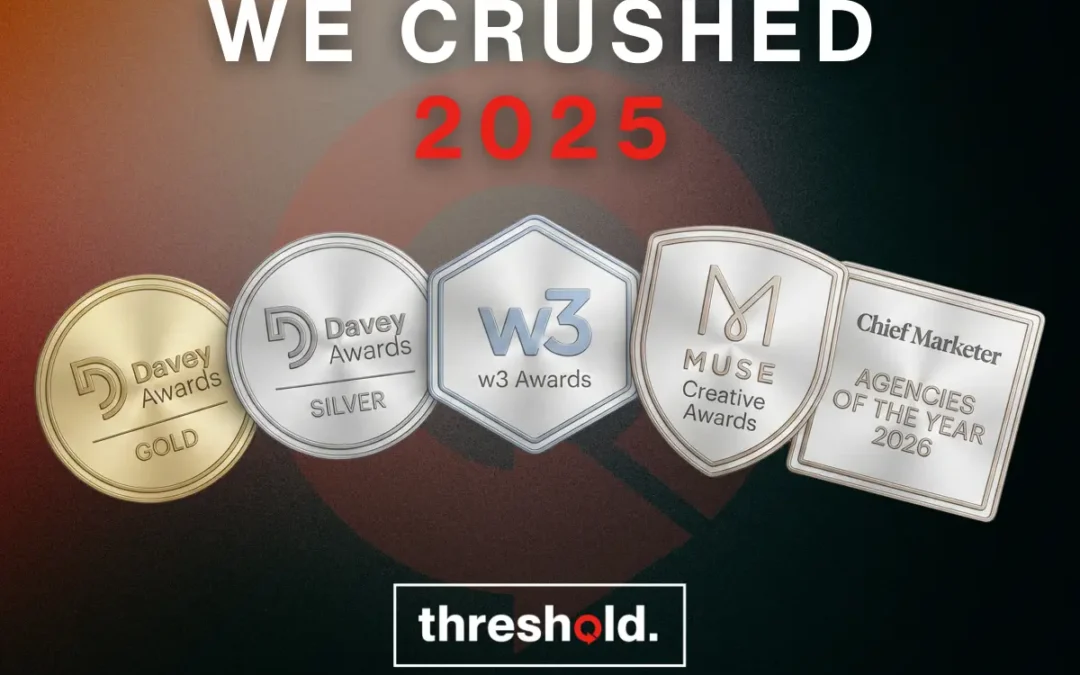
Below are a few of the projects that defined 2025 for Threshold, and the results that earned recognition from Davey Awards, w3 Awards, MUSE Awards, and a spot on Chief Marketer’s 2026 Agencies of the Year list.
Gateway 737: from zero brand to 100% leased.
Client: Holder Properties
Vertical: Student housing
Project: Full brand build, website, and leasing strategy for a 940-bed community in Columbia, SC
the challenge.
Gateway 737 started in 2024 with no name, no brand, no website, and no renewals to lean on. It would open in August 2025 in a competitive University of South Carolina market, surrounded by established communities with years of word-of-mouth.
The brief was simple and unforgiving:
“Build a brand and digital presence that lets a brand-new property compete like a market leader.”
what we did.
⭕ named and branded the community from the ground up, including logo, color system, and messaging that speaks to USC student life
⭕ launched a high-converting landing page early, then a full site focused on fast floor-plan discovery, mobile UX, and clear CTAs
⭕ turned every physical touchpoint into media, from brochures to a construction trailer that transformed into a leasing lounge
⭕ focusing on organic engagement and cultural resonance—via on-campus events, strong social media, and an authentic brand—rather than high media spending.
the results.
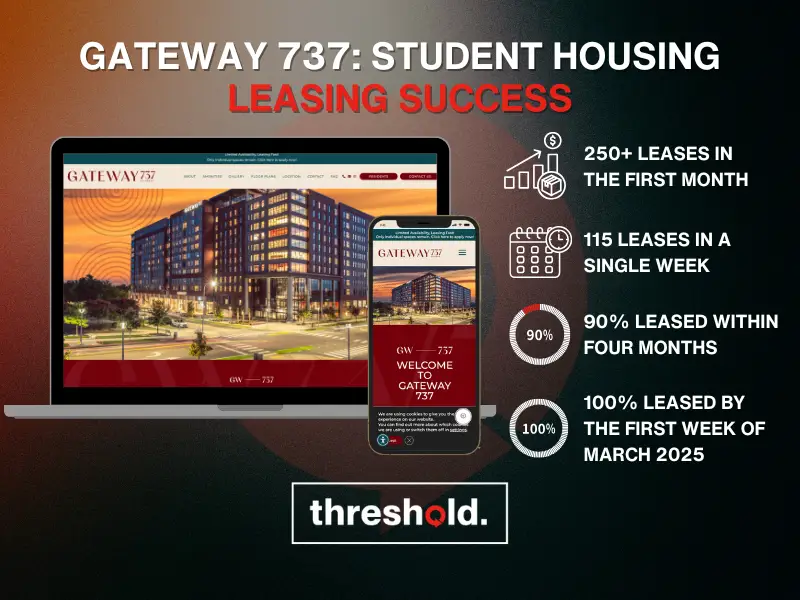
The leasing numbers tell the story:
⭕ 250+ leases in the first month (27.5% leased)
⭕ 115 leases in a single week
⭕ 90% leased within four months of pre-leasing (Sept–Dec 2024)
⭕ 100% leased by the first week of March 2025, months before doors opened
For a brand-new property with zero renewals, that is a rare outcome. Gateway 737 quickly climbed near the top of its market’s pre-leasing charts.
In late 2025, that same work earned:
⭕ Davey Awards Silver for Gateway 737: Student Housing Website
⭕ w3 Silver Award in Real Estate Websites
Dannemora Federal Credit Union: beating growth goals in a tough market.
Client: Dannemora Federal Credit Union (DFCU)
Vertical: Financial – credit unions
Project: Full-funnel digital acquisition campaign
DFCU serves members across four upstate New York counties. Competing against national digital banks and fintechs, they needed to:
⭕ grow new checking accounts and deposits
⭕ stay compliant and on-brand
⭕ maximize value from a finite media budget
the strategy.
Threshold built a multi-stage campaign focused on Kasasa Cash Back checking, with:
⭕ upper-funnel awareness and engagement on Meta and Google Display
⭕ high-intent search campaigns to capture active account shoppers
⭕ tight geographic and behavioral targeting to avoid wasted spend
⭕ persistent retargeting to move warm prospects from “interested” to “opened account”
the results.
Within 12 months, DFCU saw:
⭕ 34% lift in new accounts (596 new accounts against a 20% growth goal)
⭕ 24% lift in deposits, adding $2.4M in new deposits
⭕ search CTR roughly 3x higher than industry benchmarks
This is what “performance marketing” means for financial institutions: measurable member and deposit growth, not just impressions.
Threshold is a go-to partner for banks and credit unions, serving more than 200 financial institutions nationwide with integrated branding, digital, and website work.
Maxwell Downtown Brooklyn: urban lifestyle, conversion built in.
Client: Maxwell Downtown Brooklyn
Vertical: Multifamily
Project: Branding-first website for a new Brooklyn community
Maxwell sits in one of the most competitive rental markets in the country. Prospects compare it to dozens of buildings within a short subway ride and make decisions quickly on mobile.
The site we launched for Maxwell focused on three things:
- neighborhood and lifestyle first – visuals and copy anchor the building in the energy of Downtown Brooklyn, not just unit specs
- clear paths to action – simple journeys from homepage to floor plans, availability, and tour booking
- speed and accessibility – lightweight build, mobile-first layouts, and trust-building content architecture
In 2025, that work earned a Gold Davey Award in the Real Estate Website category
We are also seeing this type of build become the new baseline for our property work: lifestyle-driven, but ruthlessly focused on getting prospects to the next step in the leasing journey.
recognition that followed the work.
None of these projects were built to chase trophies. But it matters when outside judges see the same quality and performance our clients experience day to day.
In 2025, that translated into:
⭕ Davey Awards Gold – Maxwell Downtown Brooklyn, Real Estate Website
⭕ Davey Awards Silver – Gateway 737, Student Housing Website
⭕ w3 Silver Award – Gateway 737, Real Estate Website
⭕ MUSE Creative Silver Award – Straits Row Apartments, Website – Real Estate
⭕ Chief Marketer 2026 Agencies of the Year – Threshold listed among the industry’s top marketing agencies, highlighting the quality and consistency of our work across clients
We also renewed our Great Place to Work® Certification for 2025, which we love most because good culture shows up in the work: engaged teams, smoother collaboration, and ideas that go a layer deeper for clients.
what this means for your 2026 marketing.
Looking back at 2025, a few patterns show up across all of this work:
⭕ the briefs were specific. Grow leases fast, grow deposits by a certain percentage, and hit pre-leasing targets.
⭕ the work was practical. Websites and campaigns were built to do a job: get someone from curiosity to conversion.
⭕ the measurement was intentional. From leasing velocity to cost per conversion, we built every project with a feedback loop.
If you are leading marketing for a real estate brand, a bank or credit union, or another growth-minded organization, here is the simple lens we use:
Can we tie this project to numbers you care about, then design the creative, media, and web experience around that?
If the answer is yes, we are probably a good fit.



 Laura Robbins, Corporate Marketing Manager
