by threshold | Jan 22, 2026 | Creative, Design, Digital Marketing, General, Marketing
When Deborah Hayes Advertising came to Threshold, the brief was clear: design a website for Maxwell Downtown Brooklyn that feels as refined and intentional as the building itself. Maxwell is a 40-story boutique-inspired residential tower in the heart of Brooklyn, where modern living blends creativity, community, and ease. The website needed to reflect that ethos while driving engagement and conversions.
the problem.
Luxury residential websites often feel corporate, overly dense, or disconnected from the lifestyle they promise. Maxwell required something different: a digital presence that feels curated rather than commercial, sophisticated without being stiff, and elevated yet approachable. The challenge was balancing strong visual storytelling with clarity, usability, and leasing performance across devices.
the dream.
We envisioned a website that doesn’t just show Maxwell’s lifestyle—it feels like it. Elegant without excess. Intentional without artifice. Distinctly Brooklyn. The goal was to translate Maxwell’s identity into a calm, editorial digital experience that invites exploration and mirrors the residence’s quiet confidence.
the strategy.
website design.
The visual concept was inspired by effortless sophistication—timeless, confident, and approachable. This guided a restrained visual language rooted in refined typography, a carefully curated color palette, and art-forward photography. Content pacing and generous white space allow the site to breathe, creating a calm browsing experience that reflects the building’s design sensibility.
website development.
User experience guided every technical decision. Clean navigation and a clear content hierarchy help visitors move seamlessly from residences to amenities to lifestyle storytelling. The responsive framework ensures a cohesive experience on desktop, tablet, and mobile. Interactive features—including an embedded virtual tour, refined animations, and real-time pricing and availability—engage visitors while maintaining simplicity. Strategically placed calls to action, such as Schedule a Tour and View Availability, support conversion goals and connect directly to the leasing process.
the results.
The Maxwell Downtown Brooklyn website delivers a sophisticated, user-first digital presence that reflects contemporary urban living—where modern luxury meets creativity, community, and ease. A strong conceptual foundation and meticulous execution elevate the brand while remaining intuitive and performance-driven. The work was recognized with a Gold Davey Award for Website Design, celebrating excellence in digital storytelling and user experience.
Read the full Maxwell Downtown Brooklyn website Case Study.

by threshold | Jan 16, 2026 | General
Most marketing teams are drowning in reports, yet somehow still flying blind.
Dashboards tell you what happened last week or last month, and then by the time you react, the opportunity has moved on.
Predictive analytics changes that dynamic by helping you act on what is likely to happen next, not what just passed.
from rearview mirror to headlights.
Traditional analytics is descriptive. It answers questions like:
→ What channels drove the most leads?
→ Which campaigns had the lowest CPA?
→ How did email perform last quarter?
Useful, but late.
Predictive analytics uses machine learning to answer a different set of questions:
→ Which leads are most likely to convert in the next 30 days?
→ Which customers are at the highest risk of churn?
→ Which offer or product is each segment most likely to respond to?
→ Where should we allocate the next dollar of budget for the highest impact?
Instead of simply measuring performance, you’re now forecasting it and adjusting ahead of time.
what this looks like in practice.
Across industries, the patterns are similar, even if the specifics change:
Real estate and student housing
→ Identify prospects whose behavior signals they are likely to sign a lease soon.
→ Prioritize them for personal outreach, tours, and high-intent retargeting.
Banks and financial institutions
→ Flag members likely to open a new account, apply for a loan, or roll over funds.
→ Trigger personalized offers and education before they start shopping with competitors.
Service-based and subscription brands
→ Detect early signals of disengagement, like reduced logins or lower engagement.
→ Offer a check-in, new feature education, or a loyalty perk before they cancel.
The power shift is simple:
→ You move from reacting to problems to quietly preventing them and amplifying your best opportunities.
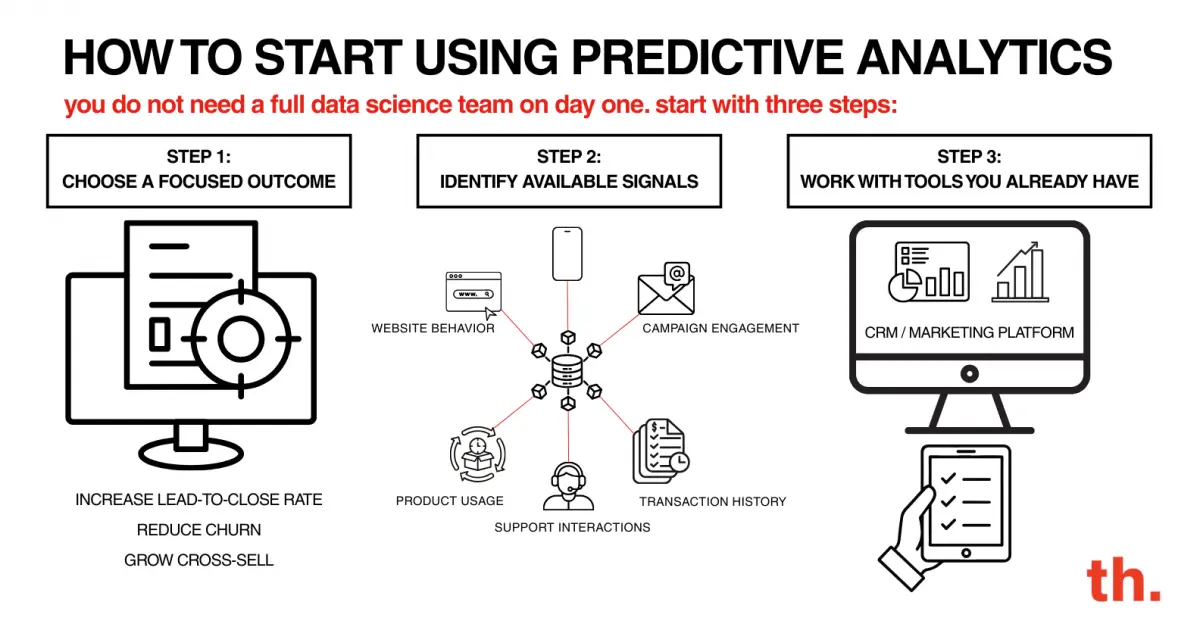
how to start using predictive analytics.
You do not need a full data science team on day one. Start with three steps:
- Choose a focused outcome. For example: “increase lead-to-close rate,” “reduce churn,” or “grow cross-sell for existing customers.”
- Identify available signals. Website behavior, product usage, campaign engagement, support interactions, and transaction history are usual starting points.
- Work with tools you already have. Many CRMs and marketing platforms now include predictive scoring and propensity models. Turn those on, validate them against reality, then train your team to act on the insights.
Predictive analytics is not about replacing human judgment. It’s about giving your team better headlights, so every decision is a little less guesswork and a lot more informed.

by threshold | Dec 18, 2025 | General
If it feels like your audience is moving faster than your marketing, you’re not imagining it.
Consumers are jumping between search, social, AI assistants, text, email, and in-person touchpoints in minutes. In that chaos, AI has moved from an “interesting experiment” to the connective tissue between data, channels, and creative. It is no longer just a copywriting shortcut or a way to spin out more assets.
Used well, AI can be the brain of your marketing engine. Used poorly, it’s one more shiny toy that adds work to your plate without moving the needle.
from gimmick to growth driver.
The teams getting real value from AI are using it to do three big jobs:
- understand audiences at a deeper level.
- Cluster users by behavior and intent, not just demographic labels.
- Surface patterns in campaign performance that are invisible in a standard dashboard.
- create and adapt content faster.
- Draft headlines, ad variations, email copy, and landing page tests in minutes.
- Generate first-pass concepts so writers and designers are editing and elevating, not starting from zero.
- Adjust bids, creative, and offers based on live performance signals.
- Recommend and trigger “next best action” for each segment automatically.
This is why enterprise AI investment has surged: brands are shifting from experimentation to production deployment where AI is embedded into everyday workflows, not sitting in a separate lab.
why ai should be your co-pilot, not your driver.
At Threshold, our stance is simple:
- AI should be your co-pilot, not your driver.
That is the core of AIO: AI-assisted, human-optimized marketing. AI handles the heavy lifting so humans can focus on what actually differentiates your brand:
- Strategy, positioning, and offer design
- Voice, storytelling, and creative judgment
- Cross-channel orchestration and stakeholder alignment
In practice, that means:
- Letting AI pull and summarize performance data so strategists can make faster decisions.
- Using AI to draft concepts that your team refines to match brand standards, compliance, and tone.
- Using AI to scale what you already know works, instead of endlessly guessing at new angles.
where should you start?
If AI still feels abstract, choose one use case where it can clearly save time or improve relevance:
- Analyze the last 90 days of campaign performance and summarize key patterns.
- Generate 10 headline and body variants for a top-performing ad set.
- Build a first-pass content outline for a new landing page, then have your team refine it.
Let that first win prove the value. Then expand deliberately.
- The goal is not to become an “AI-first brand.”
- The goal is to become a brand that uses AI to be more human, more responsive, and more effective at scale.
Make AI work for you: Identify one workflow this quarter where AI can play the role of marketing brain, then set up a simple test to compare outcomes with and without AI in the loop.
Let’s do this.

by threshold | Dec 2, 2025 | General
focused strategies to meet the unique needs of credit unions.
Credit unions excel in trust and community, but today’s members compare you to frictionless digital banks and fintechs. Modern credit union marketing must navigate this tension: driving growth while protecting the mission and competing on experience. Generic bank marketing is not enough; you need strategies built for your member-first DNA.
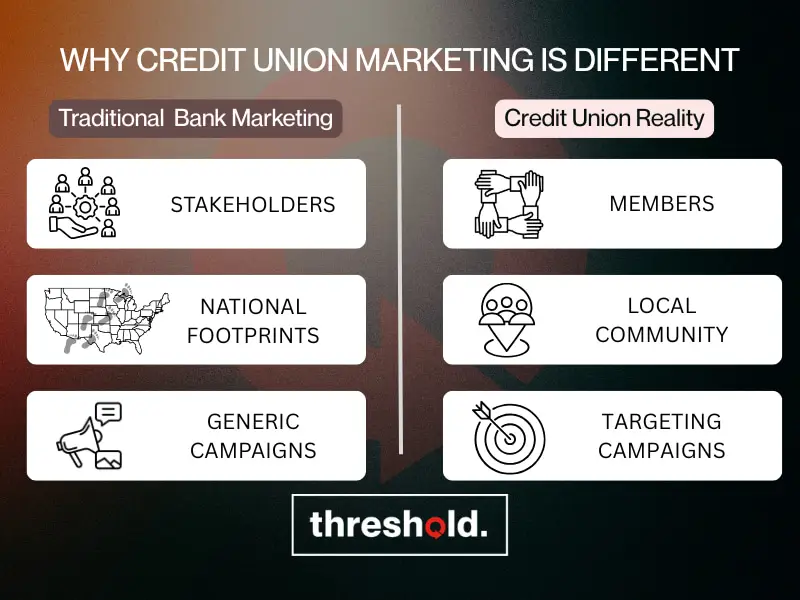
why credit union marketing is different.
Most marketing playbooks are written for national banks or direct-to-consumer brands. Credit unions operate in a completely different reality:
- Member-owned, not shareholder-driven.
Your messaging must show value and stewardship, not pure profit focus.
- Field of membership and geography.
You are often serving a specific region, employer group, or community, which changes how you target and grow.
- Regulatory and compliance requirements.
Every promotion touches disclosures, fair lending, and data privacy.
- High trust, low bandwidth.
Your members trust you with their money, but your internal team is usually lean and wearing multiple hats.
At the same time, your members are living in a digital world:
- About three-quarters of checking account holders are now active digital banking users.
- More than half of consumers want their financial provider to use their data to personalize the experience.
- Yet only about a third feel they are treated as individuals by their bank or credit union.
That gap is your opportunity.
Ready for it?
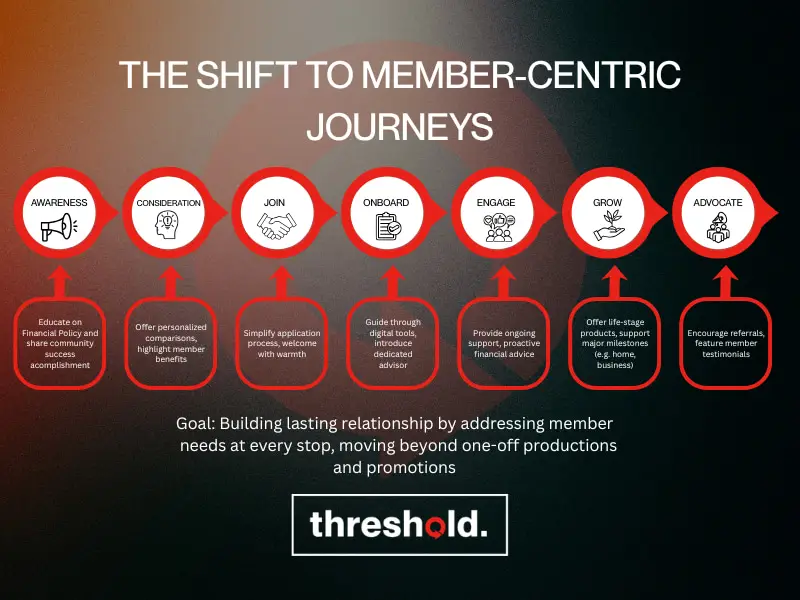
the shift: from product promotion to member-centric journeys.
The most successful credit unions design connected journeys around specific member needs (e.g., “Help first-time homebuyers”). Modern data and AI make this shift practical, driving higher revenue growth and conversion rates through personalization.
At Threshold, we call this people-first marketing, data-powered.
Your mission stays at the center. Data, AI, and automation simply help you deliver that mission more consistently and at scale.
core pillars of tailored credit union marketing.
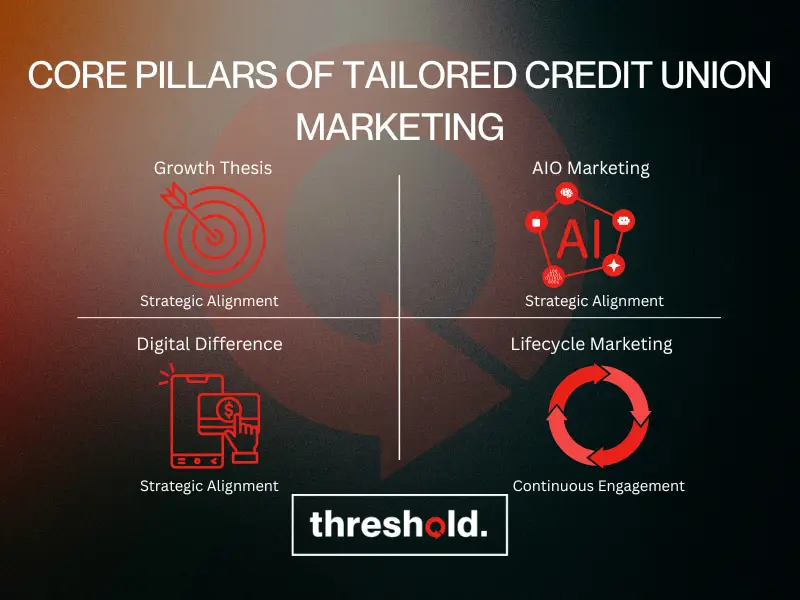
1. clarify your credit union growth thesis.
Define your core growth goal for the next 12–24 months (e.g., Net new Gen Z membership, deposit growth). Then, define your target segment, identify your competitive edge for them, and choose 2-3 core member journeys to focus on (e.g., new member onboarding, auto loan purchase).
2. AIO marketing for credit unions (ai-assisted, human optimized).
AI should augment your team, not replace it. Use AI for:
- Member insights at depth:
Cluster members by behavior and life events.
- Faster, on-brand content:
Draft emails, ads, and copy for your team to refine.
- Smarter targeting:
Predict needs (e.g., auto refi) to trigger relevant campaigns instead of mass blasting.
3. bring the credit union difference into digital.
Your digital presence must reflect the warmth and trust of your branch network through:
- GEO and community-centric positioning:
Local SEO, market-tailored landing pages, and community-focused campaigns.
- Financial wellness as a core content theme:
Educational content and tools that simplify financial decisions.
- Modern experience:
Clear, mobile-first design and intuitive navigation for key tasks.
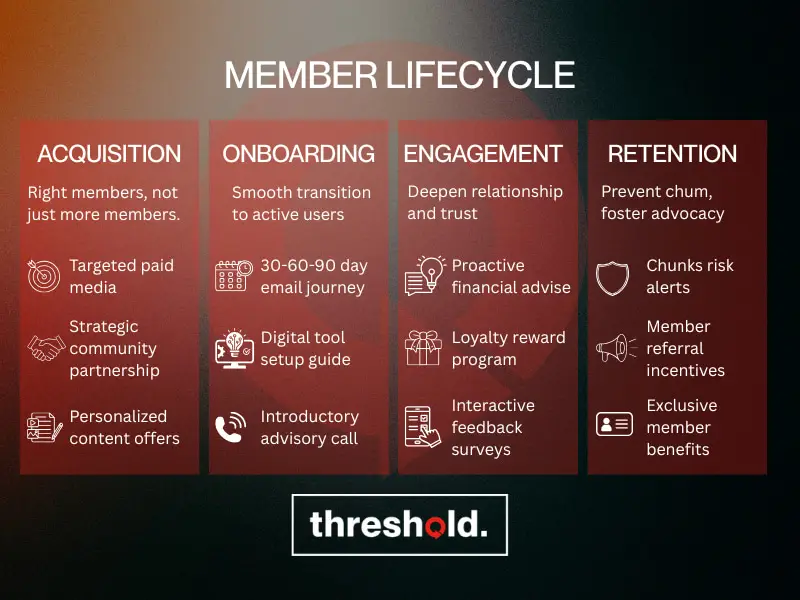
4. lifecycle marketing built around member outcomes
Move beyond isolated campaigns by managing the full member lifecycle:
| STAGE |
GOAL |
KEY TACTICS |
| Acquisition |
Right members, not just more members. |
Targeted paid media, clear differentiation messaging, simple digital onboarding. |
| Onboarding |
Help new members feel “this is my financial home.” |
Structured 30–60–90 day email/SMS journeys, personalized nudges to encourage primary account usage. |
| Engagement |
Deepen the relationship based on real needs. |
Use data to spot likely needs (e.g., auto purchase) and trigger relevant offers or education. |
| Retention |
Keep high-value members, reduce silent attrition. |
Identify churn risk and reach out with check-ins or tailored retention offers. |
5. data, governance, and trust.
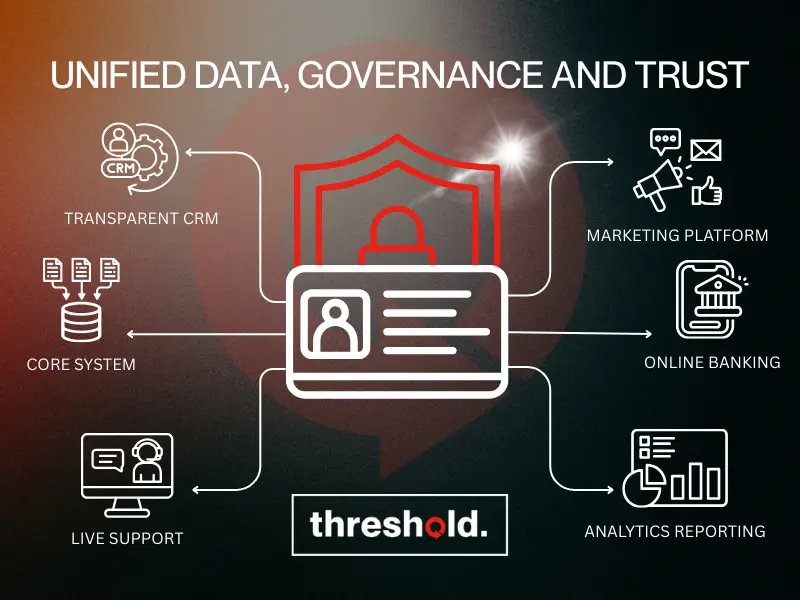
Unify member data across systems for a single view. Establish clear, transparent rules on data use and ensure compliance is involved early in campaign design. When using AI, implement human review, test for bias, and monitor for accuracy. Trust is your strongest asset.
your 90-day tailored marketing plan.
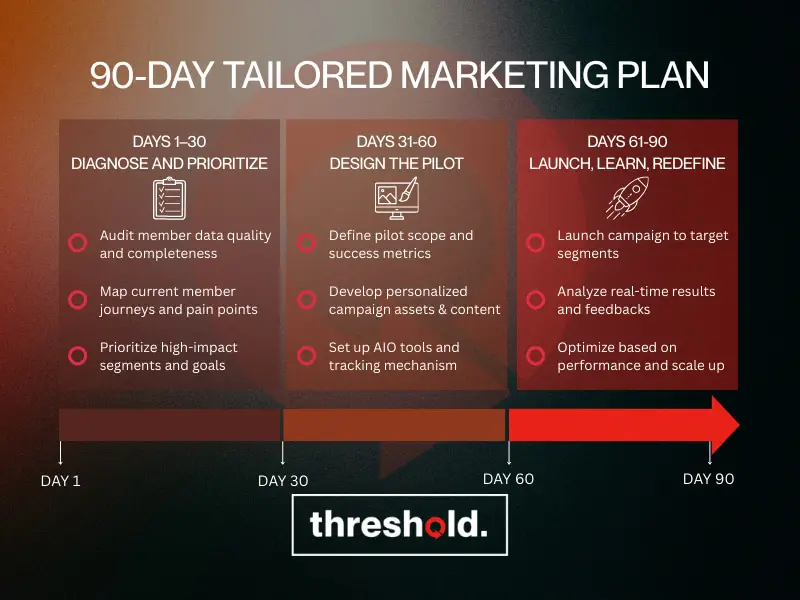
| PHASE |
DURATION |
FOCUS |
| Days 1–30 |
Diagnose and Prioritize |
Choose one primary growth goal, map the current member journey, and audit your tech stack. |
| Days 31–60 |
Design the Pilot |
Identify 1-2 core journeys to improve, draft AIO content, and implement basic personalization rules. |
| Days 61–90 |
Launch, Learn, and Refine |
Launch the pilot, review data and feedback weekly, and optimize flows/offers. |
where threshold fits in.
Ready to turn your member-first mission into a modern, measurable marketing engine? Threshold can help with AIO strategy, GEO expertise, AI search readiness, and performance marketing that drives deposits, loans, and long-term member value.
Reach out for a strategy call today.

by threshold | Nov 12, 2025 | General
Small shops. Big ideas. Real results.
Threshold has been recognized at the 21st Annual Davey Awards with Gold for “Maxwell Downtown Brooklyn” and Silver for “Gateway 737: A Student Housing Website.” These honors celebrate work that blends elegant design with measurable performance for our partners in multifamily and student housing.
Why this win matters for our clients
Awards are not the goal. Outcomes are. These Davey recognitions signal that our website builds meet a rigorous creative standard while staying anchored to the metrics that move your business. When we design a website, we are building a growth engine that supports leasing velocity, brand credibility, and long-term equity.
The work that won

Maxwell Downtown Brooklyn: Gold Winner
A modern property experience that puts the neighborhood, the lifestyle, and conversion clarity front and center. Content architecture, page speed, and streamlined paths to help prospects reach the right floor plan and book tours without friction.

Gateway 737: Silver Winner
A student housing website designed to convert. Clear messaging for parents and students, intuitive mobile UX, and performance-minded visuals that load fast and reinforce trust at every step of the journey.
What the Davey Awards recognize
The Daveys spotlight world-class creative from small and mid-sized teams across websites, design, video, advertising, social, mobile, and emerging tech. For a boutique agency like Threshold, this is the perfect arena. It validates that a focused team with deep category expertise can deliver work that competes at a global level.
The Threshold playbook that turns design into performance
If you are evaluating partners, this is the repeatable system we bring to every engagement.
- Insight before interface
Stakeholder interviews, audience research, and competitive mapping guide the content strategy and funnel design.
- SEO architecture with intent
We build site maps and internal links around search intent and property-specific demand. Structured data, clear headings, and crawlable components help pages surface where prospects actually look.
- Clarity-first UX
Mobile behavior leads our decisions. Fewer taps. Strong CTAs. Intuitive navigation that turns curiosity into booked tours and signed leases.
- Design systems that scale
Reusable components and style tokens keep future pages on brand and easy to roll out across a portfolio.
- Speed, accessibility, trust
Lightweight assets, semantic markup, and WCAG-minded patterns make the experience fast, inclusive, and credible.
- Measurement that closes the loop
Analytics, event tracking, and clear KPIs show what worked and what to improve next. Every build ships with a learning plan.

What this means for 2025 and beyond
Winning is encouragement to push further. You will see more research-driven content, smarter lead routing, stronger local SEO for property pages, and conversion-focused creative across campaigns. Our goal is simple. Build digital experiences that your audience loves and your operators trust.
Work with Threshold
If you are launching a new development, repositioning a property, or leveling up your brand’s web presence, let us show you what performance design can do.
Let’s build your next win.


by threshold | Sep 15, 2025 | Culture, General, Thought Leadership
At Threshold, we believe that a strong company culture isn’t just good for our people but it’s good for our partners. We’re proud to share that Threshold has once again been certified as a Great Place to Work® for 2025, a recognition that highlights the passion, teamwork, and innovation our THeam brings to every client project.
This certification isn’t just about what happens inside our walls. It’s proof that when talented people feel valued, supported, and inspired, they deliver their very best work in helping our clients achieve results that go above and beyond expectations.
Why This Matters for Our Clients
For real estate developers, property managers, and financial institutions, working with a marketing partner is about trust. You need a team that’s aligned, collaborative, and ready to tackle challenges with creativity and precision.
Being a Great Place to Work means that:
⭕ Our people stay engaged → bringing fresh energy and ideas to every campaign.
⭕ Collaboration thrives → ensuring seamless execution across branding, digital marketing, SEO, and advertising.
⭕ Innovation is encouraged → helping us craft strategies that keep you ahead in competitive markets.
In other words, the culture that earned us this certification is the same culture that powers our ability to drive growth for our clients.
Looking Ahead
As we celebrate this recognition, we remain focused on what matters most: helping our clients succeed. From boosting web traffic with data-driven SEO and AEO strategies, to launching integrated campaigns that convert, our motivated THeam is ready to deliver.
When you partner with Threshold, you’re not just hiring a marketing agency, you’re gaining a team that is energized, proven, and passionate about helping your business thrive.
Let’s Build Something Great Together
Whether you’re looking to expand your reach, attract more qualified leads, or reimagine your brand’s presence, Threshold has the expertise and culture to make it happen. Contact us today to explore how we can create marketing solutions that move your business forward.