by threshold | Apr 14, 2026 | Digital Marketing, Financial Marketing
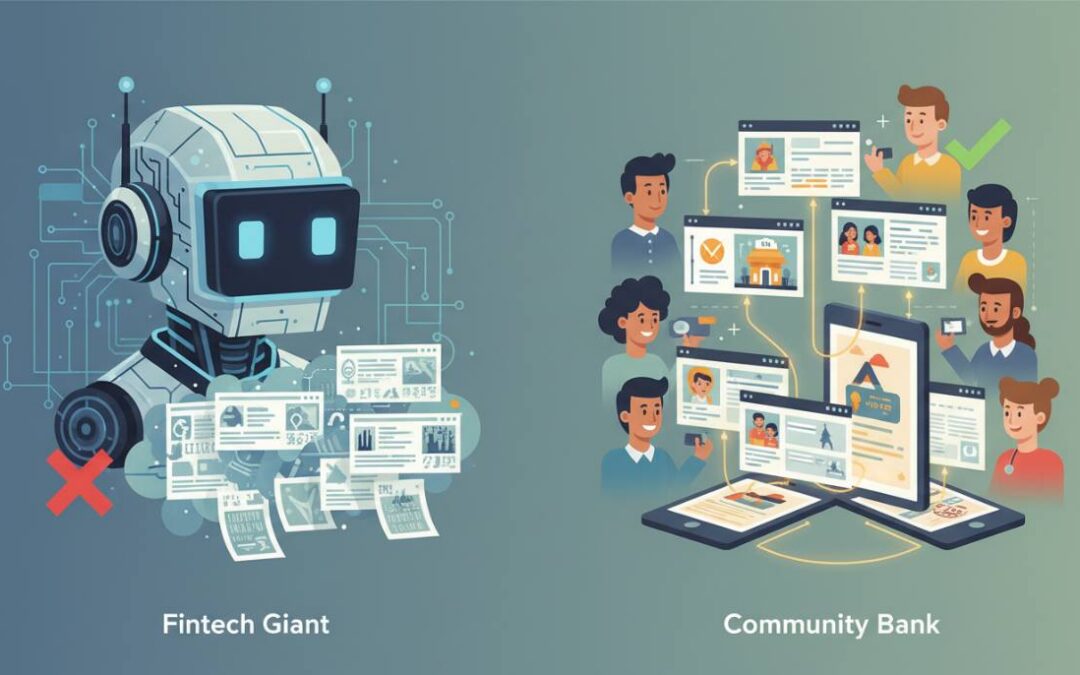
Fintech giants spend billions trying to convince your neighbors that an algorithm understands their lives better than a local banker does. They have the massive budgets and the sleekest apps, but they often miss the mark on the one thing that actually drives a conversion: authentic connection. While the big bots are busy running the same generic ads from coast to coast, community banks have a secret weapon. You know the streets, the schools, and the local economy better than any Silicon Valley server ever could. When you pair that local knowledge with high-speed, hyper-personalized digital creative, you don’t just compete. You win.
the automation gap in fintech marketing.
Most fintech marketing relies on massive data sets to blast out standardized messages. It is efficient, sure, but it is also cold. They use stock photos of people who look like they have never set foot in your town, and the copy feels like it was written by a committee in a high-rise. This creates a massive opening for community banks and credit unions.
When comparing fintech vs community bank marketing, the difference is often found in the “vibe” of the ad creative. A fintech ad feels like a transaction. A community bank ad should feel like a conversation. By focusing on hyper-local banking ads that reflect the actual life of your community, you build a level of trust that a national brand simply cannot replicate.
why hyper-personalized digital ad creative works.
Personalization is about more than just putting a customer’s name in a subject line. It is about showing them that you see what is happening in their world right now. Here is how local institutions are out-pacing the giants:
- reflecting local reality: If a local plant is hiring or a new housing development is breaking ground, your ads can speak directly to those specific milestones.
- visual familiarity: Using imagery of actual local landmarks or recognizable neighborhood aesthetics makes your community bank digital ads feel like they belong in the user’s feed.
- niche problem solving: Fintechs offer broad solutions. You can offer a loan product specifically designed for the challenges facing small businesses on your specific Main Street.
speed beats the algorithm.
One of the biggest hurdles for local banks has historically been the turnaround time for high-quality creative. In the past, by the time a campaign was approved and designed, the market had already shifted. That has changed. Today, the goal is to get high-volume, high-quality creative into the market fast.
When you can react to a local interest rate shift or a community event within 24 hours, you aren’t just a bank. You are a relevant part of the daily news cycle. This agility is exactly how credit union lead generation stays ahead of rigid national competitors who have to jump through months of corporate red tape to change a single headline.
The modern consumer doesn’t want a bank that just holds their money. They want a partner that understands their zip code.
scaling your creative without losing the human touch.
A common fear for marketing directors at community banks is that increasing the volume of digital ads will lead to a drop in quality or a “robotic” feel. It doesn’t have to be that way. The key is to build a system where personalized financial marketing is the standard, not a special project.
By using a dedicated creative partner who understands the regulatory landscape and the local culture, you can produce dozens of ad variations that feel hand-crafted. You get the speed of a fintech with the soul of a community institution. This balance of high-end design and local heart is what stops the scroll and gets the click.
ready to out-convert the giants?
You have the local trust and the community roots. All you need is the creative engine to tell that story at scale. Whether you are looking to boost your mortgage applications or grow your core deposits, we specialize in making the “impossible” turnaround times look easy. If you need high-volume, hyper-local digital ads that actually move the needle, we are here to help. Yep, we can do that.

by threshold | Dec 15, 2025 | Culture, Digital Marketing, Financial Marketing
the work behind the awards.
At the start of 2025, we were clear on what “good” needed to look like:
⭕ launch websites and campaigns that actually move leasing, accounts, and deposits
⭕ prove impact with real numbers, not just nice creative
⭕ keep things fast and affordable enough for lean internal teams
By the end of the year, we had student housing projects that fully leased ahead of opening, financial campaigns that beat growth goals, and property websites delivering multi-digit conversion lifts.
The awards were a bonus. The real story is the work.
Below are a few of the projects that defined 2025 for Threshold, and the results that earned recognition from Davey Awards, w3 Awards, MUSE Awards, and a spot on Chief Marketer’s 2026 Agencies of the Year list.
Gateway 737: from zero brand to 100% leased.
Client: Holder Properties
Vertical: Student housing
Project: Full brand build, website, and leasing strategy for a 940-bed community in Columbia, SC
the challenge.
Gateway 737 started in 2024 with no name, no brand, no website, and no renewals to lean on. It would open in August 2025 in a competitive University of South Carolina market, surrounded by established communities with years of word-of-mouth.
The brief was simple and unforgiving:
“Build a brand and digital presence that lets a brand-new property compete like a market leader.”
what we did.
⭕ named and branded the community from the ground up, including logo, color system, and messaging that speaks to USC student life
⭕ launched a high-converting landing page early, then a full site focused on fast floor-plan discovery, mobile UX, and clear CTAs
⭕ turned every physical touchpoint into media, from brochures to a construction trailer that transformed into a leasing lounge
⭕ focusing on organic engagement and cultural resonance—via on-campus events, strong social media, and an authentic brand—rather than high media spending.
the results.
The leasing numbers tell the story:
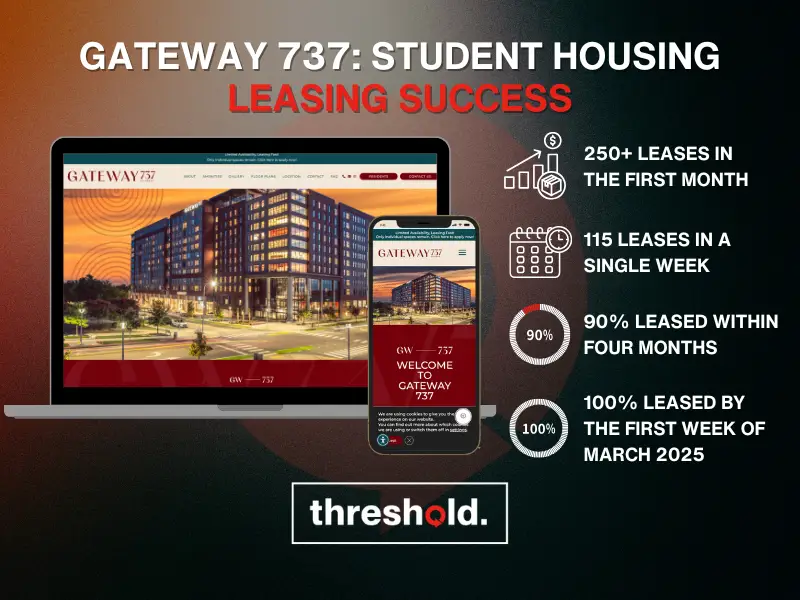
⭕ 250+ leases in the first month (27.5% leased)
⭕ 115 leases in a single week
⭕ 90% leased within four months of pre-leasing (Sept–Dec 2024)
⭕ 100% leased by the first week of March 2025, months before doors opened
For a brand-new property with zero renewals, that is a rare outcome. Gateway 737 quickly climbed near the top of its market’s pre-leasing charts.
In late 2025, that same work earned:
⭕ Davey Awards Silver for Gateway 737: Student Housing Website
⭕ w3 Silver Award in Real Estate Websites
Dannemora Federal Credit Union: beating growth goals in a tough market.
Client: Dannemora Federal Credit Union (DFCU)
Vertical: Financial – credit unions
Project: Full-funnel digital acquisition campaign
DFCU serves members across four upstate New York counties. Competing against national digital banks and fintechs, they needed to:
⭕ grow new checking accounts and deposits
⭕ stay compliant and on-brand
⭕ maximize value from a finite media budget
the strategy.
Threshold built a multi-stage campaign focused on Kasasa Cash Back checking, with:
⭕ upper-funnel awareness and engagement on Meta and Google Display
⭕ high-intent search campaigns to capture active account shoppers
⭕ tight geographic and behavioral targeting to avoid wasted spend
⭕ persistent retargeting to move warm prospects from “interested” to “opened account”
the results.
Within 12 months, DFCU saw:
⭕ 34% lift in new accounts (596 new accounts against a 20% growth goal)
⭕ 24% lift in deposits, adding $2.4M in new deposits
⭕ search CTR roughly 3x higher than industry benchmarks
This is what “performance marketing” means for financial institutions: measurable member and deposit growth, not just impressions.
Threshold is a go-to partner for banks and credit unions, serving more than 200 financial institutions nationwide with integrated branding, digital, and website work.
Maxwell Downtown Brooklyn: urban lifestyle, conversion built in.
Client: Maxwell Downtown Brooklyn
Vertical: Multifamily
Project: Branding-first website for a new Brooklyn community
Maxwell sits in one of the most competitive rental markets in the country. Prospects compare it to dozens of buildings within a short subway ride and make decisions quickly on mobile.
The site we launched for Maxwell focused on three things:
- neighborhood and lifestyle first – visuals and copy anchor the building in the energy of Downtown Brooklyn, not just unit specs
- clear paths to action – simple journeys from homepage to floor plans, availability, and tour booking
- speed and accessibility – lightweight build, mobile-first layouts, and trust-building content architecture
In 2025, that work earned a Gold Davey Award in the Real Estate Website category
We are also seeing this type of build become the new baseline for our property work: lifestyle-driven, but ruthlessly focused on getting prospects to the next step in the leasing journey.
recognition that followed the work.
None of these projects were built to chase trophies. But it matters when outside judges see the same quality and performance our clients experience day to day.
In 2025, that translated into:
⭕ Davey Awards Gold – Maxwell Downtown Brooklyn, Real Estate Website
⭕ Davey Awards Silver – Gateway 737, Student Housing Website
⭕ w3 Silver Award – Gateway 737, Real Estate Website
⭕ MUSE Creative Silver Award – Straits Row Apartments, Website – Real Estate
⭕ Chief Marketer 2026 Agencies of the Year – Threshold listed among the industry’s top marketing agencies, highlighting the quality and consistency of our work across clients
We also renewed our Great Place to Work® Certification for 2025, which we love most because good culture shows up in the work: engaged teams, smoother collaboration, and ideas that go a layer deeper for clients.
what this means for your 2026 marketing.
Looking back at 2025, a few patterns show up across all of this work:
⭕ the briefs were specific. Grow leases fast, grow deposits by a certain percentage, and hit pre-leasing targets.
⭕ the work was practical. Websites and campaigns were built to do a job: get someone from curiosity to conversion.
⭕ the measurement was intentional. From leasing velocity to cost per conversion, we built every project with a feedback loop.
If you are leading marketing for a real estate brand, a bank or credit union, or another growth-minded organization, here is the simple lens we use:
Can we tie this project to numbers you care about, then design the creative, media, and web experience around that?
If the answer is yes, we are probably a good fit.

by threshold | Dec 5, 2025 | Financial Marketing, Thought Leadership
 Laura Robbins, Corporate Marketing Manager
key takeaways.
the fintech threat is a perception problem:
Fintechs win by exploiting the experience gap and trust paradox, stealing market share through superior speed, transparency, and value alignment. Traditional financial institutions must realize they cannot simply build their way out; they must strategically out-market fintechs on value and trust to shift customer perception.
strategy must be hyper-personalized and authentic:
The path to winning requires leveraging rich customer data via AI-powered hyper-personalization to deliver the next best action. Simultaneously, institutions must deploy bold, trust-first branding that is highly authentic, transparent, and actively highlights social responsibility to connect with digital-native consumers.
marketing demands a frictionless experience:
Success requires extending the marketing strategy into operational processes to eliminate brand friction across the entire customer lifecycle. The goal is a seamless, unified experience where digital convenience is matched by the availability of human trust for complex issues, making your institution the effortless choice.
The narrative of financial institutions is being rewritten by disruption. Fintech companies are actively dismantling traditional revenue streams by exploiting the friction points that legacy systems created. The question is no longer if this is happening, but how quickly you will deploy a strategic defense.
the silent erosion: where fintechs are winning.
Fintechs—from challenger banks to online lenders—have mastered simplicity, speed, and hyper-personalization. They’ve capitalized on three key weaknesses inherent in the traditional banking model:
the experience gap:
Customers, particularly the digital-native Generation Z, prioritize seamless, mobile-first experiences. Fintechs deliver this instantly (e.g., Venmo, digital account opening). Traditional banks struggle to keep up due to core system debt and complex processes that often lead to user frustration. This extends to product features: Fintechs offer flexible payment options (like embedded installment plans) and goal-based saving tools (named savings buckets), which traditional banks often lack.
the segment scramble:
Fintechs offer category-killer solutions by laser-focusing on niche, underserved segments (e.g., faster small business loan approvals, robo-advisors). They are capturing high-value, profitable relationships that traditionally belonged to banks.
the trust paradox:
While banks own historical trust, fintechs build contemporary credibility through radical transparency and superior service (e.g., clear fee structures, 24/7 digital support). They are nurturing customer loyalty at a speed traditional banks simply cannot match. Fintechs also win by showcasing clear alignment with customer values, turning financial services into a form of community building and identity expression.
This erosion threatens your two most valuable assets: brand power and the fundamental customer relationship.
the mistaken strategy: product vs. perception.
Many financial institutions believe the answer is to simply build a new app or launch a singular digital product. This is a crucial mistake. You are treating a perception problem with a product solution.
Fintechs are winning because their marketing and branding strategy makes their customer experience feel simpler, faster, and more aligned with modern life.
You can’t out-innovate a start-up on speed; you must strategically out-market them on value and trust.
reclaiming the customer narrative.
Winning against fintech requires financial institutions to bridge the gap between their established foundation of trust and capital and the digital-first expectations of today’s consumer—Threshold’s specialty.
This bridge is built upon four interconnected strategic pillars:
1. identity resolution & hyper-personalization.
The advantage of traditional institutions lies in their rich, historical customer data. The strategy is to deploy AI-powered identity resolution to create a complete, 360-degree customer view. This enables the execution of truly hyper-personalized marketing campaigns that proactively address customer needs, leveraging the data you already own.
2. content-to-credibility pipeline.
Traditional banks must shift from transactional messaging to acting as a trusted advisor. This involves developing a robust content strategy (including thought leadership, interactive tools, and videos) that addresses customers’ core financial anxieties. This content must be easily digestible and entertaining, delivered directly within the mobile app or through social channels, focusing on critical topics such as debt, saving for retirement, and budgeting. This process enables you to establish your authority and credibility in the market, making your institution the default source of reliable financial knowledge.
3. frictionless brand experience.
Marketing must extend beyond campaigns into operational processes. This means mapping the institution’s entire customer lifecycle to eliminate brand friction. The ideal modern experience acknowledges that while digital must be exceptional, Gen Z still values the peace of mind that a physical branch provides for complex issues. The strategic goal is to ensure that all marketing collateral, digital assets, and customer communications speak with a unified, simplified voice, making it effortless for customers to choose and transact with you, from application to everyday service.
4. bold, trust-first branding.
Your brand image must communicate security while embracing modern relevance. Institutions must adopt bold, trust-first branding that demands authenticity, as younger consumers can easily spot performative marketing. By utilizing community marketing and social engagement strategies to emphasize social responsibility, environmental sustainability, and ethical leadership, financial institutions can be positioned as approachable, supportive pillars in their customers’ lives, effectively countering the often impersonal nature of many fintechs.
The war for the future of finance is a war for customer relevance. You have the history, the capital, and the regulatory advantage. Now, you need the marketing agility to match the disruption.
expert application: proof of concept.
For a financial institution, every strategic goal is an investment in your mission and the financial health of your members. Success is measured not just in growth, but in the sustained trust and security you provide.
To demonstrate the power of this multi-layered framework, consider Dannemora Federal Credit Union (DFCU), a smaller credit union client that was facing intense competition from large, well-known digital banks. With the population of DFCU’s field of membership being limited to Clinton, Essex, Franklin, and St. Lawrence Counties in New York, the strategic imperative was to attract new members efficiently. (Check out our Case Study here.)
DFCU engaged Threshold to develop a strategy focused on three clear goals:
| STRATEGIC GOAL |
RESULT |
| Increase new account holders & deposits by 20% |
34% lift in new accounts (596 accounts in <12 months) |
| Boost brand awareness within the field of membership |
24% lift in deposits ($2.4MM increase in <12 months) |
| Meet or exceed industry benchmark for search CTR |
3x higher search CTR compared to industry benchmark |
how we surpassed our goals.
Threshold’s strategy for DFCU centered on a high-impact, multi-stage digital campaign designed to maximize new account acquisition for Kasasa Cash Back® checking.
The initial phase focused heavily on awareness and engagement, leveraging platforms like Meta and the Google Display Network to deliver visually engaging and informative advertisements that clearly showcased the unique benefits of the Kasasa Cash Back® checking accounts. This top-of-funnel reach was amplified by utilizing precision audience targeting, which combined geographical location data, user interests, and signals indicating active intent to open a checking account, ensuring marketing spend was directed toward the most qualified prospects.
The final, critical stage involved a robust retargeting strategy designed to reinforce the conversion process and encourage retention. This was executed through personalized, persistent messaging across both the Google and Meta ecosystems, guiding warm leads who had previously shown interest toward opening an account.
dominate the financial institution market.
Threshold partners with financial institutions to develop these robust, multi-layered strategies. We bring the expertise to help you compete, ensuring your marketing strategy is a source of strength and compliance, not a point of vulnerability.
The war for the future of finance is a war for customer relevance. You have the history, the capital, and the regulatory advantage. Now, you need the marketing agility to match the disruption.
Stop trying to copy the fintech product. Start dominating the fintech narrative.

by threshold | Jul 30, 2025 | Digital Marketing, Financial Marketing, Marketing
Big Budgets Don’t Always Win — Smarter Marketing Does
Let’s be honest: when it comes to ad spend, local banks and credit unions can’t outspend the big banks. But that doesn’t mean they can’t outsmart them.
In fact, the most successful credit union marketing strategies don’t just replicate what the big players do, they take advantage of what credit unions do better: local relevance, community connection, and trust. When paired with a sharp digital strategy, those strengths can become a serious competitive edge.
At Threshold, we help financial institutions build campaigns that don’t just make noise; they drive growth. Here’s how we help local banks and credit unions win in a crowded market.
1. Stop Competing on Rates. Start Competing on Relevance.
Everyone’s shouting about “great rates.” But most consumers can’t tell the difference between 4% and 4.07%, especially if the ad looks like every other banner in their feed.
If you want to stand out, shift your message from product first to person first. What problem are you solving? What moment are you showing up for?
We help community banks and credit unions develop campaigns that speak to life stages, not just loan terms, like:
⭕ “Ready to ditch student loans?” vs. “Auto loans as low as 6.3% APR”
⭕ “First car? We’ll help you make the smartest move” vs. “Low rates on used car loans”
It’s about speaking human and being helpful before being promotional.
2. Zero In on the Right Audience — Not Just the Right Keywords
Big banks often rely on broad targeting and brand recognition. Community banks and credit unions don’t have that luxury which is why your campaigns need to be smarter from the start.
Threshold uses behavioral data, intent signals, and geographic targeting to build hyper-relevant media strategies. Whether it’s Google Ads, Meta, or programmatic platforms, we focus your spend on the people most likely to convert and tailor your messaging to what they care about.
💡 Case in Point:
With Dannemora Federal Credit Union, we built a multi-channel strategy that increased account openings by 34% YoY. See the full case study →
3. If You Want Younger Members, You Need Younger Platforms
Younger audiences aren’t ignoring banks, they’re just ignoring boring ads. If you’re only showing up on Facebook or running static search ads, you’re missing the channels where Gen Z and Millennials actually spend time.
We help credit unions activate on:
⭕ Short-form video platforms like TikTok, Reels, and YouTube Shorts
⭕ Performance-driven Meta and Google campaigns with relevant creative and messaging
⭕ Landing pages & websites that match the tone and intent of younger search behavior
Younger users don’t want to read five paragraphs about your credit card program. They want short, punchy value statements and a clear path to act.
4. Local Still Wins If You Show Up Right
One of the biggest advantages community banks and credit unions have over big banks is local trust. But too often, that local edge gets lost in generic campaign messaging.
We help local banks and credit unions bring their community connection to life through digital campaigns that feel personal, familiar, and rooted in place, even at scale.
That means:
⭕ Using creative and copy that reflects local culture, seasonality, and language
⭕ Geo-targeting ads to cities, counties, or regions that matter most
⭕ Customizing offers and messaging to align with what’s happening in your market
You don’t need a massive brand campaign to make an impact. You just need to sound like you’re part of the community you serve.
5. Conversion-Ready Landing Pages Make All the Difference
You paid to get the click. Don’t lose the lead. Your website experience needs to do more than inform. It needs to convert.
We build conversion-focused landing pages that:
⭕ Align perfectly with your campaign message
⭕ Use clear calls to action (not just “Learn More”)
⭕ Make it easy for users to complete their next step whether that’s opening an account, scheduling a call, or checking eligibility
This is where smaller institutions can out-perform the big guys: less red tape, faster pivots, more personalized journeys.
You Don’t Need to Be Bigger. You Just Need to Be Smarter.
Community banks and credit unions have always won on relationships, but now you need to win on relevance, too. With the right digital strategy, creative that actually connects, and a performance mindset, you can reach the right people, drive more conversions, and build loyalty that lasts.
And you don’t need a national budget to do it.
Want to Compete Smarter?
Let’s talk about how Threshold helps community banks and credit unions turn strategy into results.

by threshold | Feb 24, 2025 | All, Culture, Digital Marketing, Financial Marketing, General, Marketing
 Ava Page-Arnold
how financial institutions can use content to build trust and drive engagement.
In an industry built on trust and credibility, financial institutions can no longer afford to overlook content marketing. Today’s consumers don’t just want products and services—they want education, guidance, and reassurance before making financial decisions. That’s where a strong content marketing strategy comes in.
At Threshold, we specialize in financial institution marketing, helping banks, credit unions, and fintech companies create strategic, high-performing content that builds trust, strengthens customer relationships, and drives business growth. With years of experience in the industry, we understand the unique challenges financial brands face, from compliance regulations to evolving consumer expectations.
In this guide, we’ll break down the best practices for content marketing in the financial sector, ensuring your institution stands out, engages your audience, and builds long-term customer loyalty.
why content marketing is essential for financial institutions.
The days of traditional banking ads and impersonal marketing are over. Today’s consumers expect educational, relevant, and accessible financial content. A well-crafted content strategy can:
⭕️ Position your brand as a trusted financial authority
⭕️ Educate customers on complex financial topics
⭕️ Increase website traffic and improve SEO rankings
⭕️ Nurture leads and improve conversion rates
⭕️ Enhance customer retention through ongoing engagement
Simply put, content marketing bridges the gap between your expertise and your audience’s needs.
best practices for financial content marketing
focus on education, not just promotion.
Consumers don’t want a sales pitch—they want clear, actionable financial advice. The most successful financial brands prioritize education over direct selling, offering value first and building trust before ever making an offer.
⭕️ how to do it right:
- Write blog posts that break down complex financial topics (e.g., “How to Improve Your Credit Score in 6 Months”).
- Create financial planning guides, checklists, and explainer videos.
- Use real-life examples and case studies to illustrate financial principles.
example: Instead of just promoting mortgage rates, publish a guide titled “Buying Your First Home: A Step-by-Step Financial Checklist.” This positions your brand as a helpful resource rather than just a service provider.
optimize for search (SEO) to reach the right audience.
Your content won’t drive results if no one can find it. SEO (Search Engine Optimization) is crucial for ensuring your financial content ranks high in search results and reaches the right audience.
⭕️ SEO strategies for financial content:
- Conduct keyword research to find high-intent search terms (e.g., “best retirement savings strategies”).
- Optimize blog titles, meta descriptions, and headings with relevant keywords.
- Use FAQ pages and schema markup to improve visibility in Google’s featured snippets.
- Regularly update older content to keep it fresh, relevant, and SEO-friendly.
example: A credit union writing about personal loans should optimize content for long-tail keywords like “best personal loan options for home renovation” instead of just “personal loans.”
build trust with customer stories and testimonials.
Financial decisions carry high stakes, and consumers need reassurance before choosing a provider. Sharing real customer experiences can add authenticity and credibility to your marketing efforts.
⭕️ how to leverage customer stories:
- Publish success stories showing how your institution helped customers reach their financial goals.
- Create video testimonials featuring real clients discussing their positive experiences.
- Showcase real data and case studies to back up your claims.
example: A small business owner sharing their journey of securing a loan through your institution can resonate more powerfully than a generic product page listing loan rates.
personalize content for different customer segments.
Not all financial customers have the same needs. A first-time homebuyer requires different advice than a retiree planning for their next chapter. Personalized content ensures your messaging is relevant and impactful for every audience segment.
⭕️ ways to personalize financial content:
- Segment email newsletters based on customer demographics and interests.
- Offer interactive tools like mortgage calculators, savings planners, or financial health assessments.
- Create industry-specific content (e.g., financial planning for small business owners vs. individual investors).
example: Instead of a generic blog about credit cards, create separate guides:
✔ “Best Credit Cards for College Students”
✔ “How to Use a Business Credit Card for Cash Flow Management”
use a multi-channel approach.
Consumers engage with financial content in multiple ways—some prefer reading blogs, others engage with social media, and some prefer watching short videos. Your content strategy should span multiple platforms to maximize reach and engagement.
⭕️ how to diversify your content:
- Blog Articles: Write in-depth, SEO-optimized content on trending financial topics.
- Short-Form Videos: Share quick financial tips on Instagram Reels, TikTok, and YouTube Shorts.
- Webinars & Podcasts: Host Q&A sessions with financial experts.
- Infographics & Carousels: Create visually engaging explainers for social media.
example: A personal finance company could write a blog on “5 Budgeting Tips for Families”, then turn the key takeaways into a 30-second Instagram Reel and a LinkedIn carousel post.
to wrap things up.
Financial institutions that embrace content marketing as a long-term strategy will gain a competitive edge, build stronger customer relationships, and establish themselves as industry leaders. By prioritizing educational content, SEO best practices, personalization, and multi-channel engagement, financial brands can create lasting connections with their audience.
Ready to elevate your content marketing strategy? Let’s get you started.