by threshold | Oct 1, 2026 | Digital Marketing, General, Thought Leadership
 Laura Robbins, Corporate Marketing Manager
key takeaways.
- The gap between click and lease is the stretch of the leasing funnel no one owns: what happens after a prospect clicks an ad and before they sign a lease.
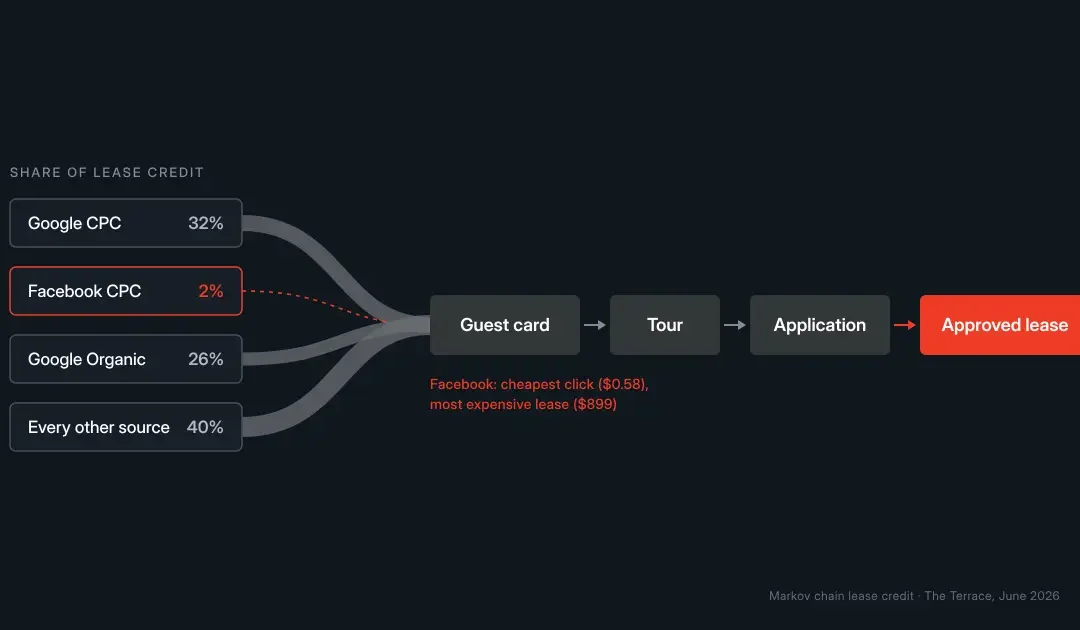
- At The Terrace, an apartment community Threshold tracked in June 2026, Facebook had the cheapest clicks ($0.58) but the most expensive leases ($899 per approved lease). Google search cost $3.75 per click and $500 per lease.
- Most marketing reports stop at the lead, so budget decisions get made on cost per click instead of cost per lease.
- Closing the gap usually means reallocating the budget you already have, not spending more.
Marketing rarely fails loudly. It leaks, and most reports can’t see where.
At The Terrace, Facebook delivered the cheapest clicks on the board: $0.58 each, about 6.5× cheaper than Google search. When Threshold followed those clicks all the way to signed leases, Facebook turned out to be the most expensive channel the property paid for: $899 per approved lease, compared with $500 for Google.
A report that stopped at clicks would have called Facebook the best deal going.
what is the gap between click and lease?
The gap between click and lease is everything that happens between a prospect clicking an ad and signing a lease: the landing page, the guest card, the tour, the application, and the approval. It’s where most leasing budgets leak, because no single team owns it and no standard report measures it.
Property marketing is usually split across three teams:
- Digital teams own reach, targeting, and cost per click
- Website teams own design, floor plans, photos, and content
- Leasing teams own the tour, the application, and the lease
Each one can be “working.” Together, they often aren’t. Ad platforms know who clicked. The property management system knows who signed. Nothing connects the two.
why do good property websites still underperform?
Property websites underperform when they aren’t built for the campaigns driving traffic. A site can have professional photography, virtual tours, and fast load times and still lose prospects because the page doesn’t match what earned the click.
Common examples in multifamily, student housing and senior living:
- An ad for a move-in special lands on a homepage where the special is nowhere in sight
- A search for a pet-friendly two-bedroom lands on a generic floor plans page
- A student housing pre-leasing campaign lands on a page that doesn’t show which floor plans are still available
- In senior living, the adult child doing the research lands on content written only for the resident
- Scheduling a tour takes several clicks, a form, and a callback
Nothing feels wrong, but nothing pulls the prospect forward either. A prospect with three other properties open in other tabs doesn’t wait to be pulled.
why is the click the most expensive moment in leasing?
The click is the moment when a prospect’s intent is clearest, their expectations are highest, and their attention is shortest. If the landing page doesn’t immediately confirm they’re in the right place and make the next step obvious, momentum is lost, and the prospect returns to a listing site.
The next step should be unmistakable: check availability, schedule a tour, or submit a guest card. No amount of bid optimization upstream can win back a prospect who left at this point.
why can’t most marketing reports see the gap?
Most marketing reports stop at the lead. They show clicks, cost per click, and sometimes guest cards, but not which guest cards became tours, applications, or signed leases, because that data lives in the property management system. As a result, budget goes to the channels with the cheapest clicks, not the cheapest leases.
When Threshold connected website analytics, ad platform data, and Entrata (The Terrace’s property management system) for June 2026, the full funnel looked like this:
- 7,001 website visits
- 161 guest cards (2.9% of website users)
- 35 approved leases (about 1 in 5 guest cards)
- $179 in blended ad spend per approved lease
Channel by channel, the picture changed:
- Organic search earned 25.8% of lease credit on $0 in ad spend.
- Listing sites earned 11.5% of lease credit (Apartment Guide 6.0%, CoStar 5.5%), a figure you can now weigh against their commissions.
- ChatGPT already appeared as a lead source, earning 1.5% of lead credit, tied with Bing.
None of that is visible in a report that ends at the click.
what is click-to-lease attribution?
Click-to-lease attribution tracks every prospect from their first website visit through guest card, tour, application, and approved lease, then credits each marketing channel for its role in producing signed leases. It connects ad platforms, website analytics, and the property management system into one report, so cost per lease can be calculated channel by channel.
Threshold’s model uses Markov chain attribution, which works in three steps:
- Map every path: chart each route prospects took from first click to signed lease.
- Remove a channel: take one channel out of the map and recalculate the odds of conversion.
- Measure the drop: the leases that disappear are that channel’s credit.
Unlike last-click attribution, this credits every touchpoint for what it contributed, not just the final one.
why doesn’t more optimization fix the problem?
Optimizing one channel can’t fix a broken handoff between channels. When digital, website, and leasing data aren’t connected, teams tune the part they own while the gap between them stays open.
That shows up as:
- Channels that look cheap getting more budget, even when they don’t sign leases
- Landing page fixes waiting in a queue behind other priorities
- Learning loops stretching from days to months
Performance plateaus. The team is capable, but no one can see the whole system.
how do you close the gap between click and lease?
You close the gap by running digital, website, and leasing as one system, measured against signed leases instead of clicks. In practice:
- Campaign intent shapes the landing experience, so the special in the ad is the first thing on the page
- The next step is obvious: check availability, schedule a tour, apply
- Every channel is measured to the signed lease, not the click
- Budget follows leases, not traffic
- Insights arrive in days, not quarters
Most importantly, someone owns the outcome (occupancy), not just a channel.
does closing the gap require more ad spend?
No. Closing the gap usually means reallocating existing budget, not increasing it. At The Terrace, the biggest opportunity was moving dollars from the channel with the cheapest clicks (Facebook) to the channel with the cheapest leases (Google search), and protecting the organic search that was signing leases for free.
Same budget, pointed at what actually fills units.
the takeaway.
If your campaigns are driving traffic but not move-ins, the problem may not be targeting, creative, or budget. It may be that no one owns the gap between click and lease, or can even see it.
Close that gap, and occupancy tends to follow.
frequently asked questions.
What’s the difference between cost per click and cost per lease?
Cost per click is ad spend divided by clicks. Cost per lease is ad spend divided by the approved leases a channel is credited with. The two can point in opposite directions: at The Terrace, Facebook was 6.5× cheaper per click than Google but 1.8× more expensive per lease.
Why would the cheapest click produce the most expensive lease?
Low-cost clicks often come from prospects with lower intent. They browse but rarely submit a guest card, tour or apply. A channel can drive lots of cheap traffic and still contribute very few signed leases.
What data does click-to-lease attribution use?
It uses data most properties already have: website analytics for sessions and sources, ad platforms for spend and clicks, and the property management system (such as Entrata) for guest cards, applications, and approved leases.
Are listing sites (ILSs) worth their commissions?
It depends on how many leases they produce. Click-to-lease attribution shows each listing site’s share of lease credit, which you can compare directly against the commission it charges. At The Terrace, listing sites earned 11.5% of lease credit in June 2026.
Is ChatGPT sending prospects to apartment websites?
Yes. At The Terrace, ChatGPT earned 1.5% of lead credit in June 2026, the same share as Bing. Attribution reporting makes it possible to spot new channels like this the month they appear.
Does this apply to student housing and senior living?
Yes. The funnel stages and names differ (pre-leasing in student housing, move-ins and family decision-makers in senior living), but the gap is the same: what happens between the click and the signed lease is rarely owned or measured.

by threshold | May 14, 2026 | Digital Marketing, Marketing, Tech/Web
If you look at industry averages, a “good” digital campaign is often defined by steady traffic and a handful of leads. But for many businesses, those leads never seem to move the needle on the bottom line.
At Threshold, we have analyzed performance across our entire portfolio. In head-to-head comparisons against industry benchmarks, we have seen our systems deliver a 75% higher conversion rate and a 77% lower cost-per-acquisition.
These results are not the product of a secret algorithm or a higher budget. They are the result of closing the two most common points of failure in any marketing engine: Process and Ownership.
1. process: the difference between a click and a customer.
A marketing process is often treated as a series of handoffs. The ad team hands off to the website, and the website hands off to the sales team. Every handoff is a potential point of failure where a lead can be lost.
When we audited the growth of a financial partner, they set a goal for a 20% lift in customer acquisition. By refining the process—aligning geographic targeting with specific customer lifecycles—the actual result was a 27.5% lift.
how process drives results:
- operational integration: A website should not just be a digital brochure. It must be an operational tool that routes leads to the right person in seconds.
- speed to action: Research shows that responding to a lead within five minutes increases conversion probability exponentially. If your process includes manual data entry or delayed email notifications, your marketing spend is being wasted.
- seamless handoffs: We map the journey so that the data captured on the website is the exact data the sales team needs to close the deal.
2. ownership: ending the accountability vacuum.
The most common reason for a plateau in ROI is a lack of clear ownership. When one agency manages your ads, and another manages your website, no one is responsible for the performance of the entire system.
If your cost-per-click is low but your sales are stagnant, who is accountable? The media team will point to the website. The web team will point to the lead quality.
the threshold differentiator:
We move beyond channel management to system ownership. We take accountability for the entire digital ecosystem. This means we don’t just look at how your ads are performing; we look at how those ads are impacting your overall business goals.
By taking ownership of the full funnel, we recently achieved a 58% higher click-through rate compared to industry standards. This happened because we were managing the relationship between the creative, the landing page experience, and the final conversion.
stop investing in silos.
Technology alone cannot fix a broken process. More budget cannot fix a lack of ownership.
The brands that outperform their competitors are the ones that view digital marketing as a single, managed workflow. They have a documented process for every lead and a partner who takes ownership of every outcome.
Your marketing should be shattering benchmarks. Connect with Threshold to close your gaps and scale your growth.

by threshold | Feb 6, 2026 | Design, Financial Marketing
Strong brand identity for financial institutions is built through clear messaging, reassuring design, and guided digital experiences—not more content.
A strong brand identity is essential for financial institutions competing in today’s digital-first landscape.
Banks, credit unions, and financial service providers are no longer compared only to each other; they are compared to every clear, intuitive digital experience customers have anywhere. That comparison often begins with a website visit that lasts only seconds.
In financial services, trust is not built by publishing more content.
Trust is built through clarity, reassurance, and clear next steps.
A well-designed website and cohesive digital marketing strategy help financial institutions communicate confidence, guide decisions, and create lasting brand recognition — without overwhelming users.
This article outlines best practices for building a strong brand identity in financial services, with a focus on websites and digital marketing that convert trust into action.
key takeaways: building a strong brand identity for financial institutions.
- Trust is built through clarity, not content volume.
Clear messaging and guidance outperform dense information.
- Your website is the primary expression of your brand identity.
Design, messaging, and usability shape trust in seconds.
- Strong financial brands guide users, not just inform them.
Clear next steps reduce hesitation and increase confidence.
- Consistent digital branding builds recognition and credibility.
Alignment across web, email, and digital channels reinforces trust.
- Design quality directly affects perceived trustworthiness.
Clean, modern layouts signal stability and professionalism.
- Clarity is a competitive advantage in financial services.
Institutions that simplify decisions earn trust faster.
what is brand identity in financial services?
Brand identity in financial services refers to how a financial institution communicates trust, stability, and value across various digital touchpoints, including websites, digital marketing, and online experiences.
It includes:
- Messaging and tone
- Visual design and layout
- Navigation and usability
- How clearly next steps are presented
Together, these elements shape how customers and members feel about your institution before they ever speak to a human.
why brand identity matters for financial institutions.
A strong brand identity helps financial institutions:
- Build trust faster in a crowded market
- Differentiate from banks, credit unions, fintechs, and neobanks
- Increase engagement and conversion across digital channels
- Reinforce long-term loyalty and confidence
Research shows users form an opinion about a website in as little as 50 milliseconds, and nearly 94% of first impressions are design-related (The Financial Brand). That means brand trust often begins before a single paragraph is read.
trust is built through clarity, not content volume.
Many financial institutions assume trust grows by explaining everything.
In reality, more content often creates more hesitation.
Visitors don’t leave because they lack information. They leave because they can’t quickly answer three questions:
- Do you understand me?
- Can I trust you?
- What should I do next?
Clear headlines, plain language, and confident guidance reduce cognitive load and help users feel in control — a critical trust signal in regulated industries.
how websites shape brand trust in financial services.
A financial institution’s website is often the most influential brand touchpoint.
Outdated layouts, dense navigation, or unclear messaging subtly erode confidence. Conversely, modern, uncluttered design and intuitive structure signal stability and competence.
Effective financial institution websites:
- Use plain language instead of jargon
- Present information in a clear hierarchy
- Balance compliance with usability
- Guide users forward instead of overwhelming them
- Perform reliably across devices
Design quality isn’t cosmetic — it’s foundational to trust.
best practices for financial institution websites.
High-performing financial websites share a few consistent traits:
- Clear value propositions above the fold
- Consistent visual identity across pages
- Simple navigation that reduces decision fatigue
Reassuring calls to action that feel low-pressure
Compliance content that supports understanding, not interrupts it
Consistent branding across digital touchpoints can increase revenue by up to 23%, according to industry studies, by reinforcing familiarity and confidence.
the role of digital marketing in brand identity.
Digital marketing reinforces brand identity beyond the website.
Paid ads, email campaigns, landing pages, and social media should all reflect the same voice, values, and clarity users experience on the site itself. When messaging aligns across channels, users feel reassured they’re in the right place.
Strong digital brand consistency:
- Increases recognition
- Reduces hesitation
- Improves conversion efficiency
Lowers acquisition costs over time
In financial services, consistency equals credibility.
how clear brand identity improves conversion and growth.
A clear, confident brand identity does more than look good — it drives measurable outcomes.
Financial institutions with strong digital brand clarity often see:
- Higher engagement rates
Improved conversion performance
Shorter decision cycles
- Stronger customer and member loyalty
Clarity makes decisions easier — and easier decisions convert more often.
final thought.
In financial services, brand identity isn’t about saying more — it’s about saying the right things, clearly, and guiding users with confidence.
When your website and digital marketing work together to reduce friction and reinforce trust, brand identity becomes a powerful growth engine.

by threshold | Oct 28, 2024 | Digital Marketing, Financial Marketing, General, Marketing
 Ava Page
SEO (Search Engine Optimization) is a term that gets thrown around a lot in marketing, but for financial services? It’s more like the unsung hero of digital strategies. In a world where people are looking for the best credit union, mortgage lender, or banking app with just a quick Google search, SEO is the key to making sure your financial institution shows up when (and where) it matters most.
So, let’s break down why SEO is crucial for financial services marketing and, more importantly, how Threshold can give your SEO a boost—because we’re not just about keywords, we’re about driving real, measurable results.
seo builds trust in the financial world.
Let’s be honest—trust is everything in financial services. People need to know they can rely on your institution to handle their money, savings, loans, and more. And when it comes to digital trust, Google is often the gatekeeper. A high-ranking search result sends a signal to potential customers that your business is reputable, credible, and safe.
But it’s not just about landing on page one (although that’s important). It’s about being there consistently with relevant, informative content. Your SEO strategy should focus on positioning your institution as a trustworthy source of information on financial products, services, and solutions. And that’s where Threshold comes in. We design digital marketing strategies and websites that are built on solid SEO foundations, ensuring your institution stands out in a sea of competition.
local seo = local customers.
Most people looking for financial services want something close to home. Local SEO is essential for financial institutions that want to capture customers in specific areas. Think of people searching for terms like “best credit union near me” or “affordable mortgage lenders in [city].” Local SEO helps you show up in these searches with relevant, geo-targeted content.
Here at Threshold, we specialize in local SEO that drives nearby customers to your digital doorstep (and eventually, your physical one). From optimizing your Google Business Profile to adding localized content to your site, we know how to make sure you’re visible to the people who matter most—your local community.
SEO for financial services isn’t just keywords.
Sure, keywords are a big part of SEO. But for financial institutions, it’s more about intent. People searching for financial products aren’t just browsing—they’re looking to make decisions. That means your content needs to provide value right away. Are you answering their questions? Solving their problems? Helping them compare products?
With SEO strategies tailored for financial services, you can create content that not only ranks well but also speaks directly to your customers’ needs. Whether it’s blog posts explaining the difference between fixed and variable interest rates or landing pages breaking down your loan application process, Threshold helps craft content that converts—not just content that ranks.
mobile-first SEO is a must.
Everyone’s searching on their phones these days—especially when it comes to financial services. Whether they’re checking interest rates on the go or looking up a nearby ATM, customers expect a seamless mobile experience. That means your website needs to be fast, mobile-friendly, and easy to navigate if you want to rank well in search engines.
At Threshold, we don’t just build websites—we build mobile-optimized sites that Google (and your customers) love. Our web development team works alongside our SEO experts to ensure every page of your site loads quickly and looks great on any device. Plus, we stay ahead of Google’s mobile-first indexing practices, so you’re never caught off guard.
compliance, compliance, compliance.
SEO for financial services comes with a unique challenge: compliance. You can’t just throw out content full of keywords and call it a day. Financial institutions are subject to strict regulations, and your SEO strategy has to reflect that. Everything from your website copy to your blog content needs to meet compliance standards without sacrificing creativity or readability.
Threshold understands the fine line between SEO and compliance. We know how to create compelling, optimized content that meets regulatory guidelines while still engaging your audience. No keyword stuffing here—just clean, clear content that serves both your customers and the law.
analytics and reporting: know what’s working.
SEO isn’t a one-and-done thing. It requires constant tweaking and adjustments based on performance. How do you know if your SEO efforts are paying off? That’s where analytics come in. From tracking keyword rankings to analyzing website traffic, you need to know what’s working and what isn’t so you can refine your strategy.
Threshold takes the guesswork out of SEO with data-driven insights. We monitor and optimize your campaigns, providing regular reports on traffic, engagement, and conversions. You’ll know exactly where your SEO strategy is hitting (and where it needs some fine-tuning) to keep improving your rankings.
let’s boost your seo game.
At the end of the day, SEO is about one thing—getting more eyes on your financial institution. And not just any eyes, but the right ones: people looking for the services you provide. With SEO baked into everything we do, from website development to digital marketing campaigns, Threshold ensures that your financial institution ranks where it matters most.
Want to know how we can take your SEO to the next level? Let’s chat—because we’ve got the strategies that get results. Your customers are searching—make sure they find you first.
before you go.
For more tips and information about marketing your everything, take a look at the rest of our blogs, right here on our website!
You can also subscribe to our email newsletter (it’s got some great stuff), and follow us on Instagram, Facebook, or LinkedIn!
about the author.
Ava is the SEO & Paid Media Specialist at Threshold.
In her role, she is responsible for the content creation and management of all Threshold social channels, blog content, and SEO maintenance. She also aids in digital marketing strategies as a part of the activation team, focusing on setups and optimizations of campaigns ranging from organic social media to paid display, and all the fun bits in between.
When she’s not busy creating content, you can usually find her picking out new plants, island-hopping, watching Duke basketball, or spending time with her two dogs, Miska and Noodle, & two cats, T’Challa and Ada.

by threshold | Oct 4, 2024 | Digital Marketing, Financial Marketing, General, Marketing, Tech/Web
Ava Page
Let’s face it—running marketing campaigns can feel like a never-ending juggling act. Between managing multiple platforms, tracking KPIs, and trying to keep your messaging on point, things can get chaotic fast. Enter marketing automation—the magic wand that can take your campaigns from “eh, okay” to “wow, that was seamless!”
So, what’s the deal with marketing automation, and how can it streamline your campaigns for maximum efficiency? We’re breaking down the latest trends, plus showing you how Threshold’s marketing services can do all the heavy lifting without breaking a sweat (or revealing all our secrets).
AI-powered personalization: make it feel human.
Automation doesn’t mean robotic. In fact, with the right tools, it’s the opposite. Thanks to AI, you can deliver ultra-personalized messaging to your audience without having to craft a custom email for every single person. AI algorithms can analyze user behavior, segment audiences, and send targeted messages that feel like they were written just for them.
But here’s the trick: personalization is great, but it has to stay on-brand and relevant. We’ve cracked the code on balancing AI-driven insights with brand authenticity to make sure you’re not just automating for automation’s sake.
omnichannel campaign management: keeping it together.
Running campaigns across email, social media, search, display ads, and whatever new platform pops up next week? Same. The challenge is keeping it all cohesive, but automation tools now allow you to manage omnichannel marketing like a pro.
You can coordinate all your campaigns from a single platform, ensuring consistent messaging and branding everywhere your customers interact with you. It’s like having a conductor for your marketing symphony (and let’s be real, who doesn’t want their campaigns to sound pitch-perfect?).
At Threshold, we harness top-tier marketing automation tools to keep everything running smoothly across channels—no more missed opportunities or miscommunications.
lead scoring & nurturing: focus on the right leads.
Not all leads are created equal. Some are hot, some are warm, and some are colder than your coffee an hour after you made it. With automated lead scoring, you can prioritize high-intent leads, ensuring your sales team focuses on the ones most likely to convert.
But it’s not just about scoring—lead nurturing is where the magic happens. Automated workflows keep potential customers engaged with personalized content based on their behavior and preferences, warming them up until they’re ready to take action. No more chasing cold leads down rabbit holes.
And yes, Threshold has a lead nurturing system that makes the process as easy as pushing a button (okay, maybe a few buttons—but it’s super simple).
data-driven insights: know what’s working (and what’s not).
Here’s the beauty of marketing automation: it doesn’t just run your campaigns—it also gives you deep insights into what’s actually working. With real-time data at your fingertips, you can adjust your strategy on the fly, rather than waiting until after a campaign ends to realize something went sideways.
Analytics dashboards allow you to track open rates, click-through rates, conversions, and more across all your channels. The key here is using that data to continuously optimize—and trust us, we’ve got a few tricks up our sleeve for making sense of the numbers.
automated reporting: save time, look good.
Does anyone really enjoy pulling together marketing reports? Didn’t think so. With automated reporting tools, you can set up regular, detailed reports that get sent straight to your inbox without having to lift a finger. You’ll get all the insights you need to present to your team (or your boss), and—bonus—you look super organized without the hassle.
We know, sounds amazing, right? Threshold clients enjoy the luxury of customized, automated reporting that helps them stay on top of their campaigns with minimal effort.
ready to streamline your campaigns?
Look, marketing automation isn’t just a buzzword—it’s the key to making your campaigns more efficient, impactful, and, let’s be real, a lot less stressful. Whether you’re dealing with hundreds of leads, managing multiple campaigns, or just trying to keep your messaging consistent, automation can help you streamline everything from start to finish.
At Threshold, we specialize in using cutting-edge marketing automation to help our clients maximize efficiency, boost conversions, and get more done in less time (without compromising on quality). Want to know exactly how we do it? Well, you’ll just have to see for yourself. Reach out, and let’s get those campaigns running like a well-oiled machine.
before you go.
For more tips and information about marketing your everything, take a look at the rest of our blogs, right here on our website!
You can also subscribe to our email newsletter (it’s got some great stuff), and follow us on Instagram, Facebook, or LinkedIn!
about the author.
Ava is the SEO & Paid Media Specialist at Threshold.
In her role, she is responsible for the content creation and management of all Threshold social channels, blog content, and SEO maintenance. She also aids in digital marketing strategies as a part of the activation team, focusing on setups and optimizations of campaigns ranging from social to display, and all the fun bits in between.
When she’s not busy creating content, you can usually find her picking out new plants, island-hopping, watching Duke basketball, or spending time with her two dogs, Miska and Noodle, & two cats, T’Challa and Ada.