by threshold | Dec 15, 2025 | Culture, Digital Marketing, Financial Marketing
the work behind the awards.
At the start of 2025, we were clear on what “good” needed to look like:
⭕ launch websites and campaigns that actually move leasing, accounts, and deposits
⭕ prove impact with real numbers, not just nice creative
⭕ keep things fast and affordable enough for lean internal teams
By the end of the year, we had student housing projects that fully leased ahead of opening, financial campaigns that beat growth goals, and property websites delivering multi-digit conversion lifts.
The awards were a bonus. The real story is the work.
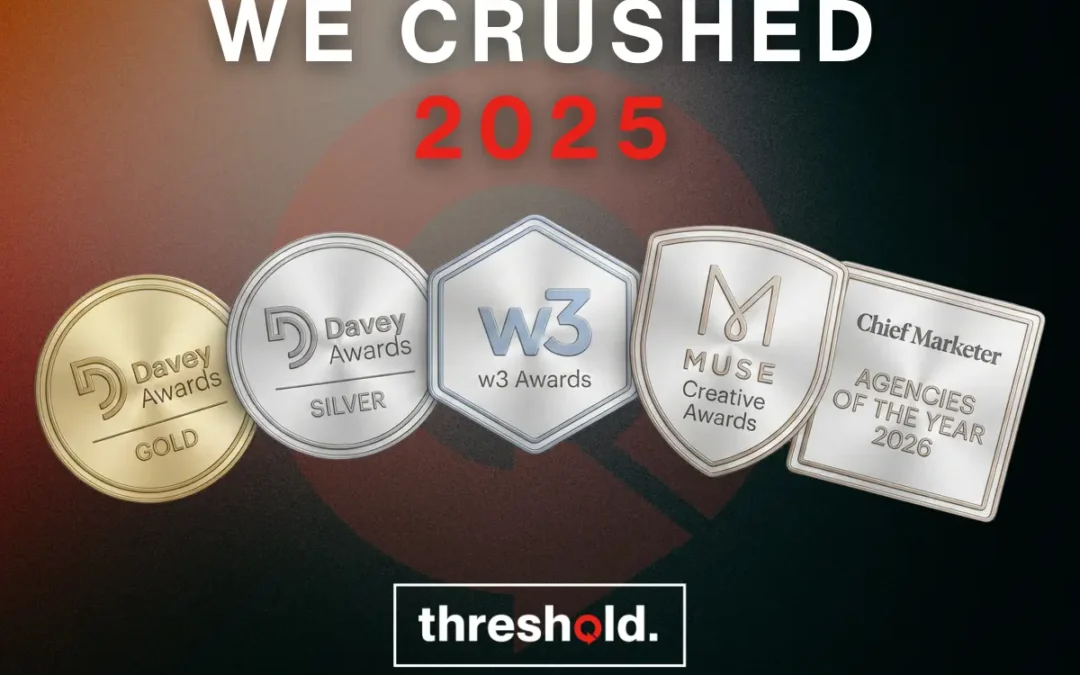
Below are a few of the projects that defined 2025 for Threshold, and the results that earned recognition from Davey Awards, w3 Awards, MUSE Awards, and a spot on Chief Marketer’s 2026 Agencies of the Year list.
Gateway 737: from zero brand to 100% leased.
Client: Holder Properties
Vertical: Student housing
Project: Full brand build, website, and leasing strategy for a 940-bed community in Columbia, SC
the challenge.
Gateway 737 started in 2024 with no name, no brand, no website, and no renewals to lean on. It would open in August 2025 in a competitive University of South Carolina market, surrounded by established communities with years of word-of-mouth.
The brief was simple and unforgiving:
“Build a brand and digital presence that lets a brand-new property compete like a market leader.”
what we did.
⭕ named and branded the community from the ground up, including logo, color system, and messaging that speaks to USC student life
⭕ launched a high-converting landing page early, then a full site focused on fast floor-plan discovery, mobile UX, and clear CTAs
⭕ turned every physical touchpoint into media, from brochures to a construction trailer that transformed into a leasing lounge
⭕ focusing on organic engagement and cultural resonance—via on-campus events, strong social media, and an authentic brand—rather than high media spending.
the results.
The leasing numbers tell the story:
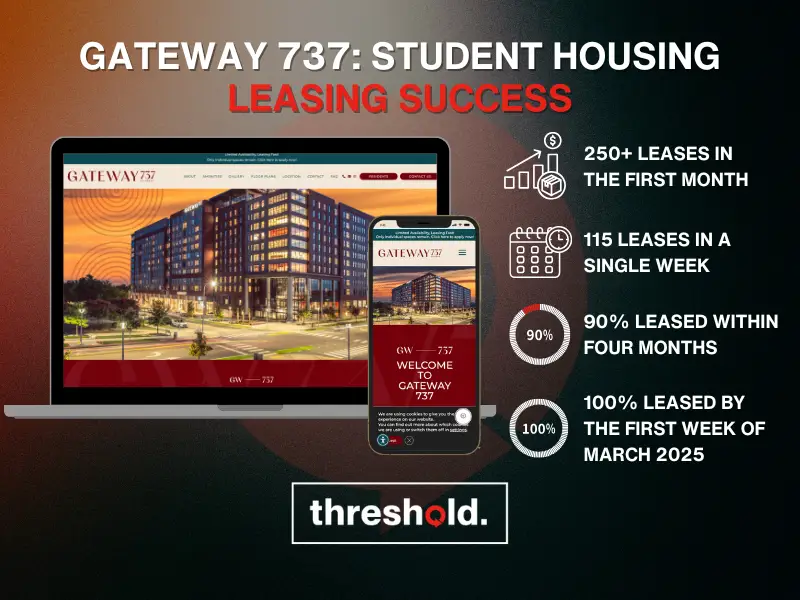
⭕ 250+ leases in the first month (27.5% leased)
⭕ 115 leases in a single week
⭕ 90% leased within four months of pre-leasing (Sept–Dec 2024)
⭕ 100% leased by the first week of March 2025, months before doors opened
For a brand-new property with zero renewals, that is a rare outcome. Gateway 737 quickly climbed near the top of its market’s pre-leasing charts.
In late 2025, that same work earned:
⭕ Davey Awards Silver for Gateway 737: Student Housing Website
⭕ w3 Silver Award in Real Estate Websites
Dannemora Federal Credit Union: beating growth goals in a tough market.
Client: Dannemora Federal Credit Union (DFCU)
Vertical: Financial – credit unions
Project: Full-funnel digital acquisition campaign
DFCU serves members across four upstate New York counties. Competing against national digital banks and fintechs, they needed to:
⭕ grow new checking accounts and deposits
⭕ stay compliant and on-brand
⭕ maximize value from a finite media budget
the strategy.
Threshold built a multi-stage campaign focused on Kasasa Cash Back checking, with:
⭕ upper-funnel awareness and engagement on Meta and Google Display
⭕ high-intent search campaigns to capture active account shoppers
⭕ tight geographic and behavioral targeting to avoid wasted spend
⭕ persistent retargeting to move warm prospects from “interested” to “opened account”
the results.
Within 12 months, DFCU saw:
⭕ 34% lift in new accounts (596 new accounts against a 20% growth goal)
⭕ 24% lift in deposits, adding $2.4M in new deposits
⭕ search CTR roughly 3x higher than industry benchmarks
This is what “performance marketing” means for financial institutions: measurable member and deposit growth, not just impressions.
Threshold is a go-to partner for banks and credit unions, serving more than 200 financial institutions nationwide with integrated branding, digital, and website work.
Maxwell Downtown Brooklyn: urban lifestyle, conversion built in.
Client: Maxwell Downtown Brooklyn
Vertical: Multifamily
Project: Branding-first website for a new Brooklyn community
Maxwell sits in one of the most competitive rental markets in the country. Prospects compare it to dozens of buildings within a short subway ride and make decisions quickly on mobile.
The site we launched for Maxwell focused on three things:
- neighborhood and lifestyle first – visuals and copy anchor the building in the energy of Downtown Brooklyn, not just unit specs
- clear paths to action – simple journeys from homepage to floor plans, availability, and tour booking
- speed and accessibility – lightweight build, mobile-first layouts, and trust-building content architecture
In 2025, that work earned a Gold Davey Award in the Real Estate Website category
We are also seeing this type of build become the new baseline for our property work: lifestyle-driven, but ruthlessly focused on getting prospects to the next step in the leasing journey.
recognition that followed the work.
None of these projects were built to chase trophies. But it matters when outside judges see the same quality and performance our clients experience day to day.
In 2025, that translated into:
⭕ Davey Awards Gold – Maxwell Downtown Brooklyn, Real Estate Website
⭕ Davey Awards Silver – Gateway 737, Student Housing Website
⭕ w3 Silver Award – Gateway 737, Real Estate Website
⭕ MUSE Creative Silver Award – Straits Row Apartments, Website – Real Estate
⭕ Chief Marketer 2026 Agencies of the Year – Threshold listed among the industry’s top marketing agencies, highlighting the quality and consistency of our work across clients
We also renewed our Great Place to Work® Certification for 2025, which we love most because good culture shows up in the work: engaged teams, smoother collaboration, and ideas that go a layer deeper for clients.
what this means for your 2026 marketing.
Looking back at 2025, a few patterns show up across all of this work:
⭕ the briefs were specific. Grow leases fast, grow deposits by a certain percentage, and hit pre-leasing targets.
⭕ the work was practical. Websites and campaigns were built to do a job: get someone from curiosity to conversion.
⭕ the measurement was intentional. From leasing velocity to cost per conversion, we built every project with a feedback loop.
If you are leading marketing for a real estate brand, a bank or credit union, or another growth-minded organization, here is the simple lens we use:
Can we tie this project to numbers you care about, then design the creative, media, and web experience around that?
If the answer is yes, we are probably a good fit.
by threshold | Apr 15, 2023 | General
 Zac Rittberg
As Gen Z continues to dominate the student housing market and transitions into first-time renters within the multifamily market, it is increasingly important to understand their social media habits. We’ve compiled some of the key social media trends and patterns among Gen Z that student housing and multifamily property management companies should use to better connect with their Gen Z target audience.
Short-Form Video Content
Gen Z is well-known for their love of short-form video content, like TikTok and Instagram Reels. Short, digestible content that they can consume on the go will resonate best with this demographic. We recommend incorporating short-form videos on your social channels, and if you haven’t created a TikTok for your community, what are you waiting for? Showcasing a tour of your community, highlighting your amenities, or walk-throughs of your models in a quick, engaging video can help capture the attention of your Gen Z prospects.
If you’re not convinced, look at what the data is telling us. YouTube (88%), Instagram (76%), TikTok (68%), and Snapchat (67%) dominate Gen Z’s social media usage.
Authenticity
Gen Z values authenticity and transparency in the content they consume. They want to see real people and real experiences, rather than overly polished and curated posts. Posting user-generated content from current residents highlighting real-life experiences or testimonials is an authentic way to showcase the diversity and unique personalities of not only your residents, but of your community.
Personalized Content
Don’t think that authenticity is enough, Gen Z expects a personalized experience from the brands they interact and engage with. They crave content that is tailored to their interests and needs. Think of it this way. You’re not selling just an apartment, you’re selling a lifestyle.
You’re selling the place where a first-time Gen Z renter is coming into adulthood for the first time. Highlight the community where your property is located that will give them the lifestyle they’re looking for.
For the adventurer, talk about proximity to hiking and biking trails. For the health nut, showcase healthy eateries and wellness amenities (like yoga & meditation studios). For the foodie, recommend restaurants with instagrammable moments.
Social Causes
Gen Z is not the generation to sit quietly. They are actively involved in social causes and they value companies and brands that align with their values. Sustainability ranks highest among social causes most important to Gen Z. If your apartment is LEED certified, you offer a recycling program, have a bike share program, or other initiatives, showcase your commitment to sustainability by highlighting these features in your socials or through short-form video content.
Have you thought about organizing a community-wide clean-up or some other volunteer event to encourage resident engagement while also promoting a social cause?
Direct Communication
The days of phone calls are long gone. Gen Z prefers direct communication through messaging apps as opposed to traditional communication methods. If you want to reach this audience, make sure that you have someone on your team monitoring social comments and messages through the social apps you use.
If those messages go unanswered, you may have just lost a lead. If those public comments go unanswered, your perception to others is that you don’t value this direct communication with your prospects and residents.
Local Micro Influencers
Last, but not least, Gen Z is highly influenced by their peers and social media influencers. However, influencers with a large national or global reach may not resonate as well with Gen Z like a local micro-influencer. These influencers have smaller but highly engaged followings with a specific region which makes them more relatable and trustworthy (or authentic!) to Gen Z.
We recommend leveraging the power of a micro-influencer in your markets by partnering with them to showcase and promote your property. Student housing communities could consider partnering with a well-known student athlete that may already be living at your property. Multi family communities could consider lifestyle influencers. Whichever micro-local influencer is the right fit for your community and your residents/prospects, your collaboration with them for social content is necessary.
Host events or meet-and-greets, offer exclusive discounts of promotions. Tapping into the influence of local micro-influencers will help you increase brand awareness and attract new residents.
By understanding these social media trends and patterns among Gen Z, you can better connect with and engage your Gen Z prospects. Incorporating these trends into your social media strategy can help you build a strong, authentic relationship with your target audience, resulting in increased resident satisfaction and retention.
Before you go
For more tips and information about digital and real estate marketing, take a look at the rest of our blogs, right here on our website! You can also subscribe to our email newsletter, or follow us on Instagram, Facebook, and Twitter!
About the author
Zac is the Digital Client Success Manager at Threshold. His role is vital to our operation as he helps our clients to develop and launch paid digital strategies, and strategize for short and long term success. When he’s not on the clock, you can catch him at the gym… pretty much always.
by threshold | Nov 15, 2022 | Creative, Digital Marketing, Marketing, Thought Leadership
 Laura Robbins Laura Robbins
|
You have your property amenities sorted, your pricing figured out, and your interior design developed. But what does that all mean if you don’t have a name that fully captures the specialty of your real estate building?
Choosing a brand name is one of the most significant aspects of a brand development process. The right name creates an image of your property and brand in the mind of potential customers, sharing the idea of what you’re all about. And, it’s the most important keyword for internet searches.
A strong brand name should be:
- Meaningful: It communicates a brand story and creates an emotional response
- Unique: It should be memorable and stand out from your competitors
- Easily Understood: Avoid words that are hard to read or pronounce – they won’t stick in people’s minds
- Visual: It should lend itself to strong brand colors and imagery
- Future-Proof: You want your name to work now, and ten years from now, so veer away from names that feel really timely
Work backward. Decide what your brand identity, such as target audience, culture, mission, and purpose, will be, and then begin brainstorming names that line up with those needs.
Feeling stuck? Follow along for some tips for determining a successful name for your brand.
Reflect On Your Company Values
Think about your property’s mission statement or parent company’s values – what is it your company stands for, and how can your name tie back to that? Spend time with what your property is trying to achieve, focusing on your purpose and vision. Determining the heartbeat of your brand can lead to a stronger name association down the road.
Connect Your Name To A Story
We communicate in stories, and talking about a brand is no different. Effective marketing connects to a larger target audience through storytelling, which is why your property name needs to mean something. If someone asks you why you named the property what you did, and all you have to say is that it sounded cool, you’re missing out on some really good marketing.
Think about the history of the city your property is located in, what it’s known for, or what interests your target audience has, and then go from there.
Having a great story also allows for stronger visuals (think website design, brochures, signage, temporary leasing space designs), as the logo, colors, and brand patterns all have a north star to draw from.
Less Is More
Short and snappy wins the race! You want to limit the length of your brand’s name, as anything longer than three or four syllables will only be harder for your potential audience to remember. The final name should be punchy, and this is best determined by running any potential names by those who aren’t part of the brainstorming, allowing for fresh eyes and fresh opinions.
Here is where you’ll also want to factor pronunciation into the mix. Your property name won’t only live on signage and a website, it will be said by residents in passing, and therefore shouldn’t be something that’s hard to say or spell. So remember to say any names aloud!
Remember Your Competitors
The last thing you want is to come up with a really amazing name, only to find out a direct competitor has something similar. Standing out from your competition is a key factor in your brand name and final brand visuals, which is why doing research on your market early on is essential.
Consider Creating A New Word
The best way to avoid having the same name as someone else? Create a non-dictionary word. Your name should still have meaning behind it, and not just be created out of thin air, but there are a few ways you can create new words, like:
- Mashing up two words together
- Spelling an existing word in a new way
- Creating a word where each letter stands for something
Plus, what’s more fun than being the owner of a completely new word?
Think About SEO
You heard it here first, do not skip thinking about SEO (Search Engine Optimization) when it comes to naming your brand or property. SEO plays a key factor in determining how popular a potential name is for organic and paid searches.
Say you’re naming your property Dragon (not a great name, but work with us here), then Googling that name will bring up a lot about dragons themselves, the television series “House of Dragon,” a speech recognition software called Dragon, and restaurants in your area with Dragon in the title. A generic name like that could make it hard to stand out in the very competitive search engine space.
Psst. This is why creating a new non-dictionary word might help!
In Summary
The success of your brand and property depends largely on the branding, which begins with a really great name. A name that’s meaningful to your audience, lends itself to great visuals, is short and snappy, and is easy to remember. A name that stands out from your competitors and can be relevant for your audience today, and in many years to come.
Don’t let determining a name feel overwhelming! Have fun with the process and see what unique options you come up with.
For more tips and information about company and real estate branding, take a look at the rest of our blogs, right here on our website! You can also subscribe to our email newsletter, or follow us on Instagram, Facebook, and Twitter!

by threshold | May 24, 2022 | Digital Marketing, Marketing
In the world of student apartment marketing, what you do during the spring and summer months can make all the difference in next year’s occupancy rates. If you’re struggling to fill your final beds for summer or fall semesters, this blog is for you. These digital marketing tips can help you get heads in beds fast.
Use Geofencing To Your Advantage
Know when your target audience is likely to be in town and take advantage of it with geofencing campaigns targeting specific locations. Housing fairs, new student or transfer student orientations, and community or leasing events open to the public are the perfect kinds of events to capture. Once you’ve captured your audience through this geofencing campaign, retarget them with tailored messaging to increase brand awareness, encourage tours, and increase foot traffic. Event retargeting allows you to connect more personally with the audience you captured because you know they attended a specific event for a specific reason and you have a solution to a need that they are looking to satisfy—a place to live.
Raise Your Ad Spend Now When It Matters Most
With most student housing properties, we see August move-in dates and May-July move-out dates, so don’t be afraid to spend your marketing budget in the spring when it matters most and you’re down to the wire to fill beds for summer or fall. Spend your budget on digital marketing tactics that will drive qualified traffic—like search ads—or increase brand awareness—like geotargeting or social ads. Speaking of social ads, don’t just stop at Facebook and Instagram. Think about TikTok and/or YouTube where a video component can go a long way to encourage online engagement. And don’t forget to implement a retargeting component to keep your brand top of mind as prospects continue shopping.

Scale your budget back when you’ve reached your leasing goals and maintain a presence online without breaking the bank. Then do it all again next year. Being flexible with your ad spend throughout the year helps maximize the impact of your ad budget by allowing you to solve for leasing challenges quickly or proactively get in front of them before they even become a challenge.
Strategically Expand Your Audience Targeting
Expand your audience targeting by creating custom audiences based on websites your audience may have visited such as a university housing page. Several tactics allow for customer matching or lookalike audiences. Use data that you already have collected to find similar users.
Refine Your Messaging to Earn More Qualified Traffic
What REALLY sets you apart from your competitors? Ask yourself the question, “Why would a student choose my property over our competitors?” Focus on one or two key differentiators in your ad messaging in order to tap into the segment of your student audience that really values what makes your community unique. For example, if your community is located right across from campus and your competitors are a mile away, focus on your location, using clever phrasing when you can. “Tired of taking the shuttle?” is a great way to get your point across in a playful way.

If you’re not sure what messaging to focus on, try listening to feedback from prospects and residents. What questions are they asking when they call you or visit your leasing office? What feedback have they given you about other properties they have visited in the area? What do they mention in positive reviews on your community? Notice any trends within the feedback and incorporate into your messaging where possible. Getting a lot of calls about pricing? Prominently display pricing in your ad copy and utilize price extensions in search. Getting a lot of questions about a specific floor plan layout? Create a carousel ad on social highlighting that floor plan, detailing the features, and incorporate some photos of that specific floor plan.

And don’t forget about the parents. Parents are still involved in housing decisions and are most likely paying the bills, so don’t leave them out. Your messaging can still be amenity focused and playful while still taking into account the things that are important to parents: all-inclusive living, fully furnished, privacy, etc. Just remember where your parent audience is. Most likely, parents are on Facebook while students are on Instagram, TikTok, or YouTube. Remember to use multiple ads and select different placements so you can tailor your messaging for students and parents.

by threshold | Aug 11, 2021 | Creative, Design, General, Marketing, Thought Leadership
 Written by Emily Barker, Graphic Designer
In the midst of the murder of George Floyd and the ensuing protests around the U.S., the design community revived discussions of anti-racism and activism and how it fits into the field of Graphic Design. Just what exactly does designing for social change look like? Specifically in the field of marketing and advertising, the topic of social justice can often feel at odds with the day-to-day worklife in an agency. That’s especially true in the field of real estate–centered design, where the emphasis is often ‘heads-in-beds’ and being 100% leased up, without much room for discussions on equity. However, this sort of all-or-nothing thinking, especially in fields that are complicated, nuanced, and related to issues of housing and equity, can stymie conversations on race and equity before they even get started. The truth is that there are many avenues toward anti-racist marketing while also meeting the needs of clients whose focus is on leads and leases, and real estate designers have a unique position in advocating for those anti-racist strategies.
Creating Historically-Informed Real Estate Design
Anoushka Khandwala in her article entitled “What Does it Mean To Decolonize Design” talks about understanding the schema of one’s own history as a way to re-examine motivations and find new and better modalities of design for the future. She argues that, “With every design choice we make, there’s the potential to not just exclude but to oppress; every design subtly persuades its audience one way or another and every design vocabulary has history and context.”
What can that mean for us as real estate designers? At Threshold we delved into the history of redlining and the Fair Housing Act as a way to better understand the industry and its numerous failures and shortcomings. This meant a combined team of creative and digital staff researched the history of the Fair Housing Act and redlining to create an agency-wide presentation of the history of the Fair Housing Act and red-lining. The creative team made social posts outlining the history of redlining and the creation of the Fair Housing Act during the 1960’s Civil Rights Movement. For more information on redlining and how it denied Black American’s housing and generational wealth in the U.S. please click here.

What this revealed to us was that, as real estate marketers, we had an obligation to help our clients adhere to the FHA rules and regulations. Strictly speaking this meant using photos of diverse individuals in the marketing materials, ensuring that websites were ADA compliant, and using FHA and ADA icons. But it also revealed holes in the system or gray areas where we could advocate for our clients to choose inclusive marketing and branding strategies and also choose to go above and beyond in their digital marketing strategies to prioritize inclusivity.
How Designers Can Be Advocates for Social Change
In Jarrett Fuller’s article on Isometric Studios he describes the studio as one that is “rethinking the way in which designers build a better world”. The founders Andy Chen and Waqas Jawaid describe their clientele as broad: “We’ll take on any kind of client who demonstrates a desire to think about what authentic inclusion looks like, what foregrounding marginalized narratives looks like.” The article goes on to describe the work of Isometric as that of advocates as well as designers.
This is a familiar role for designers as we are already advocating for good design as we talk to our clients about our work and advise them on the best choices for their brand. Isometric Studios would take that same advocacy a step further and challenge the client’s perspective on social issues when needed and advocate for development of brands that support the greater social good. Sometimes this advocacy can look like recommending that a client incorporate people of diverse races in their lifestyle photography or choosing a logo that celebrates the existing community culture where their new development will be built.

One important way to have these conversations with clients is to directly addressing the elephant that is so often in the room: gentrification. By addressing this openly we are better able to advocate for our clients to help them maintain a positive reputation and resident satisfaction. These types of conversations present the opportunity for us to simultaneously advocate for our client and the greater community’s needs by encouraging our clients to create positive connections with their communities.
How do we ask our clients to connect with the communities they will exist in? Here are a few suggestions:
- Hosting events for the neighborhood at the property
- Striking mutually advantageous partnerships with local businesses
- Resident appreciation events that feature goods and services from the local community
- Hiring local instructors to teach fitness, art, or meditation classes
- Hiring local artists to design artwork for the property
- Host a concert of local musicians
- Offer communal spaces to local groups for weekly meetings
- Organize volunteer days with residents or staff in the local community
The point of these conversations and ongoing partnerships with the community isn’t to whitewash the real estate industry, but to offer real-world pathways for community engagement for our clients.
Isometric Studios, in their interview with Jarrett Fuller describes their name’s origin as “a floor plan drawn at a thirty degree angle where the same scale is used for every axis, creating a non-distorted image. ‘It’s an ideal that isn’t really possible,’ Jawaid said. ‘But we’re interested in that ideal. We’re designing for that ideal.'”
In the same way, we can also struggle towards a more ideal design practice in real estate design. We can become advocates for creative work that will be better suited for this current, complex, and multicultural world and our clients will benefit from the nuance that design will bring to their brands.